
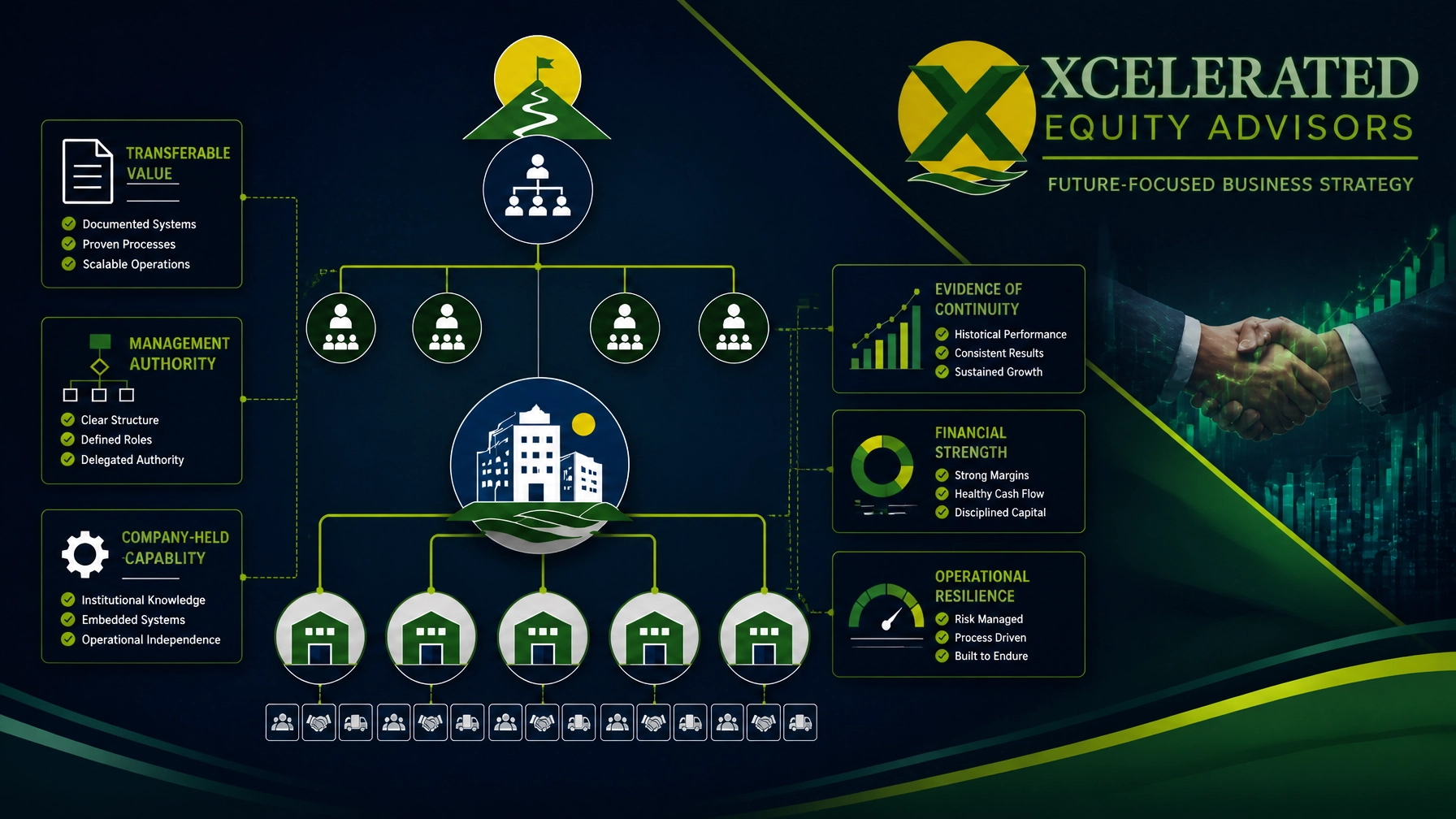

A buyer cannot give full credit for improvements the owner plans to make after a letter of intent is signed. By then, the negotiation is based on the business that exists and the evidence available to support it.
Profitability may attract interest. Transferability determines how confidently a buyer can underwrite that profit under new ownership.
Two companies can report the same EBITDA and present very different risk. One has reliable financial reporting, customer relationships distributed across the team, managers with real authority, and operating processes that have held without the founder. The other depends on the owner to explain the numbers, protect key accounts, and resolve every meaningful exception.
The earnings may be equal. The amount a buyer is willing to pay at closing, the transition expected from the seller, and the confidence placed in future performance may not be.
Transferable value is built by moving capability from the owner into the company, then giving that change enough operating time to become credible.
Historical Performance Is the Starting Point
Financial statements show what the business produced under current ownership. They do not show how much of that result depends on the owner's judgment, relationships, or daily intervention.
A buyer looks behind the earnings and evaluates four areas.
Financial reliability
Management reporting should reconcile with the financial statements. Adjustments to earnings should be supported and applied consistently. Working-capital requirements, unit economics, and major cost drivers should be understood before diligence begins.
The buyer needs confidence that the reported earnings are real, repeatable, and supported by reporting the management team already uses.
Management continuity
Managers need more than titles. They need authority over the results they are expected to produce.
If pricing, hiring, customer recovery, vendor negotiations, or routine capital decisions still wait for the owner, management depth remains unproven. The buyer must then decide whether the founder needs to stay, whether additional leadership must be hired, and what that added cost means for future earnings.
Relationship durability
Revenue is more transferable when customer knowledge, renewal history, and day-to-day contact sit inside the company. The same standard applies to suppliers, landlords, referral partners, and other relationships that support operations.
A signed contract helps, but it does not replace relationship depth. The company should be able to maintain the account without requiring the founder to lead every important conversation.
Operating repeatability
Procedures matter when managers use them, exceptions are handled within defined limits, and performance holds across people and locations. A binder created for diligence does not prove operating capability.
The buyer will place more weight on recurring reports, decision records, performance trends, training history, and examples of managers resolving problems without owner rescue.
Time Converts Improvement Into Evidence
Owners often begin preparing for a transaction by cleaning up documents. That work is necessary, but a clean file cannot replace operating history.
If a manager receives pricing authority two weeks before diligence, the new structure is still untested. If a customer relationship is introduced to a successor during the sale process, continuity remains uncertain. If a KPI dashboard appears for the first time after the buyer requests it, the buyer cannot tell whether management uses it to run the business.
Transferability becomes credible after the company has operated through normal pressure with the new structure in place. Managers need time to exercise authority. Customer and vendor relationships need time to shift. Reporting needs to survive monthly closes, budget variances, staffing issues, and changing demand.
This is why value creation must begin before a buyer appears. The operating record cannot be manufactured at the end of the process.
Build Transferability in the Right Sequence
The work becomes more effective when it follows a practical sequence.
Identify what still depends on the owner
List the decisions, relationships, knowledge, and exceptions that still return to the founder. Focus on responsibilities with a meaningful effect on revenue, margin, cash flow, customer retention, or operating continuity.
Owner dependence is often concentrated in work that consumes little time but carries significant consequence. A founder may approve only a few pricing exceptions each month, but those decisions can reveal that commercial authority has never moved into the sales team.
Transfer authority and context
Assign recurring responsibilities to named managers. Define the authority available to each role, the limits that require escalation, and the information needed to make a sound decision.
Move relationship knowledge at the same time. A manager cannot own a customer account without access to its history, commitments, contacts, and current risks.
Measure the result
Connect the responsibility to a performance measure and a regular management review. The purpose is to determine whether the new owner of the process is producing the expected result, not simply completing the activity.
If a regional leader owns labor performance, that leader needs timely labor data, scheduling authority, an approved range, and responsibility for corrective action.
Test the handoff under normal pressure
Allow the manager to run the process without routine owner intervention. Include the exceptions that typically bring the founder back into the work.
Review what held, where decisions slowed, what information was missing, and which authority limits need refinement. A failed test is useful when it exposes the gap early enough to correct it.
Retain proof
Keep the operating reviews, KPI results, decision records, customer handoffs, training materials, and corrective actions that show the capability in use.
The XEA data-room indexing framework explains why organized supporting information can influence a buyer’s view of management discipline and operating control.
Weak Transferability Changes the Negotiation
When continuity is difficult to prove, buyers look for ways to reduce their exposure. The response can affect more than the headline valuation.
A buyer may require a longer seller transition, reduce the cash paid at closing, tie consideration to future performance, require retention arrangements for key managers, or reflect the cost of added leadership in the valuation. In some cases, the buyer may decide the integration risk is greater than the opportunity.
None of those outcomes is automatic. They reflect the buyer's judgment about what will survive after closing and what must be rebuilt.
Owners have more negotiating leverage when the management team has already carried authority, customer relationships have already transferred, and reporting has already demonstrated control. The seller is then presenting an operating company rather than asking the buyer to believe in a future transition plan.
Transferable Value Improves the Business Before a Sale
This work should not be treated as a transaction-only exercise.
Clear decision rights reduce bottlenecks. Stronger managers create more operating capacity. Institutional customer relationships reduce commercial risk. Better reporting improves capital allocation. The owner gains more time for strategy, growth, family, and life outside the business.
Those benefits exist whether the eventual transition is a sale, recapitalization, management succession, family transfer, or a decision to keep the company.
Transferable value is the result of a business that can sustain performance without depending on one person to hold it together. Build that capability early enough to prove it. The buyer will evaluate what the company can sustain today, not what the owner intends to fix tomorrow.
Use the XEA Exit Assessment to identify where owner dependence, reporting gaps, relationship concentration, and weak management systems are limiting transferability and enterprise value.