
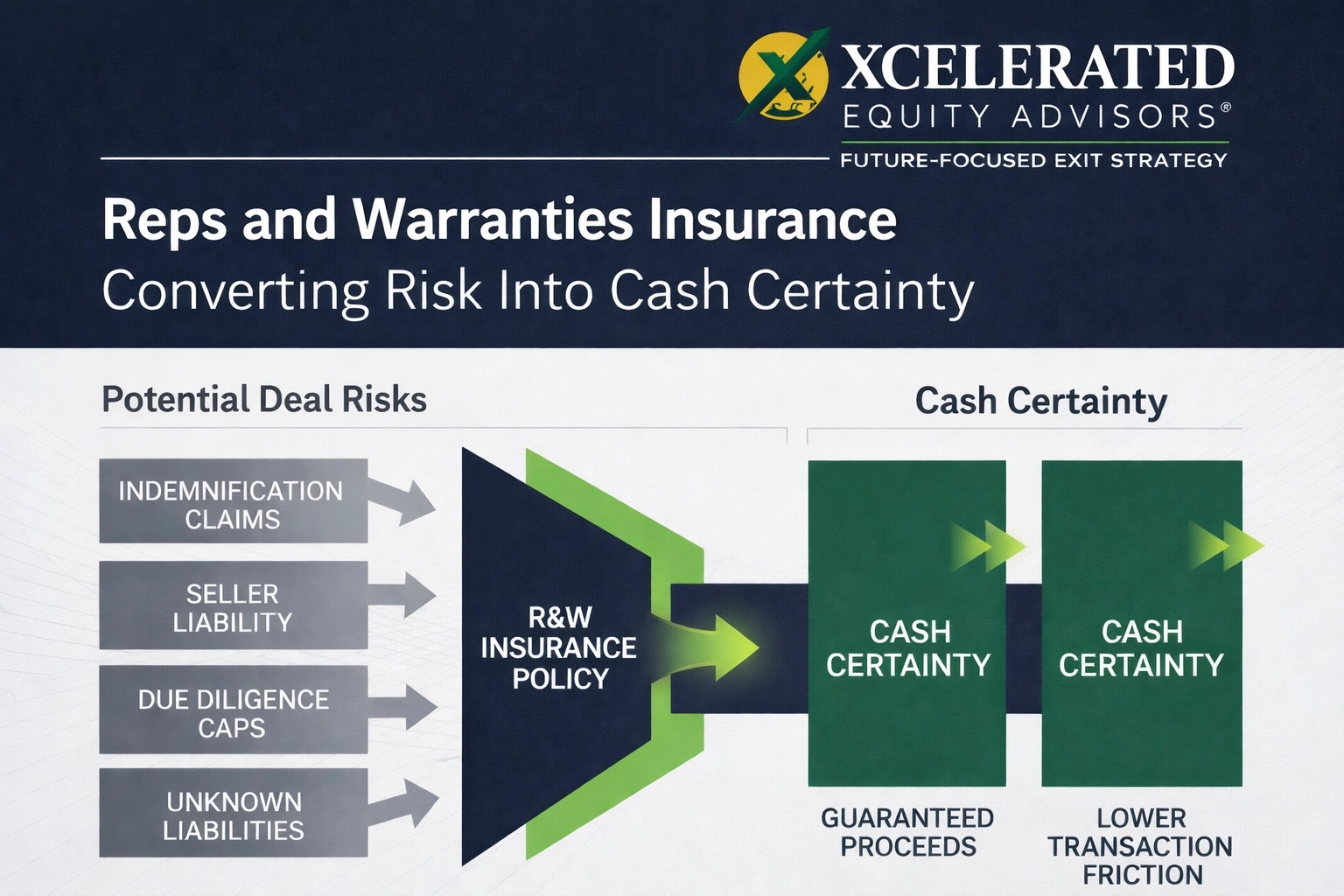

In many lower middle market transactions, sellers will have $1.0 to $2.0 million of proceeds tied up for 24 to 36 months under a traditional indemnity escrow structure. While avoiding a six-figure premium at signing might seem attractive, it often results in slower access to liquidity and increased post-close friction. In practice, the decision to use Reps and Warranties Insurance (RWI) matters most when the seller values cash certainty at closing and wants to narrow the scope of future disputes.
The Mechanics of Escrow and Risk Allocation
In a standard private market transaction, buyers demand protection against breaches of the representations you make about the business. Traditionally, that protection takes the form of an indemnity escrow where 10% to 15% of the purchase price may be held in a third-party account for 12 to 24 months. However, in well-negotiated deals, baskets, deductibles, materiality qualifiers, and claim procedures prevent most nuisance claims from reaching the seller in a meaningful way.
Escrow also does not always sit untouched until a single release date. In many transactions, the funds are released in tiers, such as 50% at 12 months and the balance at the end of the survival period. In addition, clean businesses rarely see the full escrow consumed. Aon’s 2023 claims study also indicates that most claims fall below retention levels, which reinforces the point that the true economic issue is often liquidity drag rather than catastrophic loss.
Reps and Warranties Insurance changes the transaction mechanic, but it does not eliminate seller exposure in every case. Instead of you acting as the primary source of recovery for general representation breaches, a third-party insurance carrier steps into that role. The buyer looks first to the policy for covered losses, while the seller usually still supports a small escrow or limited recourse for retention, taxes, or specifically excluded matters. This shift moves a substantial portion of the risk off your balance sheet and usually produces a cleaner exit.
Trading Premiums for Immediate Liquidity
Sellers often hesitate at the cost of RWI, which typically includes a premium, underwriting fees, and taxes. However, the right comparison is not premium versus zero. The actual comparison is premium plus a smaller residual seller exposure versus a larger traditional escrow with more direct claim friction.
For example, consider a $15,000,000 transaction. Under a traditional structure, a 10% escrow would require $1,500,000 to be held back for two years, even if part of that amount is released in stages. If you instead use an RWI policy with a $1,500,000 limit, the total policy cost is typically 2.5% to 4.0% of the policy limit, or approximately $125,000 in this case, but the seller may still support a 1% escrow equal to $150,000 for retention or excluded items. In that scenario, you are not unlocking the full $1,375,000. You are improving day-one liquidity by shifting from a $1,500,000 holdback to a much smaller residual holdback while accepting the premium cost for that reduction in friction.

Alt text: A professional 3D rendering of a legal contract with a gold seal and a shield icon, representing transaction security and insurance protection.
Buyer Incentives and the Claims Process
It is a misconception that buyers always prefer escrows simply because they are easier to access. Sophisticated buyers, especially private equity firms, often like RWI because it increases deal certainty, supports cleaner seller indemnity packages, and places a rated insurer behind covered losses. RWI can also extend survival periods for certain representations beyond what sellers would typically accept in a direct indemnity structure.
That said, RWI does not remove all friction from the claims process. A claim against an insurer is typically slower and more process-driven than direct escrow recovery due to underwriting review and carrier approval requirements. As a result, in proprietary deals or lower-quality deals where buyers have concerns about diligence depth, financial reporting, or owner dependence, they often still prefer direct seller recourse. The policy can preserve the working relationship between buyer and seller, but it is not automatically the fastest route to cash on a disputed issue.
Strategic Leverage in the Purchase Agreement
Using RWI can help you negotiate a more seller-friendly purchase agreement, but the outcome is usually reduced seller indemnity rather than true zero exposure. In the market, sellers typically still support a modest escrow in the 0.5% to 2% range for retention or excluded items such as taxes, specific known issues, or other non-covered matters. Once the wire hits your account, more of the money is yours immediately, but not always all of it.
This leverage is particularly relevant in multi-unit or operationally complex businesses where the risk of technical breaches increases with scale. The presence of RWI can help bridge gaps on issues that the buyer views as manageable and the insurer is willing to underwrite. Therefore, it is best understood as a tool to reallocate risk and reduce friction, not as a blanket elimination of post-close exposure. In practice, this results in a narrower indemnity package with lower caps, shorter negotiation cycles, and fewer points of post-close dispute.
Numerical Impact: Escrow vs. RWI
To understand the financial implications, we must look at the specific dollar impact on walk-away cash.
- Transaction Value: $20,000,000
- Traditional Escrow (10%): $2,000,000 held for 24 months, with possible tiered release.
- RWI Limit: $2,000,000
- Total RWI Costs (Premium + Fees): $160,000
- Residual Seller Escrow: 1% of Transaction Value ($200,000) for retention or excluded matters.
In the traditional scenario, you receive $18,000,000 at close. In the RWI scenario, you receive $19,640,000 at close after the $160,000 policy cost and the $200,000 residual escrow. The RWI structure puts $1,640,000 more cash into your pocket on day one, but it does so by trading premium cost for lower holdback and a different claims path rather than by eliminating seller exposure altogether.
Closing the Gap on Fundamental Reps
While RWI covers general representations such as financial statements and material contracts, it does not cover everything. Sellers are still typically on the hook for fundamental representations, such as authority, ownership, capitalization, and in some cases tax or specifically known matters that are carved out from coverage. Those exposures are narrower than a full traditional indemnity package, but they are still real and need to be managed through legal drafting and disclosure quality.
By using RWI to address the general representation package, you can reduce the window of vulnerability materially. However, the value is not just risk transfer. It is the combination of more immediate liquidity, a smaller holdback, and a more institutional claims framework that can make the closing statement closer to final proceeds.

Alt text: A clear financial table comparing the immediate cash proceeds of a traditional escrow deal versus a deal protected by Reps and Warranties Insurance.
The Tax and Timing Advantage
Escrow proceeds are generally taxed upon release, which can create timing mismatches and planning complexity depending on deal structure and jurisdiction. Utilizing an RWI-backed structure to receive a larger portion of the proceeds at closing allows for more immediate and streamlined tax planning.
RWI can also streamline the final stages of a transaction. Because the buyer has insurance backing the reps, the indemnity negotiation may narrow more quickly and the parties may spend less time fighting over every clause in the purchase agreement. However, that efficiency depends on deal quality, diligence quality, and buyer type. In weaker deals, buyers often continue to press for direct recourse despite the presence of a policy.
Decision Filter
RWI is usually most effective in transactions between roughly $10 million and $300 million where the financials are clean, diligence is organized, and the buyer is institutional. In that setting, the premium often buys better liquidity, cleaner documents, and more certainty around seller exposure.
For sub-$5 million deals, or in businesses with heavy owner dependence, inconsistent reporting, or unresolved issues, RWI may be too expensive relative to deal size, subject to broad exclusions, or unavailable altogether. In those cases, a direct escrow may remain the more practical structure even if it creates more post-close friction.
Transaction-Specific Observation
I have watched buyers accept a cleaner purchase agreement once RWI was bound because the policy replaced weeks of indemnity negotiation with a defined claims framework. I have also watched buyers reject that route when the business quality was uneven and they wanted direct recourse instead. That is the right way to analyze RWI: not as a default solution, but as a transaction structuring tool that must be evaluated against deal size, diligence quality, and buyer requirements.