
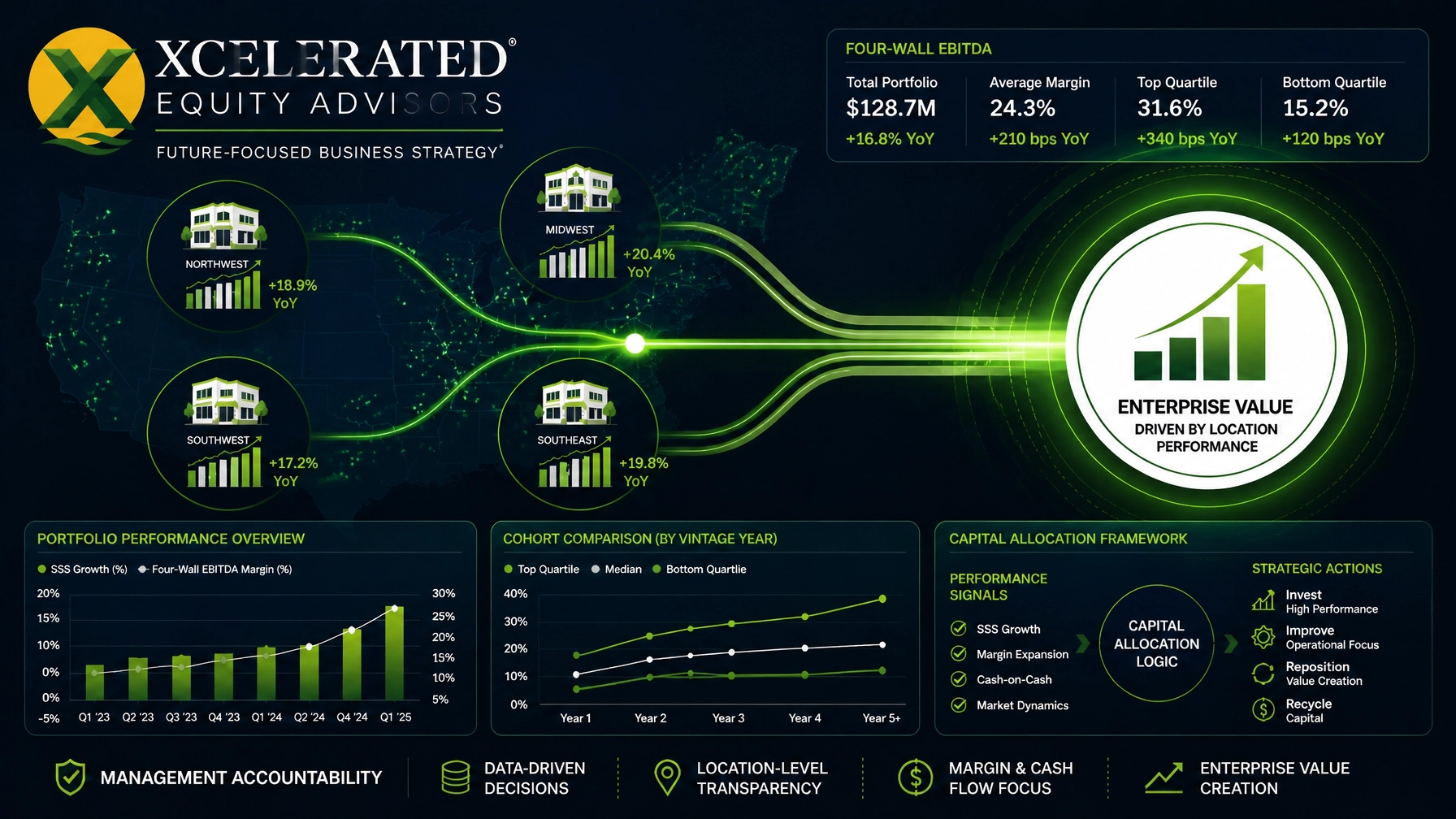

Most multi-unit owners know the consolidated income statement well. It tells them whether the company grew, whether margins held, and whether the platform produced enough cash.
It does not show which locations created those results, which ones consumed capital, or whether the operating model works consistently across the portfolio.
That distinction matters to a buyer. A ten-location company can produce healthy consolidated EBITDA while two strong units carry several average ones and one chronic underperformer. Another ten-location company can report the same EBITDA with earnings distributed across a stable base of mature units. The headline number may be identical. The quality and transferability of the earnings are different.
Buyers review performance by location to understand what they are actually acquiring. Owners should use the same analysis to decide where to invest, what to repair, and what to stop funding.
One Consolidated Number Can Describe Several Different Businesses
Consolidated reporting is necessary, but it can hide the operating story.
New locations can make total revenue look strong while mature units are declining. A high-volume location can appear valuable while excessive rent and labor leave little cash behind. A profitable unit may rely on the owner to manage key employees, resolve customer problems, or approve routine decisions. A weak location may remain open because its losses disappear inside the group result.
A buyer will separate the portfolio and determine where the earnings come from. The analysis usually centers on four questions:
- Are earnings broadly distributed or concentrated in a few locations?
- Are mature locations maintaining sales and margins?
- Are newer locations following a predictable ramp toward profitability?
- Does management identify and correct underperformance without relying on the owner?
The answers influence more than diligence. They affect the buyer's view of scalability, required capital, management depth, and future cash flow.
Use One Definition of Unit Economics
Four-wall EBITDA is useful only when every location is measured the same way. Revenue, cost of goods sold, direct labor, occupancy, local marketing, and other direct operating expenses must be classified consistently across the platform.
Shared corporate costs can be shown separately or allocated in a supplemental analysis. They should not move between locations or periods to improve the appearance of a particular unit. When the definition changes from one schedule to another, the buyer starts questioning the reporting rather than evaluating the business.
A practical monthly scorecard should include:
- Revenue and same-store sales for mature locations.
- Gross profit where product or service mix affects margin.
- Direct labor and labor as a percentage of revenue.
- Occupancy cost and occupancy as a percentage of revenue.
- Local customer-acquisition spending when demand depends on paid activity.
- Four-wall EBITDA and four-wall margin.
- Capital invested, time to breakeven, and payback progress for newer locations.
The purpose is not to create a larger reporting package. It is to connect each financial result to a management decision.
Separate Mature Units From New Openings
A new location should not be judged by the same standard as a mature one. It may still be building awareness, hiring the right team, and moving through its expected ramp. The relevant issue is whether it is following a pattern the company understands and can finance.
Group locations by opening period and compare similar maturity cohorts. Track the initial investment, monthly revenue ramp, breakeven point, and movement toward the target margin. This shows whether the expansion model is repeatable or whether every new opening requires a different explanation and additional owner intervention.
Mature locations require a different analysis. Same-store sales help show whether the existing base is holding its position. Total company growth can obscure a mature-unit decline when new openings add enough revenue to offset it.
Break same-store sales into the factors management can act on. Price, transaction volume, customer frequency, mix, and retention do not carry the same implications. A buyer will treat a price increase differently from sustained customer growth. Management should understand the difference before the buyer raises it.
Classify Each Location Honestly
Experienced operators do more than rank units from best to worst. They decide what role each location plays in the portfolio and what action it requires.
A useful review places each location into one of four operating categories:
Core performer
The location has mature, defensible economics. Sales and margins are stable, management is capable, and routine performance does not depend on the owner.
Growth candidate
The location has sound unit economics and a credible opportunity to add volume, capacity, or margin. Additional investment is supported by evidence rather than optimism.
Managed turnaround
The location is underperforming, but management has identified the cause, assigned an accountable leader, and established a time-bound recovery plan. The expected cost and financial benefit are understood.
Capital trap
The location continues to consume cash, leadership attention, or corporate support without a credible path to an acceptable return. Management must decide whether to repair, reposition, relocate, or close it.
This classification creates a disciplined capital-allocation conversation. It also shows a buyer that management understands the portfolio and is willing to make difficult decisions.
Underperformance Is Manageable When It Is Controlled
A weak location does not automatically undermine the value of the entire platform. An unmanaged or hidden problem can.
Buyers understand that multi-unit portfolios have outliers. Their concern increases when the seller cannot explain why a unit is underperforming, how long the problem has existed, what has been tried, or who owns the recovery.
A credible turnaround plan identifies the operating cause, the accountable manager, the actions underway, the capital required, the expected financial effect, and the point at which management will change course. Reporting should then show whether the plan is working.
When management discovers the problem during diligence, the damage can extend beyond the weak location. The buyer may question the reliability of the consolidated numbers, the quality of management oversight, and the assumptions supporting future expansion. That broader loss of confidence is one reason strong companies can still receive discounted offers.
Make the Reporting Useful Before a Buyer Arrives
Location-level reporting should improve the business long before a transaction begins.
It should tell management where expansion capital will earn an acceptable return. It should reveal whether a labor problem is isolated or systemic. It should show whether local marketing creates profitable demand. It should identify which managers consistently convert revenue into cash and which locations require more support than their results justify.
Run the review on a fixed cadence. Compare each location with its budget, prior year, maturity cohort, and the most relevant operating peers. Require an explanation for material variance and assign the next action to a named leader.
This operating discipline reduces dependence on the owner because managers are responsible for the numbers and the response. It also makes expansion safer. A company should be able to explain why a new location deserves capital using evidence from existing locations, not a general belief that another opening will create growth.
Give the Buyer a Coherent Location Story
By the time diligence begins, management should be able to provide consistent monthly unit-level financials, same-store sales history, opening and maturity data, lease information, capital invested, key operating metrics, and documented plans for material underperformers.
The schedules should reconcile with the consolidated financial statements. Definitions should remain consistent across locations and periods. Exceptions should be explained rather than buried.
Organized reporting does more than speed up diligence. It demonstrates that management uses the same information to run the company. The XEA data-room indexing framework explains why organized supporting information can strengthen a buyer’s view of management discipline and operational control.
Buyers are not looking for a portfolio in which every location performs identically. They are looking for evidence that management understands the differences, allocates capital rationally, and can reproduce strong results without constant owner intervention.
Location visibility exposes where value is being created and where it is being lost. Management’s response determines whether the platform becomes more scalable, transferable, and valuable.
Use the XEA Exit Assessment to identify gaps in financial visibility, management accountability, and business transferability before they affect value or deal terms.