
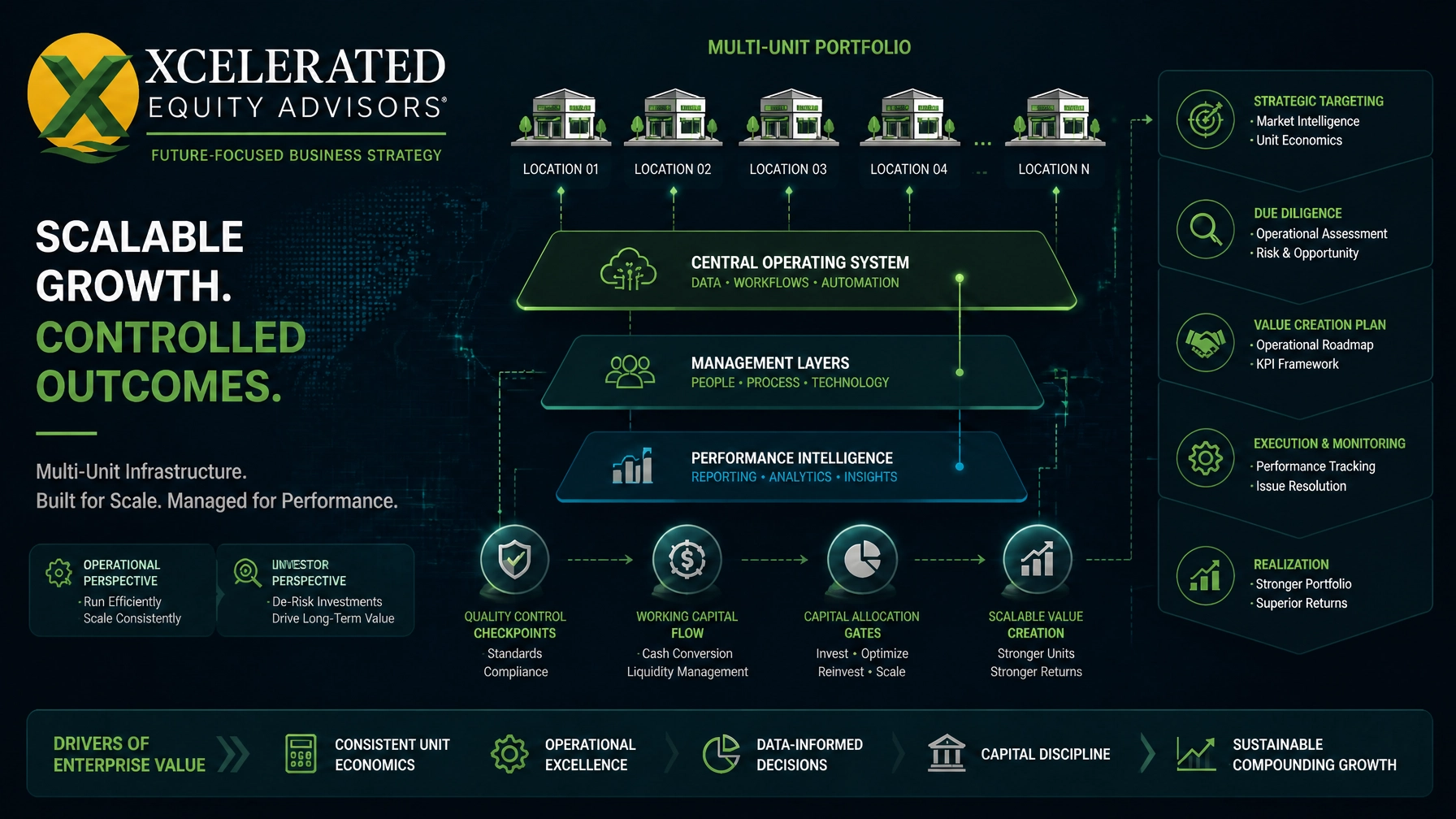

A business can add locations, employees, and revenue while making the owner more necessary. Growth increases demand on the company. Scalable growth increases the company's capacity to handle that demand.
The difference becomes visible when volume rises. Hiring slows. Training depends on one senior manager. Reports arrive too late. Quality varies by location. Working capital tightens. Routine decisions return to the owner because the management team lacks the information or authority to act.
Revenue may still be growing, but the operating model is reaching its limit.
A buyer evaluates whether the next increment of growth will produce durable earnings or require disproportionate management attention, capital, and risk. Owners should make the same determination before approving another location, sales initiative, or major investment.
Growth Can Outrun the Operating Model
A new location can increase revenue and still weaken the platform. It requires startup capital, labor, occupancy, training, local demand generation, working capital, and management support. Its value depends on the contribution produced after those requirements and the time needed to reach an acceptable return.
Total revenue does not answer that question. Management needs a consistent view of unit economics by location and maturity cohort. The analysis should show direct operating contribution, capital invested, time to breakeven, payback progress, quality, and the management capacity consumed during the ramp.
The same principle applies outside multi-unit businesses. A new product, market, sales channel, or acquisition is scalable only when the company can absorb the added work without allowing cost, complexity, or owner dependence to rise faster than earnings.
Growth describes activity. Scalability describes the system's ability to repeat the result.
Apply Five Tests Before Calling Growth Scalable
Scalable growth must pass more than a revenue test.
Unit economics
The new volume should produce an acceptable contribution after the direct costs, support requirements, and capital needed to create it.
Management should know the expected margin, ramp period, breakeven point, and payback standard before approving the investment. When those assumptions change, the forecast and operating plan should change with them.
A project that adds revenue while consuming cash indefinitely is not a growth engine. It is an unresolved capital-allocation decision.
Management capacity
Growth needs leadership capacity at the level where the work occurs. Adding locations without enough regional management, opening sales territories without sales leadership, or increasing volume without operational supervision pushes execution back toward the founder.
An organizational chart does not prove capacity. Current spans of control, open roles, decision speed, unresolved issues, and manager performance provide better evidence.
The next unit should not be approved simply because a box exists for the person expected to manage it.
Operating consistency
Quality, service, labor discipline, and reporting should hold as volume increases. Some variation is normal. Persistent unexplained variation shows that the operating method has not transferred consistently across managers or locations.
Track the measures that affect the economics of the business. Those may include rework, complaints, refunds, service levels, retention, safety events, labor productivity, or compliance exceptions.
When growth causes those measures to deteriorate, the cost extends beyond correcting the immediate problem. Customer retention weakens, managers spend more time resolving defects, and future earnings become less predictable.
Cash capacity
Profitable growth can still create a cash shortage. Payroll may be due before customer receipts arrive. Inventory and launch costs may be paid before revenue develops. New locations may require deposits, equipment, and working capital long before reaching breakeven.
The expansion sequence should be tested against cash availability, vendor terms, receivable timing, inventory needs, and the expected contribution from each investment.
Revenue growth that produces a recurring cash deficit is not self-funding. Management needs a deliberate financing plan or a different pace of expansion.
Repeatability
The result must be reproducible without founder intervention.
A location-opening process, for example, should identify the responsible leader, staffing threshold, training standard, launch budget, quality review, and payback gate. Another qualified manager should be able to use the same framework and produce a comparable result.
If the owner redesigns the process, negotiates every exception, and rescues each opening, the company has a successful founder rather than a scalable operating model.
Find the Constraint Before Approving More Growth
Every growth plan has a limiting factor. It may be recruiting, training, regional leadership, technology, reporting speed, working capital, quality control, or decision authority.
The constraint often appears in operations before it appears clearly in the financial statements. A delayed opening, repeated labor variance, rising complaint volume, or growing list of owner escalations may be the first evidence.
Review the business against the next increment of volume and identify what is likely to break first. Resolve that constraint before adding more demand to the system.
This is a more disciplined starting point than selecting a revenue target and assuming the organization will adapt. Growth plans should be built around the company's ability to execute, finance, and govern the expansion.
Use Investment Gates Instead of Momentum
Expansion creates its own pressure. Once a location has been announced, a salesperson hired, or a technology project launched, management can become reluctant to stop even when the original assumptions no longer hold.
Set investment gates before the commitment is made. Define:
- The expected operating contribution.
- The capital and working capital required.
- The accountable leader.
- The staffing and training requirements.
- The maximum acceptable ramp period.
- The measures that indicate quality and execution are holding.
- The conditions for continuing, correcting, delaying, or stopping the investment.
Review actual results against those gates. A miss should trigger a decision, not another round of optimistic explanation.
This discipline protects capital and improves the quality of management conversations. It also prevents weak investments from remaining hidden inside consolidated growth.
Buyers Test the Growth System, Not the Expansion Story
A buyer will look beyond the number of locations opened or the percentage increase in revenue. The review will focus on whether the growth produced durable contribution, whether management repeated the result, and whether the company can verify both through consistent evidence.
Location cohorts, payback history, manager spans of control, staffing assumptions, quality trends, working-capital requirements, and forecast accuracy all help establish the answer.
The distinction can be stated plainly:
"We opened six locations" describes activity.
"The last three locations reached the defined contribution standard within the approved ramp period under regional management" describes an operating capability.
The second statement gives a buyer something that can be evaluated and potentially repeated. It also gives the owner a more reliable basis for deciding whether the next investment deserves capital.
Scalable Growth Creates Value Before a Transaction
Scalability does not eliminate complexity. It gives the company enough management depth, operating control, reporting, and cash capacity to handle complexity without making the owner the permanent solution.
That creates value before any buyer becomes involved. Capital is allocated with more discipline. Managers have clearer authority. Expansion decisions become easier to defend. The owner gains more room to focus on strategy instead of rescuing execution.
Growth supports enterprise value when the operating model absorbs the added demand, preserves quality, produces an acceptable return, and repeats the result through management. When growth exposes infrastructure limits and increases owner dependence, it creates more activity without creating the same amount of transferable value.
Start with Xcelerated Equity Advisors ExitMap assessment.