

I once watched a seller walk away from the closing table with $1.2 million less in his pocket because he treated the indemnification escrow as a guaranteed payment rather than a contingent holdback. He failed to negotiate the "basket" and "cap" structures, allowing the buyer to claw back funds for minor inventory discrepancies that were immaterial to the business operation. This lack of technical oversight resulted in a 15% reduction of his total net proceeds 18 months after the deal closed.
The Anatomy of the Holdback
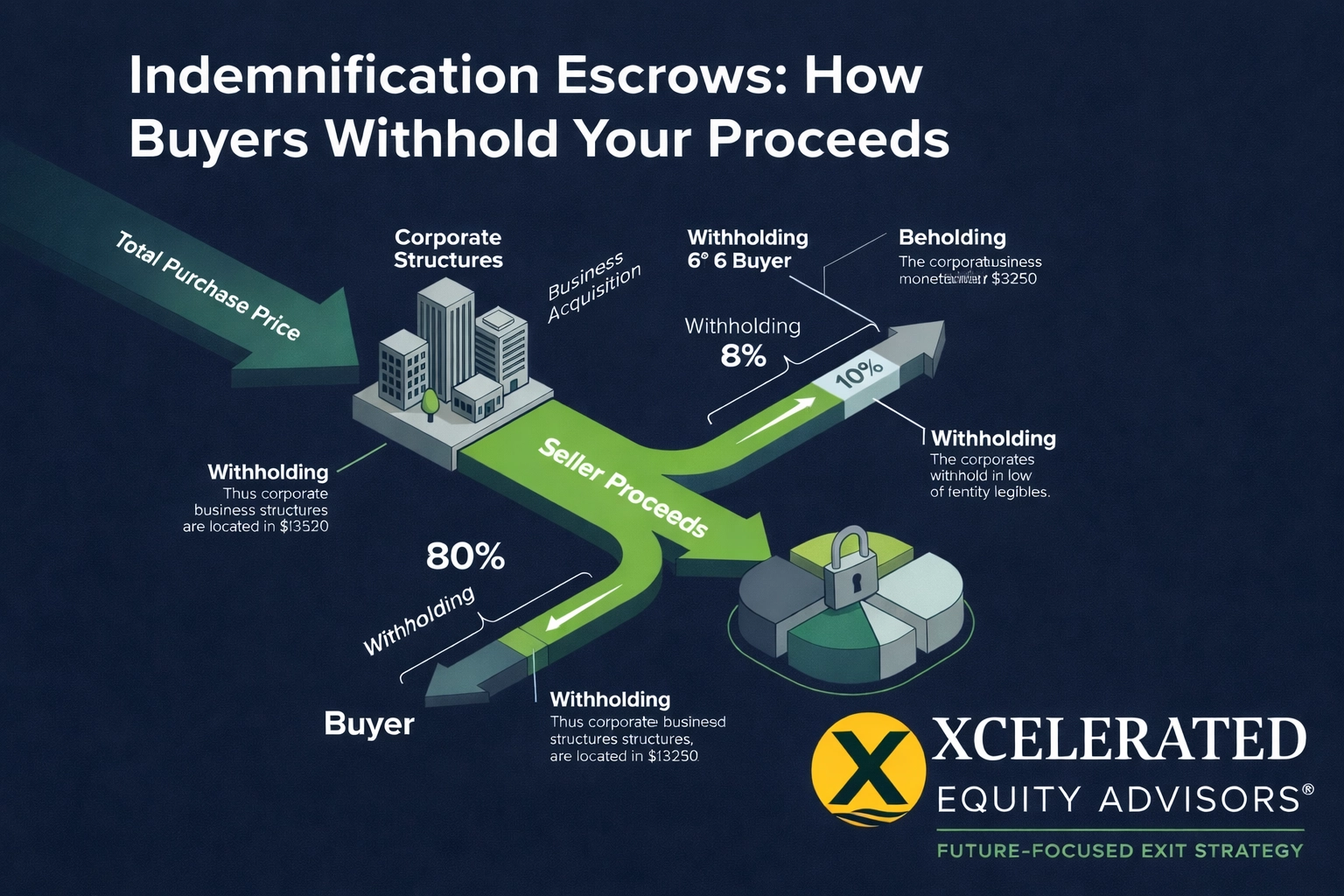
An indemnification escrow is a mechanism where a portion of your purchase price is placed in a third-party account to secure the buyer against future losses. These losses typically stem from breaches of the Representations and Warranties (R&W) you made during the transaction. While the headline price in your Letter of Intent (LOI) might look attractive, the escrow represents capital you have earned but cannot touch.
Typically, buyers demand between 10% and 15% of the total enterprise value to be held in escrow. For a $20 million transaction, this means $2 million to $3 million is sitting in a bank account, unavailable for reinvestment or personal liquidity. The goal of the buyer is to maximize this amount to shift the risk of post-close discoveries entirely onto the seller.
The escrow effectively turns a portion of your fixed purchase price into a performance-based asset. If the buyer uncovers a tax liability, a pending lawsuit, or an undisclosed contract breach, they file a claim against these funds. The buyer holds the leverage during this period because the funds are already out of your control.
Survival Periods and the Buyer’s Clock
The duration of the escrow, known as the survival period, is a critical negotiation point where sellers often lose ground. Most buyers push for a survival period of 12 to 24 months for general representations. This timeframe is designed to allow the buyer to complete at least one full audit cycle and tax year under their own management.
Certain "Fundamental Representations": such as ownership of the company, authority to sell, and tax compliance: often have much longer survival periods. These can last for the full statute of limitations, which may extend up to six or seven years. If you do not explicitly limit the scope of these fundamental reps, you remain financially exposed long after you have exited the daily operations.
A seller who does not tighten these survival periods finds themselves in a state of perpetual liability. For example, a buyer may discover a minor labor law violation in month 17 of an 18-month escrow. By filing a claim just before the deadline, they can freeze the release of the entire escrow balance until the claim is resolved.

Alt text: 3D green X logo with yellow circle and company name Xcelerated Equity Advisors®.
The Basket Trap: Tipping vs. Deductible
Buyers use "baskets" to determine when they can begin clawing back your escrow funds. A basket is essentially a deductible for claims. There are two primary types: the "Deductible" basket and the "Tipping" (or "First-Dollar") basket. Understanding the difference is the difference between losing $50,000 and losing $150,000.
In a Deductible basket, the buyer can only recover losses that exceed a specific threshold. For instance, if the basket is $100,000 and the claim is $125,000, the buyer only receives $25,000. Conversely, a Tipping basket allows the buyer to recover every dollar once the threshold is met. If that same $100,000 threshold is tipped by a $100,001 claim, the buyer takes the full $100,001 from your escrow.
Buyers prefer tipping baskets because they provide a lower barrier to entry for recouping the purchase price. Your objective during deal structure is to insist on a deductible basket. This ensures that minor, "nickel-and-dime" claims do not erode your final proceeds.
Numerical Example: The Cost of a Weak Escrow Structure
To illustrate the dollar impact, consider a multi-unit business sale with a $12,000,000 enterprise value.
- Escrow Amount (10%): $1,200,000
- Basket Type: Tipping Basket
- Basket Amount: $75,000
- Claim 1 (Unresolved Sales Tax): $60,000
- Claim 2 (Equipment Repair): $20,000
In this scenario, Claim 1 does not reach the $75,000 threshold, so no money is lost initially. However, once Claim 2 occurs, the total loss ($80,000) exceeds the tipping basket. Because it is a tipping basket, the buyer is entitled to the full $80,000, not just the $5,000 excess.
If the seller had negotiated a Deductible basket, their loss would have been limited to $5,000. By missing this technical detail, the seller lost an additional $75,000 in net cash at the end of the survival period.

Alt text: A table showing the comparison between tipping and deductible baskets and their impact on seller proceeds.
Fundamental vs. General Representations
Buyers differentiate between types of representations to extend their reach into your escrow. General representations cover daily operations, inventory, and employee matters. These are usually capped at the escrow amount. If your escrow is $1.5 million, the buyer’s recovery for general reps is typically limited to that $1.5 million.
Fundamental representations, however, are often "uncapped" or capped at the full purchase price. If a buyer finds a defect in your legal title to the company, they can seek damages beyond the escrowed funds. Sellers often fail to realize that their personal assets can be at risk if fundamental reps are not strictly defined and capped.
You must delineate exactly what qualifies as a fundamental representation. Buyers will attempt to include environmental issues or specific large contracts in this category. You must push back to keep the list of fundamental reps as narrow as possible to protect your walk-away cash.
Multi-Unit Exposure in Escrow Claims
When you sell a multi-unit business, your exposure to escrow claims increases exponentially with each location. A single unit with a lease issue or an undisclosed building code violation can trigger an indemnification claim that freezes the escrow for the entire transaction. Buyers look for "systemic" issues across multiple units to justify larger claims.
For example, if a buyer discovers that one unit in a ten-unit portfolio is non-compliant with ADA requirements, they may claim a breach of representations across all ten units. They will use this as leverage to withhold the entire escrow amount, even if the actual cost of remediation is a fraction of the holdback.
https://xeadvisors.com/the-pre-sale-audit-5-red-flags-that-kill-multi-unit-deals-during-diligence. Understanding these triggers before entering a deal is vital to protecting the back end of your transaction.
R&W Insurance: Converting Risk into Cash Certainty
One of the most effective ways to bypass the indemnification escrow entirely is through Representations and Warranties Insurance (R&W Insurance). In this arrangement, an insurance policy: rather than your cash: backs the representations in the purchase agreement. While there is a premium to pay (typically 2-4% of the coverage limit), it allows you to walk away with nearly 100% of your proceeds at closing.
The buyer gains the security of a large insurance carrier, and you gain immediate liquidity. In deals over $20 million, R&W insurance has become the standard for sophisticated sellers. It eliminates the 18-month waiting period and the risk of "buyer’s remorse" claims that often plague the escrow release process.
The policy must be carefully integrated into the Purchase and Sale Agreement (PSA). If the buyer is not required to seek recovery from the insurance carrier first, they may still attempt to come after you for the "retention" (deductible) amount. You want a "no-recourse" deal where the buyer’s sole remedy is the insurance policy.

Alt text: Green 3D X logo in front of a gold rising sun representing a strategic business exit.
The Final Math of the Exit
Ultimately, the indemnification escrow is not a "legal formality." It is a financial adjustment to your purchase price that occurs after the deal is done. Every dollar tied up in escrow is a dollar that is at risk of being reclaimed by the buyer for reasons that often have nothing to do with the actual value of the business.
If your records are disorganized or your compliance is questionable, the buyer will demand a larger holdback and a longer survival period. Your net proceeds will suffer.
You must view the escrow as a component of the deal structure that requires as much negotiation as the multiple itself. In escrow disputes, the release schedule matters as much as the headline percentage because one unresolved claim can delay the return of the entire holdback long after closing.