
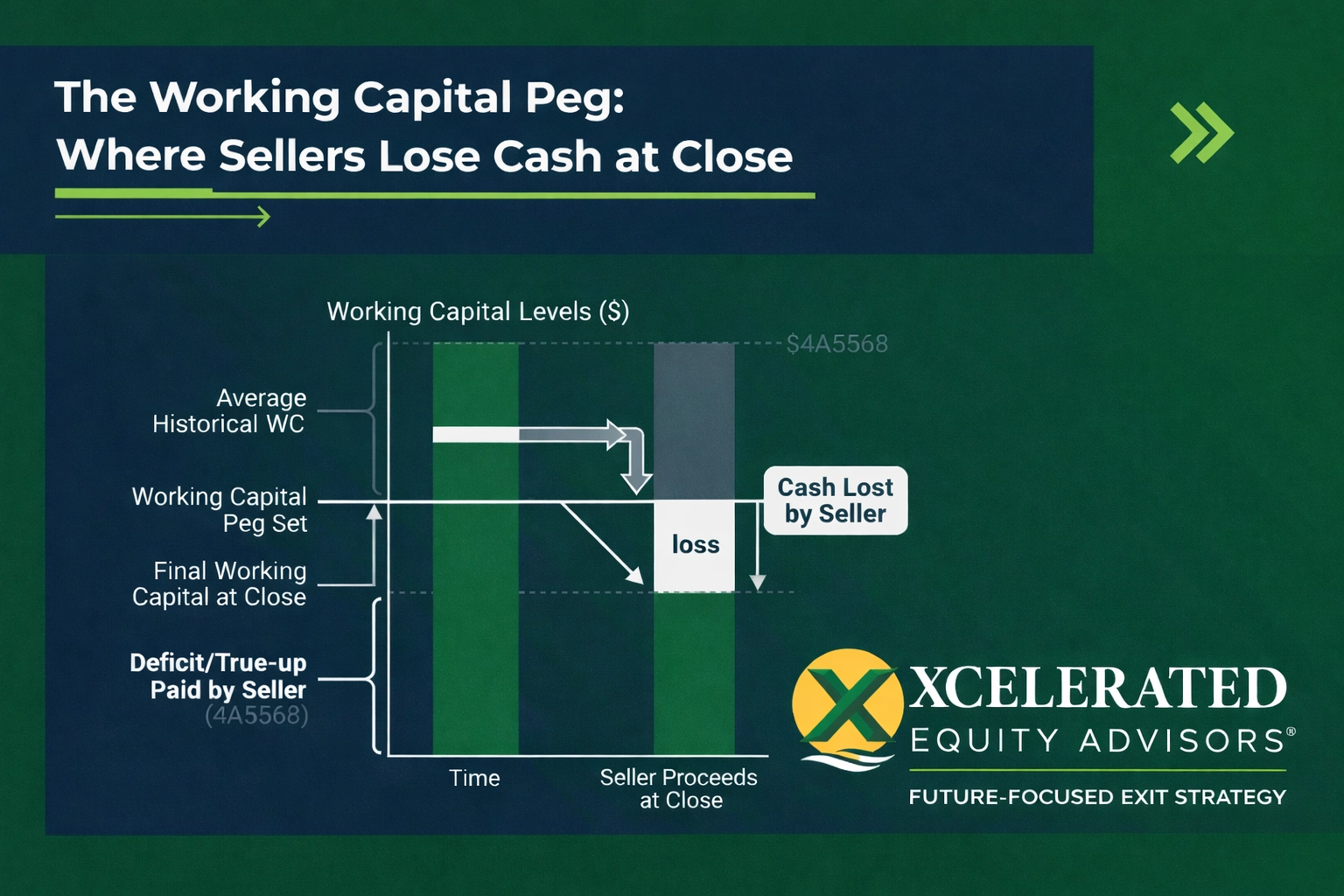

I have seen a seller lose $1,200,000 at the closing table because they agreed to a working capital peg based on a three-month seasonal peak rather than a twelve-month average. The buyer successfully argued that the elevated inventory levels were the necessary operating baseline going forward. When actual working capital at closing failed to reach that inflated target, the shortfall came out of the final wire — dollar for dollar.
What the Peg Actually Is
The working capital peg is a contractual target embedded in the purchase agreement. It defines the amount of net working capital — current assets excluding cash, minus current liabilities excluding debt — that the seller is required to deliver at closing.
When a buyer acquires a business on a cash-free, debt-free basis, they are paying for a going concern with enough liquidity to operate without an immediate cash infusion. The peg represents that baseline. If the seller delivers less working capital than the peg, the purchase price is reduced dollar for dollar. If the seller delivers more, the price increases accordingly.
The working capital peg is a negotiating instrument, and buyers control how it is defined.
The peg is derived from a calculation: typically the trailing twelve month average of net working capital. But buyers control which accounts are included, how inventory is valued, and how accruals are treated. Every definitional choice is a lever. Sellers who do not contest the definitions before signing the LOI are handing over that leverage before the negotiation begins.
How the Gap Gets Created
Most sellers do not lose money on the peg because of accounting errors. They lose it because of timing, seasonality, and the deliberate framing of what constitutes "normal."
Consider a distribution business with seasonal inventory buildup. During the peak quarter — say, late summer ahead of a fall shipping cycle — inventory levels may run forty to sixty percent above the annual average. A buyer who proposes the peg during that window and frames the elevated inventory as the operating baseline is anchoring the target at a point the business will rarely sustain.
The seller agrees in the LOI. Three to four months later, inventory has normalized. The working capital at close is materially below the peg. The adjustment is calculated. The wire is reduced. By the time the gap becomes visible, the deal is already moving toward closing and the seller has limited leverage to reset the peg.
Buyers widen the gap further through asset redefinition. Receivables over 90 days are excluded from current assets — even if they are collectible — because the buyer classifies them as impaired. Prepaid expenses are reclassified as non-operating. Certain inventory is written down at closing under a quality of earnings finding introduced in the final days of due diligence, after deal fatigue has set in and the seller is least willing to fight. Meanwhile, every liability stays in. Accrued vacation pay, deferred bonuses, customer deposits, and all accrued expenses remain in the calculation without exception. The peg holds. The actual NWC shrinks. The gap is the seller's problem.
This asymmetry — assets excluded, liabilities retained — is not accidental. It is the methodology buyers use to manufacture a shortfall that would not exist under a straightforward calculation.

Alt text: A financial graph showing seasonal fluctuations in working capital with a red horizontal line representing an inflated peg.
The $1.2 Million Illustration
To make the mechanics concrete, consider a business with a $15 million headline purchase price. The buyer proposes a working capital peg of $3.5 million, citing inventory and receivables levels from the most recent month — a seasonal high. The seller accepts.
By the time the transaction closes, inventory has normalized and a large customer invoice has been collected. The actual net working capital at closing is $2.3 million. The gap between the peg and the actual is $1.2 million. Under the purchase agreement, that gap is a dollar-for-dollar reduction in the sale price.
The seller receives $13.8 million instead of $15 million.
That is an 8% reduction in final proceeds. Not the result of a material business change, a failed integration, or a discovery of fraud. The result of a peg set at the wrong point in the cycle, using a methodology the seller did not contest.
This is precisely the kind of value erosion that occurs late in a process, when deal fatigue is highest and the seller is least likely to push back.
The TTM Standard and Its Limits
Sellers who do not anchor the peg to a trailing twelve month average expose themselves to timing-based inflation of working capital targets. Averaging across a full year smooths out seasonal distortions and removes the leverage a buyer gains by selecting a favorable measurement date.
The TTM average is not bulletproof. In a growing business, the trailing twelve months may understate the capital requirements of the current operating environment. A business that has recently tightened payment terms with vendors or accelerated collections may show an inflated TTM average that works against the seller. Buyers know this and will argue for the interpretation that raises the peg.
Before the peg is finalized, the seller must perform a normalization analysis of the balance sheet — identifying non-recurring items such as a one-time paydown of accounts payable, a delayed vendor invoice, or an unusual prepaid balance — and presenting a working capital figure that reflects steady-state operations rather than timing anomalies.
Sellers who enter the peg negotiation without this analysis are negotiating blind. Buyers typically have quality of earnings advisors who have already completed the same analysis from the other direction, with the explicit goal of finding accounts that widen the gap. Arriving unprepared is not a neutral position.

Alt text: A professional advisor pointing to a spreadsheet labeled Net Working Capital Adjustments.
What Sellers Must Demand in the Agreement
The working capital peg is not finalized at the LOI stage. It is refined, often dramatically, during due diligence — and buyers frequently introduce new findings in the final days before closing, when the seller is least willing to reopen the conversation.
Three protections matter most.
First, demand a written NWC policy in the purchase agreement. This document should list, by specific general ledger account, what is included in the calculation and how each account is valued. Inventory valuation methodology — whether lower of cost or market, FIFO, or weighted average — must be explicitly stated. If it is left undefined, the buyer retains the right to revalue assets at closing in ways that reduce the NWC calculation without triggering a breach.
Second, require a pre-closing statement at least five business days before the wire is sent. This gives the seller's team time to review the buyer's working capital calculation, identify aggressive positions, and dispute them before funds transfer. Attempting to claw back a purchase price adjustment after closing is expensive, slow, and rarely successful.
Third, be cautious about collar provisions proposed by buyers. A collar — a buffer of $100,000 to $200,000 within which no adjustment is made — sounds balanced. When the peg is set at the high end of a realistic range, the collar eliminates the seller's potential for an upward adjustment while doing nothing to protect against a downward one. The asymmetry is the point. A one-sided collar is a price reduction structured to look like a fairness mechanism.

Alt text: A legal contract page focused on the section titled Working Capital Definitions.
The Connection to Exit Readiness
The working capital peg is a balance sheet issue, not an income statement issue. Most owners preparing for a sale focus almost entirely on EBITDA — growing earnings, normalizing add-backs, defending the multiple. The balance sheet receives far less attention.
That is a structural blind spot buyers are trained to exploit. Every dollar of EBITDA growth that drives a higher purchase price can be quietly recaptured at the closing table if the seller arrives with a balance sheet that has not been properly prepared and defended. A business trading at a six-times multiple that takes a $500,000 working capital hit has effectively given the buyer nearly $84,000 in annual EBITDA for free — with no negotiation, no pushback, and no recourse after the wire clears.
The working capital peg is one of the most consistent ways proceeds are reduced at closing, and one of the few that can be controlled before the purchase agreement is signed.
Start with the assessment here: https://xeadvisors.com/exit-assessment/ This will identify where value is lost before a transaction.