
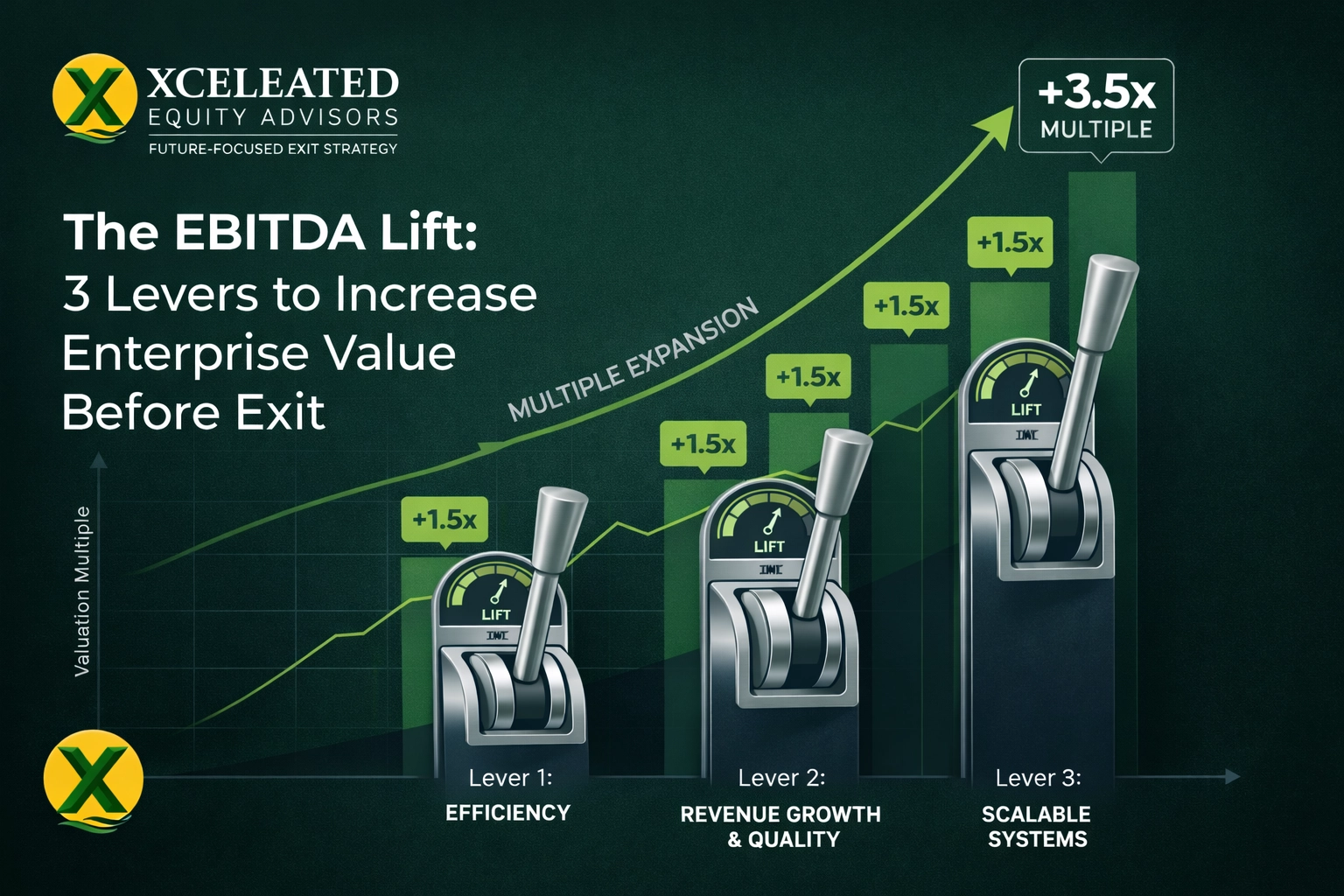

Driving Enterprise Value Through Strategic Operational Improvements
Business owners often mistake top-line revenue growth for business value. Revenue is a vanity metric that indicates market presence but does not guarantee a successful exit. In the eyes of a sophisticated buyer, value is found in the quality and durability of Earnings Before Interest, Taxes, Depreciation, and Amortization (EBITDA).
To achieve a premium valuation, you must shift your focus from generating more sales to generating better earnings. This requires a transition from an operator mindset to an investor mindset. A buyer is not just purchasing your past performance. They are purchasing a future stream of cash flow.
If that cash flow is perceived as risky or unstable, the buyer will apply a lower multiple to your earnings. Conversely, if you can prove that your EBITDA is scalable and predictable, you can trigger multiple expansion. This is where a small increase in profitability leads to a disproportionately large increase in enterprise value.
Effective multiple expansion represents the pinnacle of value creation. It occurs when the market recognizes that your earnings are backed by systems, pricing power, and strategic market positioning. A business that operates independently of its owner and demonstrates consistent margins is inherently more valuable than a high-growth business plagued by operational chaos.
The Misconception: Why Growth Does Not Equal Value
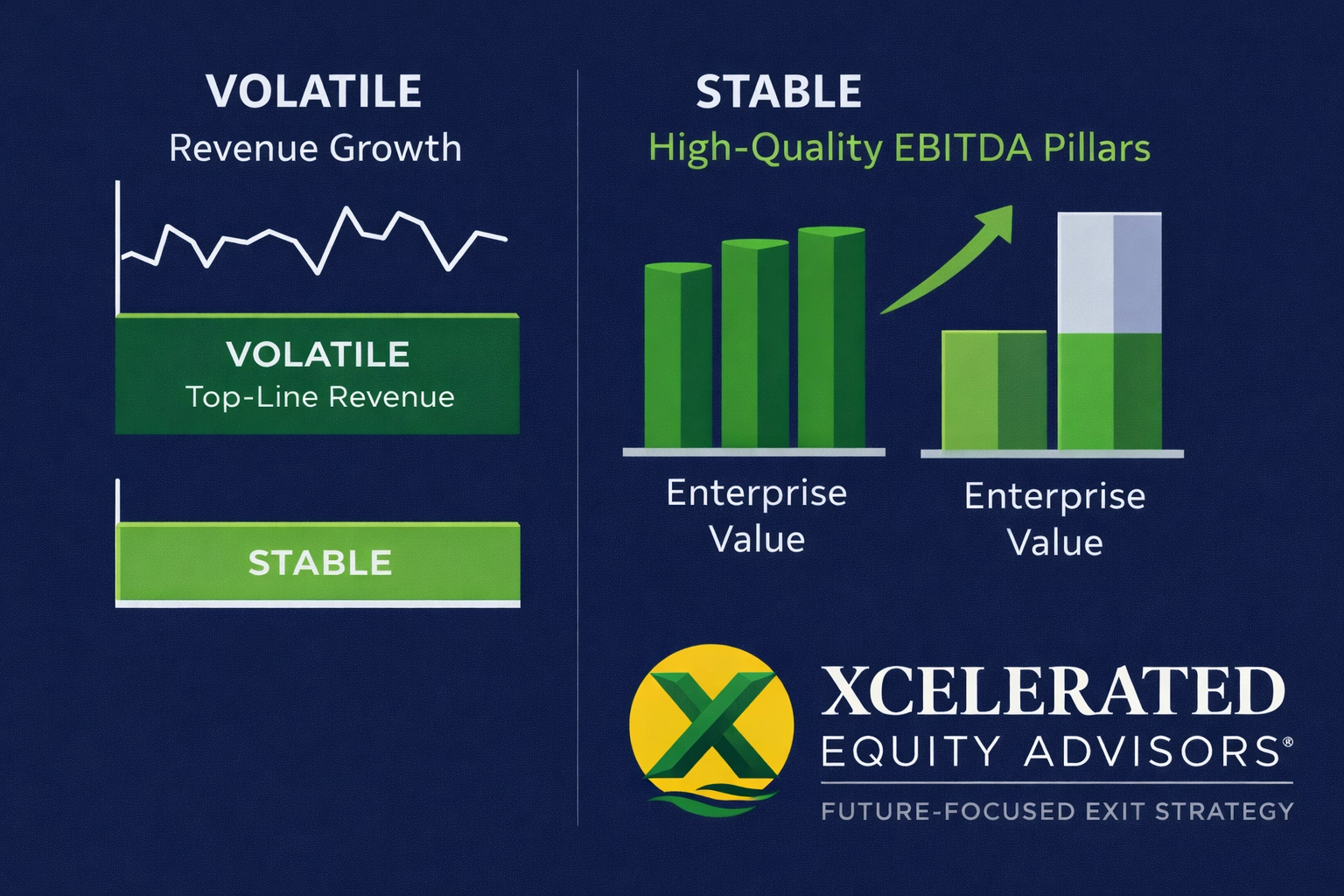
Many founders believe that if the business is growing, it is automatically becoming more valuable. That assumption is false. Growth alone is not value unless it produces durable EBITDA, stronger transferability, and lower buyer risk.
Buyers do not pay a premium for revenue volume by itself. They pay for earnings quality, margin durability, and a business model that can scale without breaking. If revenue grows while margins stay thin, costs rise unpredictably, or execution remains dependent on the owner, the company may be larger but not more valuable.
When a company scales inefficiently, it creates a "messy" P&L that requires significant normalization during diligence. Buyers discount unstable EBITDA because it represents a high level of execution risk. To secure a high multiple, you must demonstrate that your growth is profitable and your cost structure is optimized for the long term.
More importantly, growth without a systems-based foundation creates a Value Gap. The business gets bigger, but it does not get more transferable. In many cases, it becomes less salable because complexity rises faster than infrastructure, decision-making remains concentrated with the owner, and key relationships continue to depend on founder involvement. From a buyer's perspective, that is not scalable growth. It is expanded owner dependency, and expanded owner dependency suppresses both buyer confidence and valuation.
Lever 1: Pricing Power and Margin Expansion
Pricing power is the most effective lever for increasing EBITDA. It refers to the ability to raise prices without a corresponding drop in volume. This indicates that your product or service provides significant value that is not easily replaced by competitors.

What It Is & Why It Matters?
Pricing power is the ultimate evidence of a strong market position. It shows that your customers are loyal and that your business has successfully differentiated its offering. High margins provide a buffer against economic shifts and rising costs.
How to implement
Start by conducting a comprehensive pricing audit. Analyze your historical data to identify price elasticity across different product lines. Move away from cost-plus pricing and toward value-based pricing models.
Strategic packaging and positioning can also drive margin expansion. Instead of selling individual components, create bundles that solve a broader client problem. This obscures direct price comparisons and increases the perceived value of the transaction.
Institutionalize your pricing strategy so it is not a subjective decision made by sales staff. Buyers look for a disciplined approach to annual price increases and contractual escalators. This creates a predictable margin profile that justifies a higher multiple.
Valuation impact
Every dollar added through pricing falls directly to the bottom line without increasing overhead. Buyers view high-margin businesses as less risky. This strength often leads to a higher industry multiple because it proves the business has a "moat" protecting its earnings.
You can learn more about optimizing your business for these metrics through our growth advisory services.
Lever 2: Cost Structure Optimization
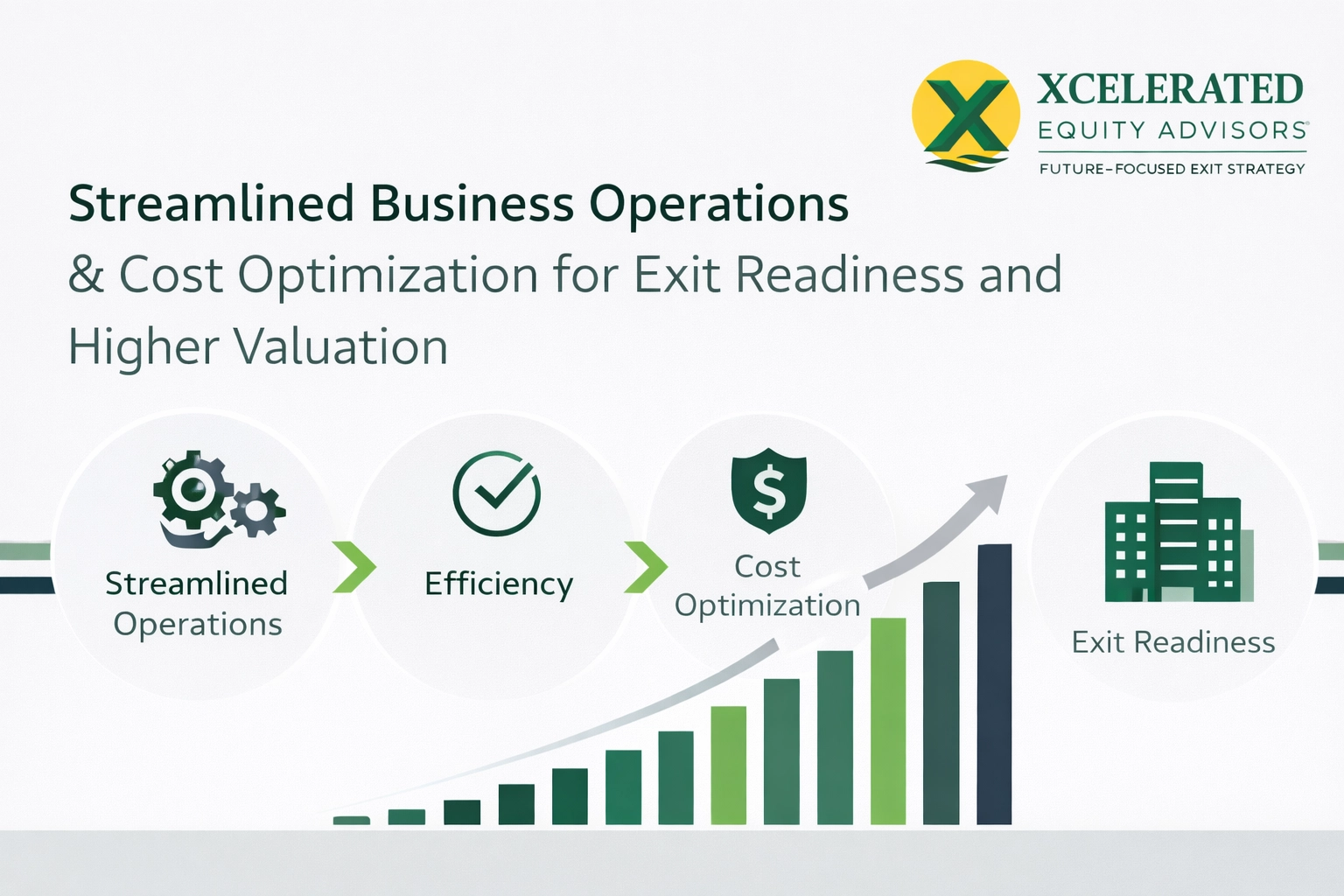
Cost optimization is not about radical downsizing. It is about maximizing the efficiency of every dollar spent. A lean, efficient cost structure signals to a buyer that the management team is disciplined and the business is ready for the next stage of growth.
What It Is & Why It Matters?
This lever focuses on labor efficiency, COGS control, and vendor management. It involves identifying and eliminating "waste" revenue that costs more to service than it generates in profit.
How to implement
Review your labor utilization rates. Ensure that your highest-paid employees are focused on high-value tasks. Implement automation or outsource low-level administrative functions to lower-cost providers.
Renegotiate vendor contracts periodically. As your volume increases, your leverage with suppliers should grow. Conduct a thorough audit of all recurring expenses to identify legacy services that no longer provide a return on investment.
Analyze the profitability of your service delivery. If the cost to deliver a service is increasing faster than the revenue it generates, the business is suffering from diseconomies of scale. Correcting these inefficiencies is critical for exit readiness.
Valuation impact
A streamlined cost structure improves the "quality" of your earnings. It shows the buyer that the business can scale without a linear increase in expenses. Professionalized operations are a key component of a high-value enterprise.
Lever 3: Customer Mix and Concentration Risk
Not all revenue is created equal. Low-quality revenue from demanding, low-margin customers can actually drag down the value of your business. Buyers look for a diversified, loyal customer base with high lifetime value (LTV), strong margins, and limited concentration.
What It Is & Why It Matters?
Customer quality is not just a retention issue. Customer mix matters equally. The ratio of high-margin work to low-margin work determines whether revenue growth actually converts into durable EBITDA. A business can post strong retention and still destroy value if it is retaining the wrong mix of work. Buyers study whether your revenue base is composed of profitable, repeatable engagements or resource-heavy accounts that compress margins and consume management attention.
This lever also includes customer concentration risk. When a single client represents more than 10 to 15 percent of total sales, buyers view the income stream as fragile. If one customer exceeds that threshold, the business may become effectively un-bankable for debt-funded buyers because the lender sees repayment risk tied too heavily to one relationship. That materially shrinks the buyer pool and undermines any path to multiple expansion.
How to implement
Segment your customer base by profitability, service intensity, and renewal behavior. Identify the bottom tier of clients who consume the most resources while producing the least margin. Reprice those accounts, redesign the scope, or exit the relationship to free capacity for higher-quality revenue.
At the same time, analyze your revenue concentration by customer, location, and contract type. If one client is too large, build a deliberate diversification plan before going to market. That may include cross-selling into smaller accounts, adding new channels, tightening contract terms, and shifting sales resources toward customers that improve mix rather than simply increase volume.
Retention strategy should focus on the right customers, not all customers equally. Formal feedback loops, renewal planning, and account management should be concentrated on high-margin clients with durable fit. Reduce acquisition inefficiency by directing marketing spend toward channels that produce profitable customers rather than customers that only inflate top-line revenue.
Valuation impact
High customer retention reduces the perceived risk of future earnings, but retention alone does not drive premium value. Buyers pay for resilient EBITDA supported by strong customer mix and low concentration. A business with profitable revenue composition and no oversized client exposure will command broader buyer interest, stronger lender support, and a higher multiple than a business with high churn, weak mix, or a single client that can disrupt the entire forecast.
The Math of Multiple Expansion
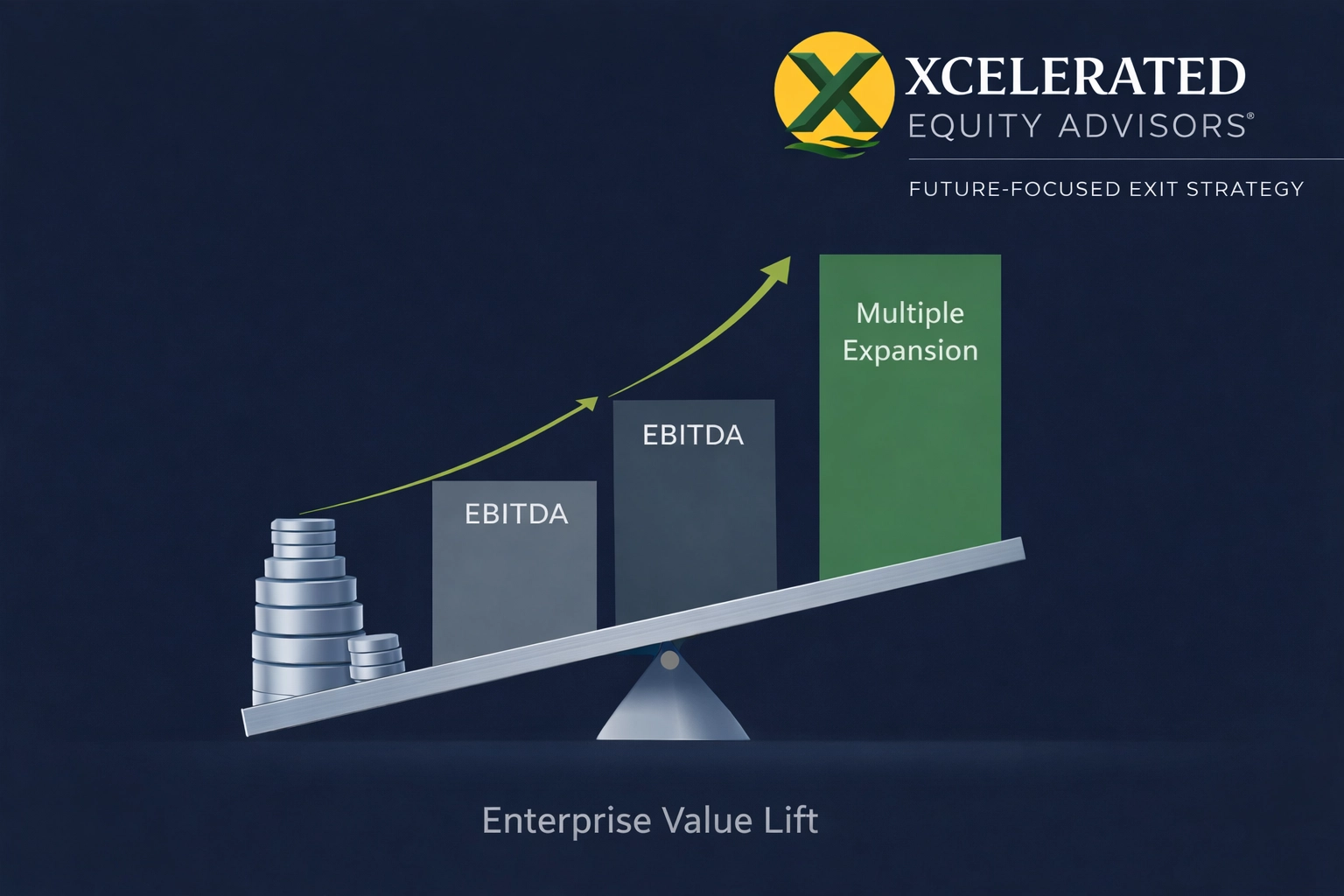
To understand the power of these levers, you must look at the math. Enterprise value is typically calculated as EBITDA multiplied by a valuation multiple. Small improvements in the numerator (EBITDA) and the multiplier (the multiple) create a compounding effect.
Consider a business with $1,000,000 in EBITDA and a 4.0x multiple. The enterprise value is $4,000,000.
By applying the three levers above, the owner achieves a 20 percent lift in EBITDA through better pricing and cost control. The EBITDA is now $1,200,000.
Because the business is now more efficient, has better customers, and higher margins, a buyer views it as less risky. The multiple expands from 4.0x to 5.5x, resulting in a new enterprise value of $6,600,000.
In this scenario, a 20 percent increase in EBITDA resulted in a 65 percent increase in total value. This is the "lift" that occurs when you focus on the quality of the business rather than just the volume of the sales. This leverage is the primary objective of any strategic exit strategy.
Key Takeaways
- EBITDA is the anchor: Buyers value cash flow, not revenue.
- Multiple expansion is the goal: Improving business quality increases the multiplier.
- Pricing is the fastest lever: Margin expansion goes straight to the bottom line.
- Efficiency builds trust: Optimized cost structures reduce buyer perception of risk.
- Customer quality matters: High-margin, loyal clients drive predictable future earnings.
- Compound results: Small operational wins lead to massive valuation gains.
Application: Value Growth Sprints
Increasing the value of a business is not an overnight event. It requires a disciplined approach over a 12 to 72 month window. At Xcelerated Equity Advisors®, LLC, we utilize value growth sprints to focus on these levers in manageable phases.
Each sprint is designed to target a specific area of the business. We audit the current state, implement the necessary changes, and then measure the impact on the valuation. This scientific approach ensures that your efforts are directly tied to the final exit outcome.
Sprints allow management to focus on one objective at a time without disrupting daily operations. This incremental improvement build-up results in a business that is not only more valuable but significantly easier to manage.
Waiting until you are ready to sell to fix these issues is a mistake. By the time you engage a broker, your historical data is already set. You must start optimizing your EBITDA now to ensure that your trailing twelve months of performance reflect a high-value, high-multiple business.
Exit Readiness Assessment
Is your business currently positioned for a high-multiple exit? Most owners have a gap between what they think their business is worth and what a buyer will actually pay. This gap is often the result of operational inefficiencies and concentration risks that the owner has overlooked.
Take the first step in closing that gap. Complete the ExitMap® Assessment to identify the specific levers you need to pull to maximize your enterprise value. Our assessment provides a clinical view of your business through the eyes of a strategic acquirer.
Start with the assessment here: https://xeadvisors.com/exit-assessment/ This will identify where value is lost before a transaction.
Tags: exit readiness, owner dependence, valuation drivers, customer concentration, management team depth, strategic planning, succession planning, value growth, business salability
[…] is rebuilt. That risk perception compresses the multiple directly. This is why we focus on The EBITDA Lift as a core pillar of value […]