
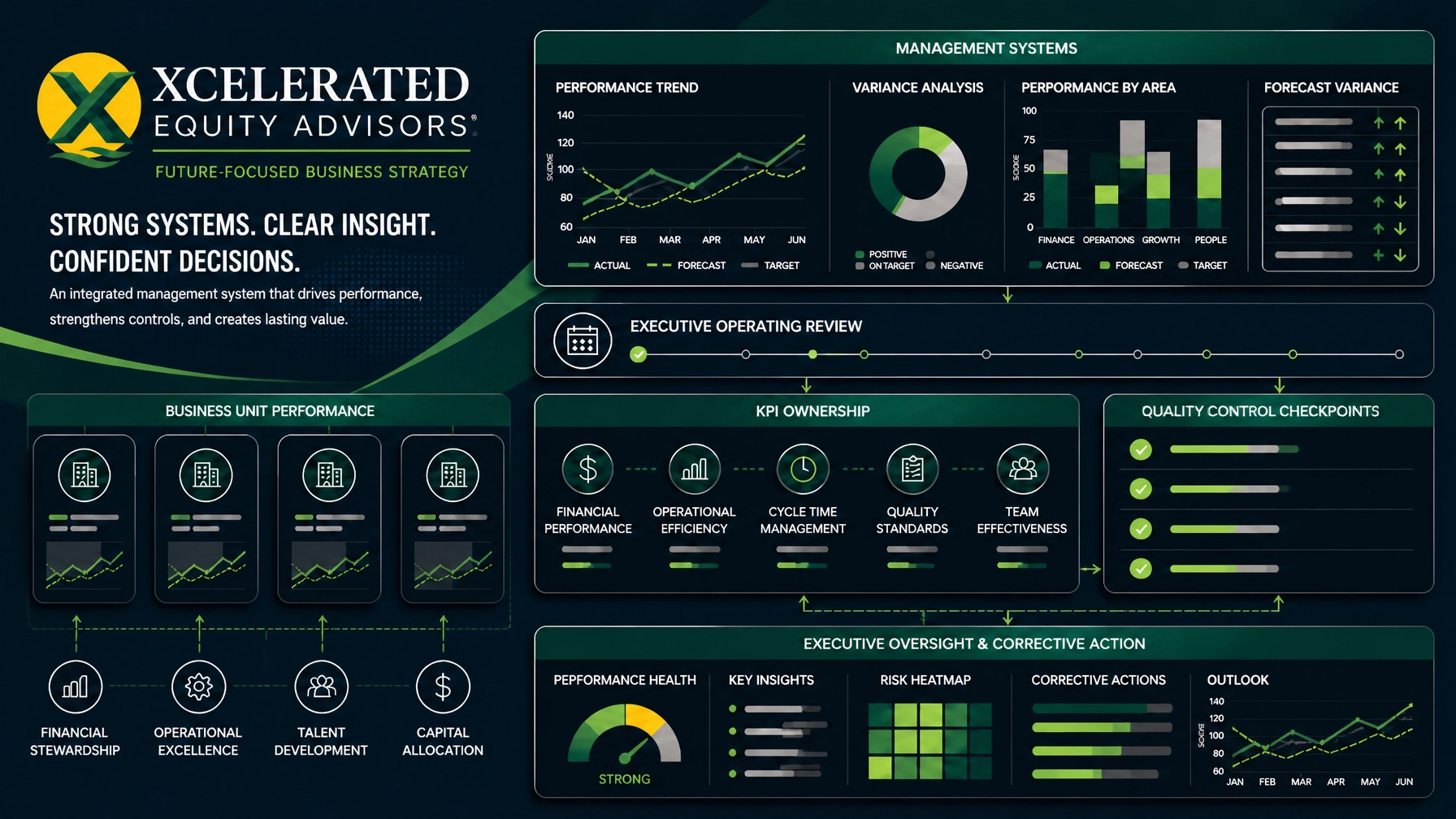

A monthly operating review can be a reporting meeting or a management system. The difference is what happens after a variance appears.
Suppose one location misses its labor target for the second month. A dashboard identifies the problem. A management system identifies the cause, assigns a corrective action to a named leader, sets a due date, and verifies the result at the next review.
EBITDA shows what the business produced. The management system shows how the company detects problems, protects performance, and adjusts when conditions change.
Buyers do not pay separately for meetings and dashboards. They place more confidence in earnings when management can show a reliable process for sustaining and improving them.
A Management System Is a Closed Loop
Reporting becomes management when the company consistently moves through five steps:
- Set the plan and operating assumptions.
- Measure actual performance using consistent definitions.
- Identify and explain material variance.
- Assign corrective action to someone with authority.
- Verify whether the action produced the expected result.
Many companies complete the first three steps. They build a budget, produce reports, and discuss why performance moved. The process breaks when no one owns the response or when the issue disappears from the agenda before the result is checked.
That open loop creates execution risk. Management knows what happened but cannot show that the organization corrected it.
Earnings and Forecasts Answer Different Questions
Reported EBITDA shows the operating result recorded for a completed period. Adjusted EBITDA presents the seller's view of normalized earnings after proposed add-backs or other adjustments. Buyers test those adjustments because a seller's calculation is not automatically a durable earnings stream.
The forecast addresses what management expects next. It should connect revenue, labor, margin, working capital, and other operating assumptions to actions the management team controls.
A forecast is credible when management compares it with actual performance, explains variance, and revises assumptions when the facts change. Repeated misses without timely adjustment suggest that the forecast is an aspiration rather than a management tool.
This distinction matters in diligence. A strong historical year can support valuation, but the buyer still needs to determine whether management understands the drivers well enough to protect future performance.
KPI Ownership Requires Authority
A KPI report has limited value when nobody clearly owns the result.
In a multi-unit business, a unit manager may own labor percentage, service quality, local conversion, or customer retention. Finance may own forecast accuracy and reconciliation. Regional operations may own margin and quality across locations.
Each owner of a KPI needs timely information, decision authority, an approved performance range, and responsibility for corrective action. Holding someone accountable for a number while retaining every decision that affects it creates the appearance of management without the operating capacity.
Incentives should reinforce the same economic result. A manager rewarded only for revenue may make decisions that weaken margin, customer quality, or cash flow. Compensation does not need to mirror every KPI, but it should not encourage behavior that conflicts with the operating plan.
Buyers may interview KPI owners directly. The manager should be able to explain how the measure is calculated, what caused the latest variance, what action was taken, and whether the result improved. If the owner must translate every answer, management depth remains difficult to prove.
The Operating Cadence Shows Whether Management Can Execute
A recurring meeting matters when it produces decisions and follow-through.
Return to the location that missed its labor target. A useful review would determine whether the cause was scheduling, overtime, vacancies, sales volume, or weak supervision. The responsible manager would receive a specific action, authority to implement it, and a deadline. The next review would compare the result with the approved target.
This sequence is simple, but it reveals a great deal. It shows whether management identifies problems early, distinguishes symptoms from causes, makes decisions at the appropriate level, and closes the loop without owner rescue.
Keep a decision and action log. Record the issue, owner, due date, expected financial effect, and final result. The log should not become administrative clutter. It should preserve the commitments that materially affect earnings, cash, customers, or operating risk.
Controls Make the Information Trustworthy
Management cannot act effectively when operating reports and financial statements use different definitions.
Labor, revenue, margin, customer acquisition, retention, and unit-level EBITDA should reconcile with the underlying financial and operating data. Shared costs should be treated consistently. Adjustments should be documented rather than recreated when diligence begins.
Controls also apply to corrective action. If one location misses margin, the record should show the variance, assigned response, due date, and later result. That evidence demonstrates that the control operated before the buyer arrived and that management used it to run the company.
The XEA data-room indexing framework explains why organized supporting information can influence a buyer's view of management discipline and operating control.

How Buyers Evaluate the System
A buyer may begin with the monthly reporting package and select one material variance. The review can then move backward to the source data and forward through the corrective action.
The buyer is looking for consistency among the number, management's explanation, the assigned response, and the later result. The review becomes more credible when another manager can follow the same process using the same definitions.
Perfect performance is not required. A working management system is valuable because it identifies problems before they become permanent, gives managers the authority to respond, and verifies whether the response worked.
When that system is absent, the buyer may assume future performance requires more oversight, additional management, or significant post-close integration work. Those costs and risks can affect the confidence placed in forecast earnings.
Management Systems Create Value Before a Sale
The same system that gives a buyer confidence gives the owner better control today.
Forecasts become more useful. Managers know what they own. Problems are addressed earlier. Capital and leadership attention move toward the issues with the greatest financial consequence. The owner spends less time translating reports and rescuing execution.
Management systems do not replace earnings performance. They make the earnings easier to understand, monitor, and sustain. That increases the company's operating capacity and makes future performance less dependent on the founder.
Use the XEA Exit Assessment to identify where weak KPI ownership, inconsistent reporting, open corrective actions, and owner-dependent management are limiting transferability and enterprise value.