
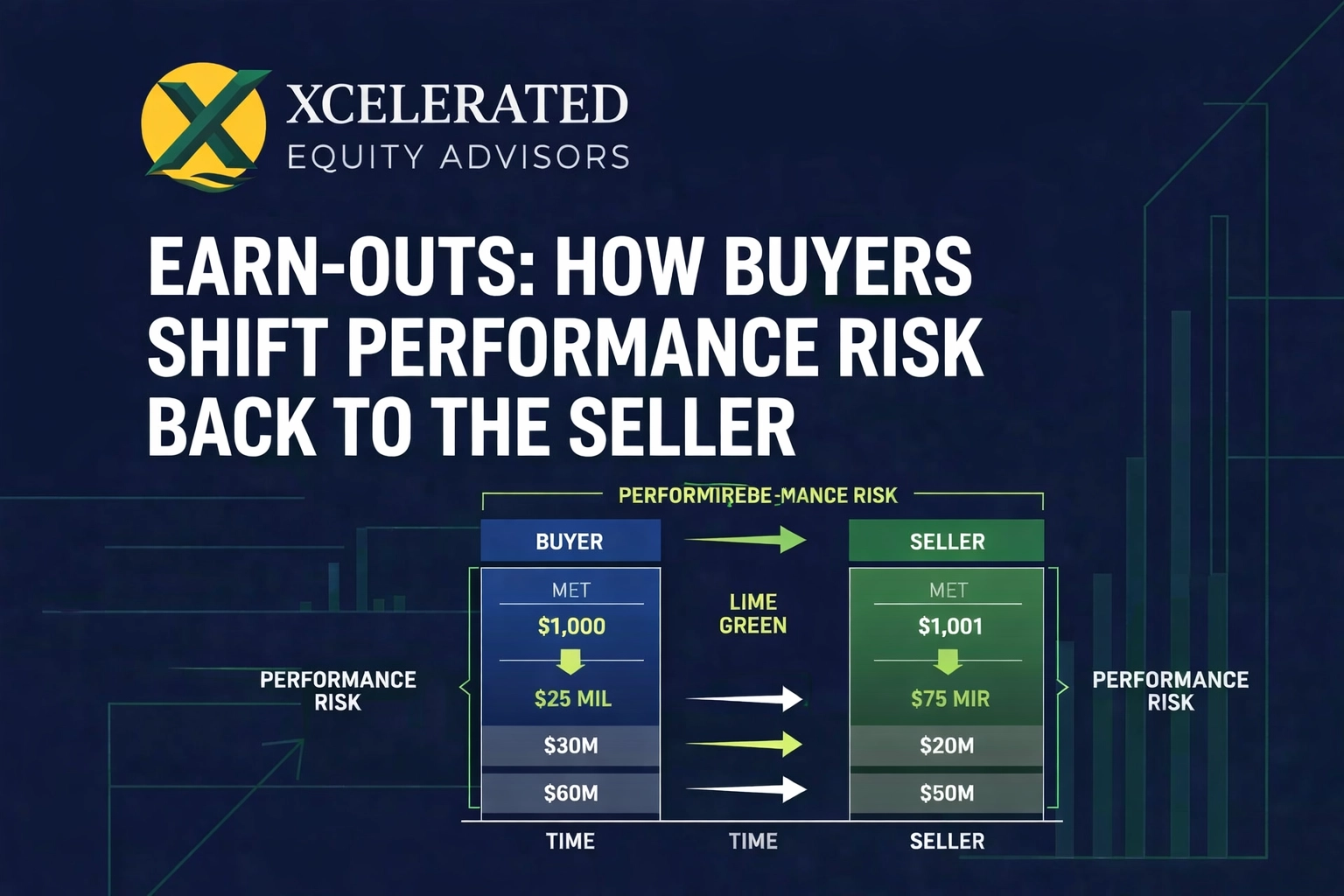


I watched a seller forfeit a $2.4 million earn-out payment because they failed to negotiate a specific exclusion for centralized corporate overhead in their post-close EBITDA definition. The seller assumed the buyer’s management team would maintain the existing lean cost structure to ensure the targets were hit. The buyer immediately consolidated the back office and allocated $800,000 in "shared services" costs to the business, which wiped out the profit margin required to trigger the payout.
The Illusion of the Headline Purchase Price
Buyers use earn-outs as a bridge to close the gap between their valuation and your asking price. For example, if you believe the business is worth $15 million and the buyer is only willing to pay $11 million in cash, an earn-out is proposed to fill the $4 million delta. The seller feels they achieved their price, while the buyer has successfully de-risked the transaction by only paying that $4 million if the business performs under their management.
This structure inherently shifts the risk of future performance from the buyer’s capital to the seller’s proceeds. The "headline price" on the Letter of Intent is often a fiction designed to gain exclusivity. The buyer knows that once they take operational control, they possess multiple accounting and operational levers to ensure that the earn-out targets remain elusive.
Accounting Manipulation: The EBITDA Trap
Most earn-outs are tied to EBITDA because buyers want to ensure the business generates enough cash flow to service any debt used for the acquisition. The definition of EBITDA in a post-closing environment is rarely the same as the one used during your Quality of Earnings review.
Buyers often utilize "Standard of Care" clauses that allow them to run the business in accordance with their own corporate policies. This can include:
- Allocated Corporate Overheads: Charging the business for HR, legal, and executive salaries at the parent company level.
- Changed Inventory Methods: Shifting from LIFO to FIFO, which can create a one-time paper profit or loss that impacts the earn-out period.
- Capital Expenditure Loading: Accelerating necessary repairs or tech upgrades into the earn-out period to depress net income.

Alt text: A technical document highlighting various EBITDA adjustment line items in a purchase agreement.
Operational Control and the Loss of Autonomy
The moment the deal closes, you are no longer the owner; you are typically an employee or a consultant. The buyer has the right to change the business exit roadmap. They may decide to discontinue a high-margin product line because it doesn't fit their long-term strategy, or they might reassign your best sales talent to a different division.
If the earn-out is based on Gross Revenue, the buyer might intentionally lower prices to gain market share. While this helps their long-term value, it can destroy the profit margins if your earn-out was tied to EBITDA. Conversely, if the earn-out is tied to profit, they may cut the marketing budget to "save" money, which eventually leads to a revenue decline that prevents you from hitting your targets.
A Numerical Breakdown of the Earn-out Loss
Consider a business with a $3 million EBITDA and an agreed-upon $15 million purchase price. The buyer offers $10 million in cash at close and a $5 million earn-out based on achieving $3.5 million in EBITDA in year one.
- Baseline EBITDA: $3,000,000
- Target EBITDA: $3,500,000
- Buyer’s Post-Close Allocation: $400,000 (Shared Services Fee)
- Revenue Decline Impact from Marketing Reduction: $300,000
- Actual Year One EBITDA: $2,800,000
In this scenario, the accounting allocations and post-close operating changes reduced EBITDA to $2,800,000. Because the threshold of $3,500,000 was not met, the seller receives $0 of the $5 million earn-out. The buyer effectively paid 3.3x EBITDA on the $10 million cash consideration at close, while the seller underwrote the missing value through contingent proceeds.
Technical Protections and Negative Covenants
To mitigate these risks, sellers must negotiate "Negative Covenants" and specific operational protections during the transaction. These are legal guardrails that prevent the buyer from making material changes that would adversely affect the earn-out.
You should insist on an "Acceleration Clause." This clause dictates that if the buyer sells the company again or terminates you without cause during the earn-out period, the entire remaining earn-out balance becomes due immediately. Without this, the buyer could fire the founder to save on salary costs, which further depresses the expenses but removes the person most likely to hit the performance targets.
The Impact of Multi-Unit Structures
In multi-unit businesses, buyers frequently use earn-outs to account for underperforming locations. If three out of ten units are struggling, the buyer may structure the earn-out specifically around those units' turnaround. If those units share resources with the profitable ones, the buyer can manipulate how costs are assigned to each location. We see this frequently when analyzing how to increase business EBITDA across distributed footprints; what looks like profit at a unit level can be erased by corporate-level accounting shifts.

Alt text: A bar chart comparing projected earn-out payments against actual realized payments in private equity deals.
Interplay with Net Working Capital
The earn-out also interacts with the working capital adjustments discussed in previous weeks. If the buyer sets an artificially high working capital peg, the business has less cash to invest in the growth required to hit the earn-out. The seller is forced to fund the very growth that the buyer is using to justify the deferred payment.
If the business needs $500,000 in new inventory to hit the revenue target, but the buyer refuses to fund it because it would hit the working capital adjustment, the seller is trapped. They either forgo the earn-out or pay for the inventory through a purchase price reduction.
Why Revenue-Based Earn-outs Are Preferable
Whenever possible, sellers should push for revenue-based earn-outs rather than profit-based ones. Revenue is much harder to manipulate through accounting "voodoo" than EBITDA. A revenue target provides a cleaner metric that is less susceptible to centralized overhead allocations.
Buyers resist this because revenue does not pay the bank. The compromise is often a "Floor" on EBITDA combined with a Revenue target. This ensures the buyer that the business won't be run into the ground to hit a top-line number, but it protects the seller from the buyer’s internal expense decisions.
Reps, Warranties, and the Indemnification Link
Buyers also use earn-outs as a "set-off" for indemnification claims. If the buyer discovers a minor tax issue or a customer dispute after closing, they may attempt to deduct that claim directly from your earn-out payment rather than going through the escrow process. This turns your performance-based payment into a secondary security deposit for the buyer.
Ensuring that earn-out payments are treated as separate from indemnification obligations is a critical technical hurdle in the definitive purchase agreement. If you fail to decouple these, the buyer has every incentive to find "breaches" in your representations to avoid paying the deferred price.
Final Transaction Observation
Earn-outs are not a "bonus" for good performance; they are a mechanism for buyers to pay for your business using your own future cash flow while shifting execution risk back to you. Every dollar left in an earn-out is a dollar you have not actually realized from the sale.
In transaction terms, an earn-out is deferred purchase price with disputed math, delayed control, and weak collection leverage once the buyer owns the books.