
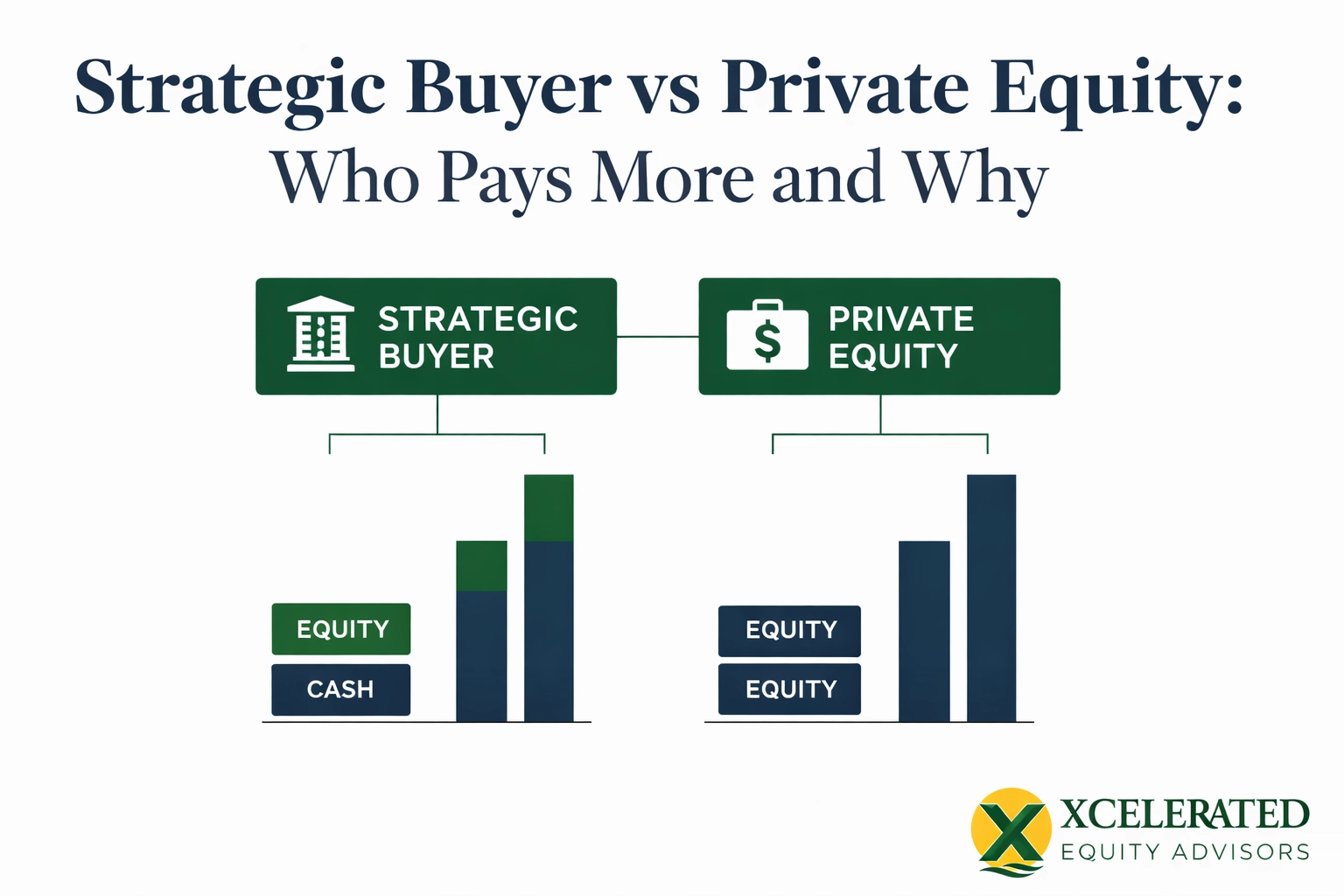

A sound exit planning strategy requires more than chasing the highest headline price. Business owners often approach the sale of their company with a single metric in mind: the headline price. They view the transaction as a linear negotiation where the highest bidder wins. However, this perspective fails to account for the fundamental differences between the two primary classes of buyers: Strategic Buyers and Private Equity firms.
The identity of the buyer dictates the deal structure, the post-closing obligations, and the ultimate total consideration. A strategic buyer might offer the highest cash payment at the closing table. A private equity firm might offer a lower initial check but a significantly higher total payout over a five year horizon. Therefore, understanding these motivations is critical for any owner moving toward an exit.
The Misconception: Why Growth Does Not Equal Value
Business owners often assume that stronger revenue growth automatically produces a higher valuation. That assumption fails in real transactions because buyers do not pay for growth in isolation. Buyers pay for transferable earnings, operational resilience, and confidence that performance will continue after the founder exits.
A company can grow quickly and still trade at a discount if margins are inconsistent, reporting is weak, customer concentration is high, or the business depends too heavily on the owner. Growth without transferability often increases perceived risk instead of value because it signals that performance may not hold after closing.
This distinction matters in both strategic and private equity processes. Strategic buyers assess whether growth strengthens integration economics. Private equity buyers assess whether growth is scalable, repeatable, and durable under professionalized management. In both cases, quality of earnings matters more than topline momentum alone, which is why growth alone is not value.
What It Is & Why It Matters?
Strategic buyers are typically larger companies operating within your industry or a closely related vertical. They are not looking for a standalone investment. They are looking for an acquisition that can be integrated into their existing operations to create a sum larger than its parts.
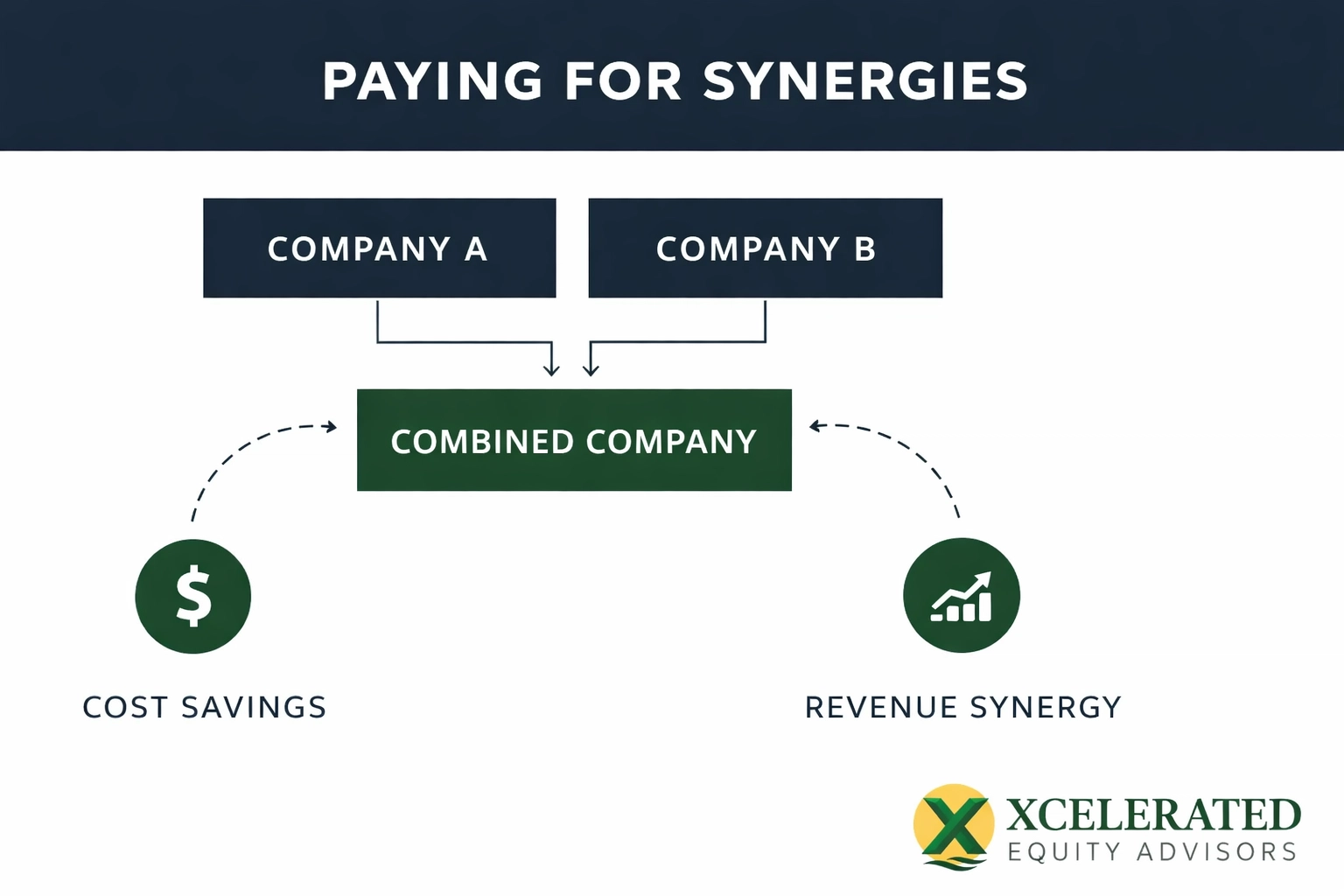
These buyers value your company based on synergies. Synergies exist in two forms: cost savings and revenue enhancements. A strategic buyer may realize that by acquiring your business, they can eliminate redundant administrative functions, consolidate warehouse space, or leverage a larger purchasing power to lower COGS. Therefore, these immediate cost reductions mean that your $2 million in EBITDA is worth significantly more once it is under their umbrella.
Because of these efficiencies, strategic buyers are often willing to pay a premium. They can justify a higher multiple because they are calculating the return based on the post-integration earnings rather than your current standalone performance.
The Private Equity Model: The Platform Play
Private Equity (PE) firms operate with a different set of incentives. They are financial buyers. They raise capital from institutional investors to acquire companies, improve their operations, and sell them for a profit within a three to seven year window.
PE firms generally look at two types of acquisitions: platforms and add-ons. A platform company is a standalone business with a strong management team and scalable systems. Add-ons are smaller companies purchased to be tucked into an existing platform.
Unlike strategic buyers, PE firms often require the founder to remain involved. They are buying the future growth potential of the company and need the existing leadership to execute the plan. Because PE firms do not always have the same immediate cost synergies as a strategic competitor, their initial cash offer may be lower. However, they compensate for this through deal structure.
The Second Bite of the Apple
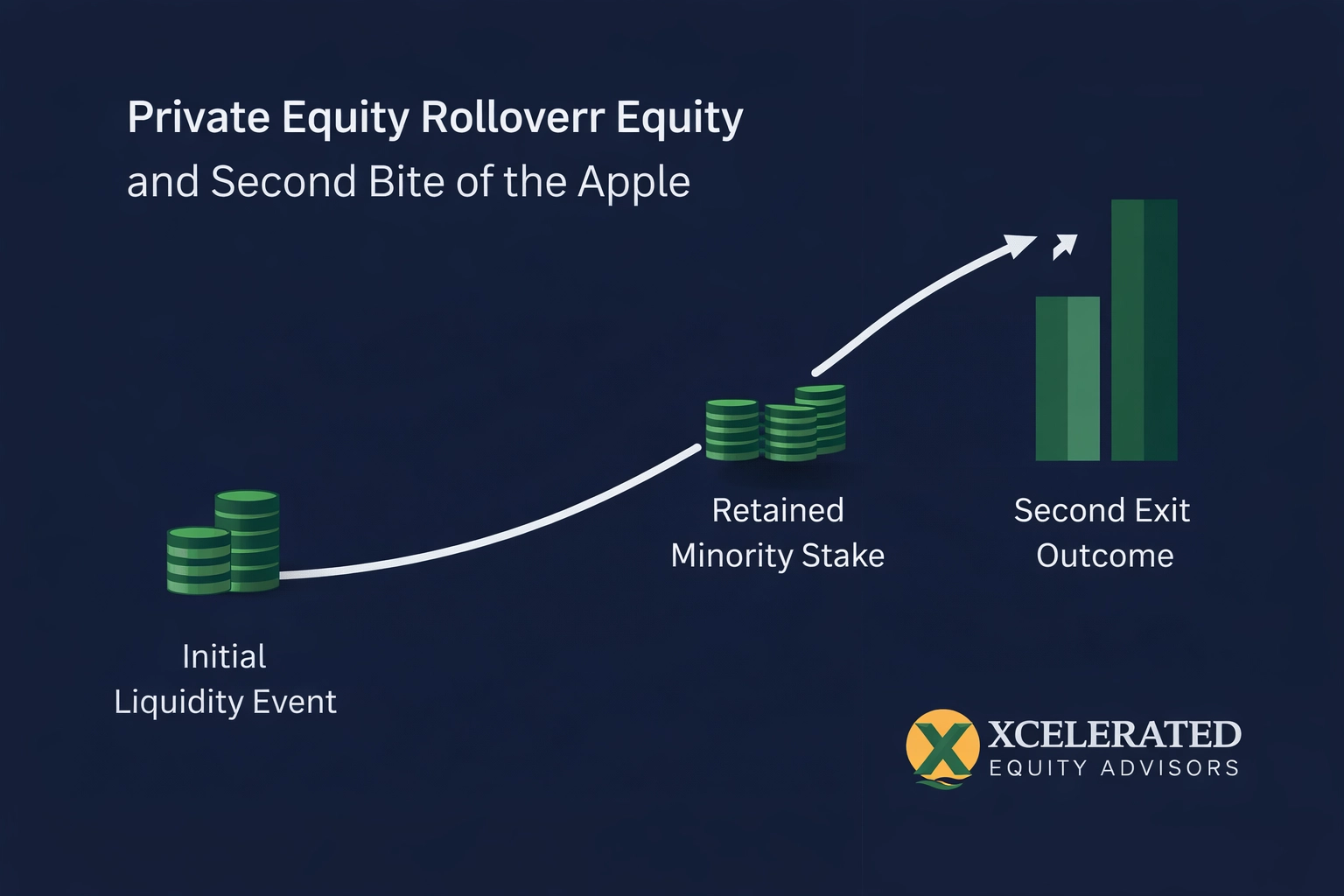
The defining characteristic of a Private Equity transaction is the “rollover equity.” In this scenario, the owner sells 60% to 80% of the business for cash but retains a 20% to 40% ownership stake in the new entity.
The goal is to grow the company aggressively under PE ownership. Therefore, when the PE firm eventually sells the company to a larger firm or a strategic buyer in five years, the owner’s retained minority stake is often worth as much as, or more than, the original 80% stake they sold. This is known as the “second bite of the apple.”
For an owner who is not ready to retire immediately and believes in the growth potential of the company, the PE route can lead to a much higher total net worth. It transforms the exit from a single event into a multi-stage wealth creation strategy.
Valuation Mechanics and the EBITDA Lift
Both buyer types utilize multiples of EBITDA (Earnings Before Interest, Taxes, Depreciation, and Amortization) to determine value. However, the way they apply these multiples differs.
Strategic buyers focus on the “Internal Rate of Return” (IRR) relative to their own cost of capital. If your company helps them defend a market position or acquire a proprietary technology, they may pay a multiple that defies standard industry averages.
Private Equity firms are more disciplined regarding entry multiples. They rely on “Multiple Expansion” and “EBITDA Lift.” If a PE firm acquires a company at a 6x multiple and, through operational improvements and scale, sells it five years later at an 8x multiple, they have achieved multiple expansion.
The EBITDA Lift is a core component of the Xcelerated Equity Advisors® methodology. By institutionalizing processes and reducing owner dependency before the sale, we increase the baseline EBITDA. This makes the company more attractive to both buyer types. A strategic buyer sees less risk in the integration. A PE firm sees a cleaner platform that is ready for immediate scaling.
Stability vs. Autonomy
The choice between these buyers also involves a trade-off in corporate culture and personal autonomy.
A sale to a strategic buyer often results in full integration. The seller’s brand may disappear. The employees may be absorbed into a larger corporate structure. For many owners, this is a “clean break” exit. They receive their cash and move on to the next chapter of their lives with no further responsibility to the business.
A sale to Private Equity is rarely a clean break. The PE firm will expect the owner to meet aggressive growth targets. There will be increased reporting requirements and a new level of board oversight. While the owner maintains a level of operational control, they are now accountable to financial partners.
Which Buyer Pays More?
The data suggests a clear trend. Strategic buyers typically pay more in upfront cash. Thus, they are the preferred option for owners seeking maximum immediate liquidity and a total exit from operations.
Private Equity firms often provide the highest “total consideration” when the second exit is factored in. They are the preferred option for owners who want to de-risk their personal balance sheet by taking some “chips off the table” while still participating in the upside of the company’s future growth.
The following table outlines the primary differences:
| Feature | Strategic Buyer | Private Equity |
|---|---|---|
| Primary Motivation | Market share and synergies | Financial return and scaling |
| Upfront Cash | Usually higher | Usually lower (due to rollover) |
| Owner Involvement | Minimal post-transition | High (3–5 year commitment) |
| Deal Structure | 100% Asset or Stock sale | Majority recapitalization |
| Future Upside | None (unless earnout exists) | Significant via rollover equity |
Assessing Your Exit Readiness
Selecting the right buyer requires an objective Assessment of your business and your personal goals. If your company is highly dependent on your daily involvement, a Private Equity firm will likely discount their offer or pass entirely. If your company has specialized intellectual property but lacks a sales force, a strategic buyer will find immense value in plugging your product into their distribution engine.
The most successful exits occur when the owner has prepared the business to be attractive to both groups. This creates a competitive bidding environment that drives up the final price regardless of the buyer’s identity.
Before engaging with any buyer, you must understand the current marketability of your enterprise. Determining whether you are positioned for a strategic premium or a PE platform play is the first step in a professional exit strategy.
To begin this process, we recommend a formal evaluation of your business across the primary drivers of transferability. You can complete the preliminary ExitMap Assessment at https://xeadvisors.com/exit-assessment/.
Start with the assessment here: https://xeadvisors.com/exit-assessment/ This will identify where value is lost before a transaction.
Conclusion
Valuation is not a static number. It is a variable that changes based on who is holding the checkbook. A strategic buyer pays for what you have built and how it fits their puzzle. A private equity firm pays for what you can build next with their capital.
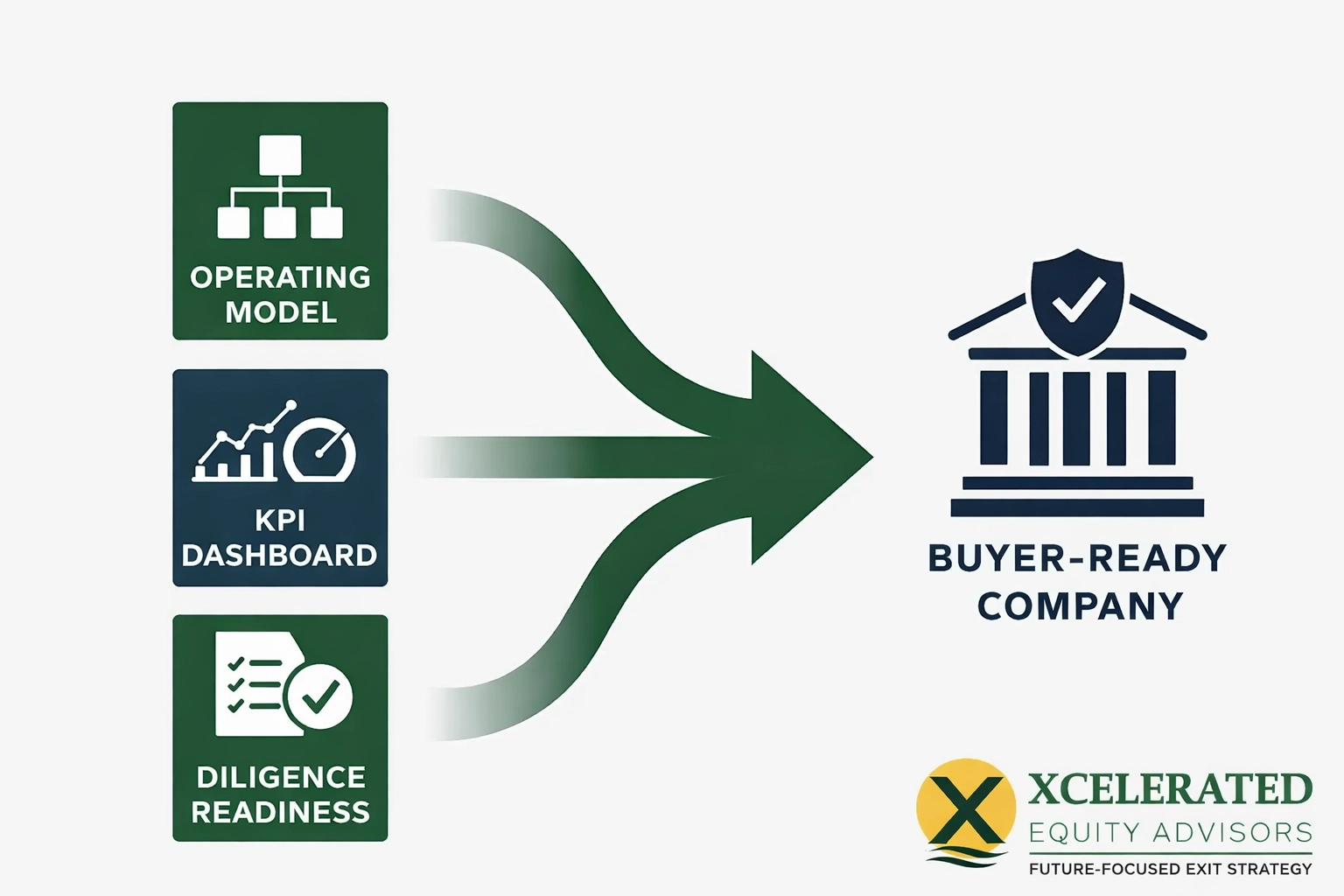
The most effective way to maximize your outcome is to build a business that functions independently of your presence. This “transferability” is the ultimate currency in the M&A market. Whether you choose the immediate liquidity of a strategic sale or the long term wealth creation of a private equity partnership, the strength of your underlying operations will determine your leverage at the negotiating table.
Preparation is the only hedge against market volatility. Ensure your business is ready for the scrutiny of a professional buyer by focusing on value growth and structural efficiency today.