
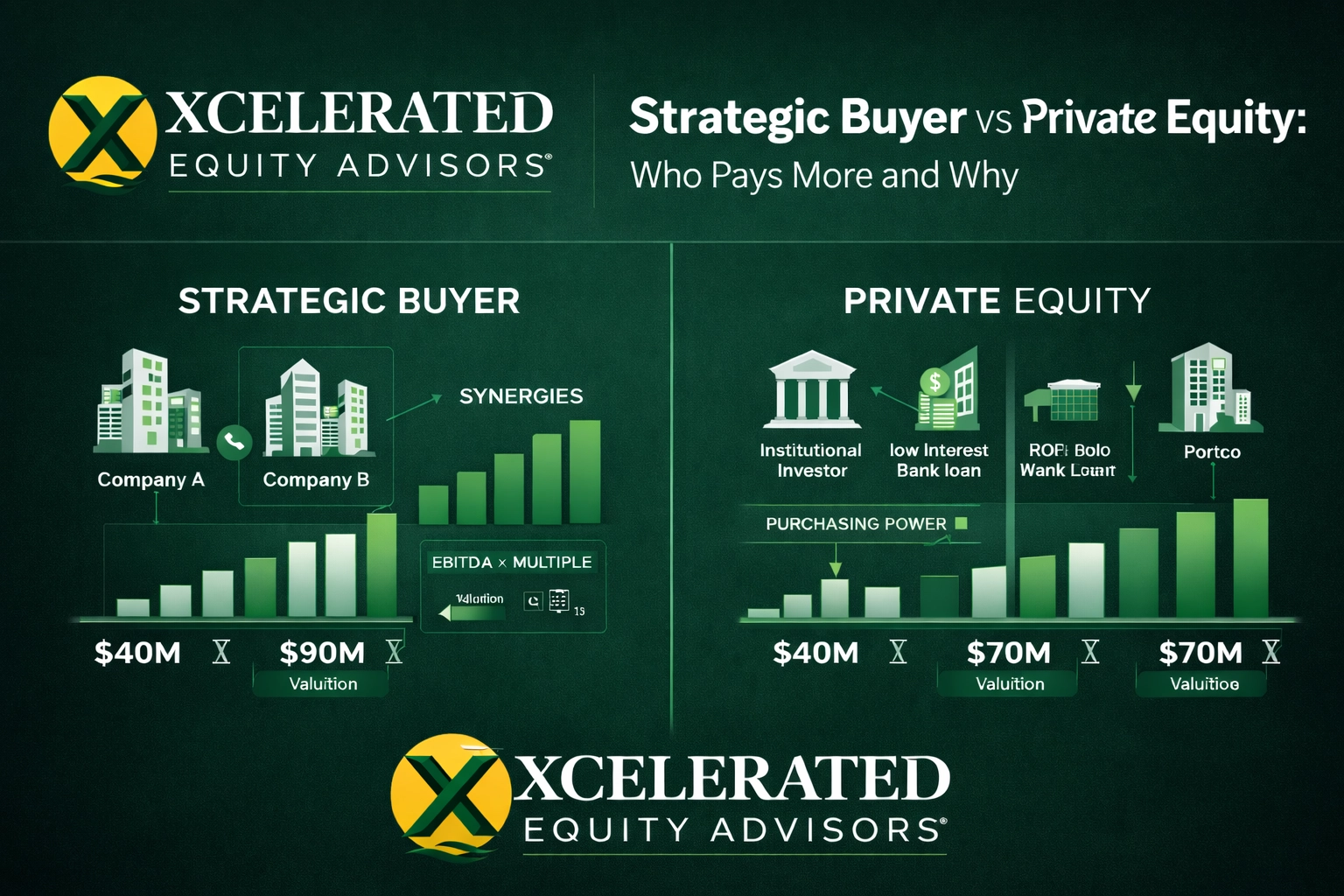

Most owners approaching a sale fixate on one number: the headline price. They treat the transaction as a linear negotiation where the highest bidder wins and everything else is detail. That framing is incomplete, and it costs sellers money.
The identity of your buyer determines the deal structure, your post-closing obligations, how risk is allocated, and your total consideration over time. A strategic buyer might write the largest check at closing. A private equity firm might offer a lower initial number but a significantly higher total payout when the second transaction is factored in. These are not variations of the same outcome. They are fundamentally different financial strategies, and choosing between them requires understanding what each buyer is actually purchasing.
I have worked through exits on both sides of this comparison. The owners who maximized their outcomes understood which buyer type fit their situation before they went to market, not after the LOI was signed.
What a Strategic Buyer Is Actually Buying
Strategic buyers are operating companies, typically larger businesses within your industry or an adjacent vertical, and they are not buying a financial asset. They are buying a capability, a market position, a customer base, or a geography that accelerates something they are already trying to do.
That distinction drives everything about how they value your business. A strategic buyer does not need to underwrite your EBITDA in isolation. They underwrite your EBITDA plus the earnings improvement they expect to capture by combining your business with theirs. Those improvements, called synergies, come in two forms.
Cost synergies are the easier ones to quantify. When a strategic acquires your business, they can typically eliminate redundant administrative functions, consolidate facilities, and renegotiate vendor contracts at combined volume. In practice, cost synergies frequently yield a 5-15% reduction in combined SG&A. That savings goes directly to the buyer’s bottom line, which means they can afford to pay more for your business and still hit their return threshold.
Revenue synergies are less predictable but often larger. A strategic buyer entering your market through your customer relationships can expect a 2-6% Year-1 revenue uplift through cross-selling and footprint expansion, assuming the integration is executed well. When a buyer can model that kind of near-term accretion, they can stretch the purchase price above what any purely financial buyer could justify.
This is why strategic buyers typically pay 15-30% more than private equity for comparable assets, and why strategic transactions can reach 10x EBITDA or higher in competitive processes while PE typically operates in the 6-7x range. The strategic buyer is not being generous. They are pricing in value that only exists inside their organization.
In a transaction I’ve worked on in the services sector, a strategic buyer paid $90.7M EV for a firm while a PE bid $70.9M—a spread captured through these exact synergy models.
What this means for preparation is straightforward. To attract a strategic premium, your business needs to be easy to integrate. Clean financials, documented processes, and a management team that does not require the founder to function all reduce integration risk, which is what compresses strategic offers from their theoretical ceiling down to something more conservative.
What a Private Equity Firm Is Actually Buying
Private equity firms are financial buyers. They raise capital from institutional investors, acquire businesses, improve operations, and sell them within a three-to-seven-year window at a profit. They do not have operating infrastructure to absorb your business. They cannot underwrite synergies. Their return model depends entirely on two levers: EBITDA growth during the hold period and multiple expansion at the time of their exit.
Because of this, PE valuations are disciplined by leverage constraints and IRR requirements. A leveraged buyout model stress-tests the acquisition price against the business’s ability to service the acquisition debt. If your EBITDA is not predictable and transferable enough to support that debt load, the PE buyer either passes or reduces the price until the model works. This is why PE offers are generally lower than strategic offers on the same asset.
PE firms acquire businesses in two modes. Platform acquisitions are standalone businesses with strong management depth and scalable systems, companies PE can build on. Add-on acquisitions are smaller businesses purchased to fold into an existing platform, typically at lower multiples. Understanding which category your business falls into affects both who will approach you and what they will pay.
Unlike a strategic buyer, a PE firm almost always requires the founder to remain involved post-close, typically for two to five years. They are not buying a finished asset. They are buying a growth story that needs its current leader to execute the next chapter. This is a material post-closing obligation that many owners underestimate when comparing PE offers to strategic offers on headline price alone.
The Second Bite of the Apple
The defining structural element of most PE transactions is rollover equity, and it is the concept most owners fail to fully price into their decision.
In a typical PE recapitalization, the founder sells 60-80% of the business for cash at closing and retains a 20-40% ownership stake in the new combined entity. That retained stake is now supported by PE capital, professionalized management, and an acquisition strategy designed to grow the platform aggressively before a larger exit.
When the PE firm sells the platform three to five years later, to a larger PE firm or a strategic buyer, the founder’s retained minority position is liquidated at the new, higher valuation. In well-executed platform builds, that second payout can equal or exceed the cash received at the original closing. The total consideration over both events often significantly outperforms the upfront premium a strategic buyer would have paid.
The tradeoff is real. Rollover equity is illiquid, and your second bite depends entirely on whether the PE firm executes the growth plan successfully. You are also no longer the majority owner. You have a board, quarterly reporting requirements, and performance targets you did not set. For founders who want a clean break and maximum immediate liquidity, PE is usually the wrong choice. For founders who believe in the business’s growth runway and are willing to stay in the seat for another cycle, the math often favors PE.
The Comparison in Practice
| Strategic Buyer | Private Equity | |
|---|---|---|
| Primary motivation | Synergies and market position | Financial return and platform growth |
| Upfront cash | Typically 15-30% higher | Lower due to rollover structure |
| Valuation basis | Post-integration earnings | Standalone EBITDA plus leverage capacity |
| Typical multiple range | 10x EBITDA and above | 6-7x EBITDA |
| Owner involvement post-close | Minimal, often a clean exit | 2-5 year commitment expected |
| Deal structure | Full purchase, asset or stock | Majority recapitalization |
| Future upside | None unless earnout exists | Significant via rollover equity |
Which Buyer Fits Your Situation
The answer depends on three things: your personal liquidity goals, your tolerance for post-closing obligations, and the specific profile of your business.
If your business has specialized capabilities, a defined customer base, or a geographic footprint that would accelerate a larger competitor’s strategy, you are a strong strategic candidate. A competitive process with two or more strategic buyers in the room will produce the highest upfront price and the cleanest exit.
If your business has strong systems, a capable management team independent of the founder, and meaningful growth runway still ahead, you are a PE platform candidate. The upfront check will be smaller, but the total outcome over both events is often larger, and you retain meaningful participation in the value you spent years building.
If your business still depends heavily on your daily involvement, neither buyer type will pay full value. A strategic buyer will price the integration risk. A PE firm will discount the offer or pass. The businesses that create competitive tension between both buyer classes, and therefore extract the best terms from both, are the ones with clean operations, documented systems, and earnings that hold up under scrutiny without the founder in the room.
That preparation does not happen during a transaction. It happens in the 12-72 months before one. At Xcelerated Equity Advisors®, our work is centered on increasing enterprise value BEFORE a transaction so the buyer sees a transferable asset rather than founder-dependent risk.
Application
If you do not yet know which buyer profile fits your business, that clarity is the starting point. The ExitMap Assessment identifies the specific gaps that would concern each buyer type: owner dependency, reporting quality, customer concentration, and management depth. It also maps a path to closing them before you go to market.
Start with the assessment here: https://xeadvisors.com/exit-assessment/ This will identify where value is lost before a transaction.
Tags: exit readiness, owner dependence, valuation drivers, customer concentration, management team depth, strategic planning, succession planning, value growth, business salability