


The Strategic Reality of Multi-Unit Exits
Most owners think more units automatically mean a higher multiple. In practice, buyers do not pay for footprint alone. They pay for control, transferability, and EBITDA that holds after the founder steps out.
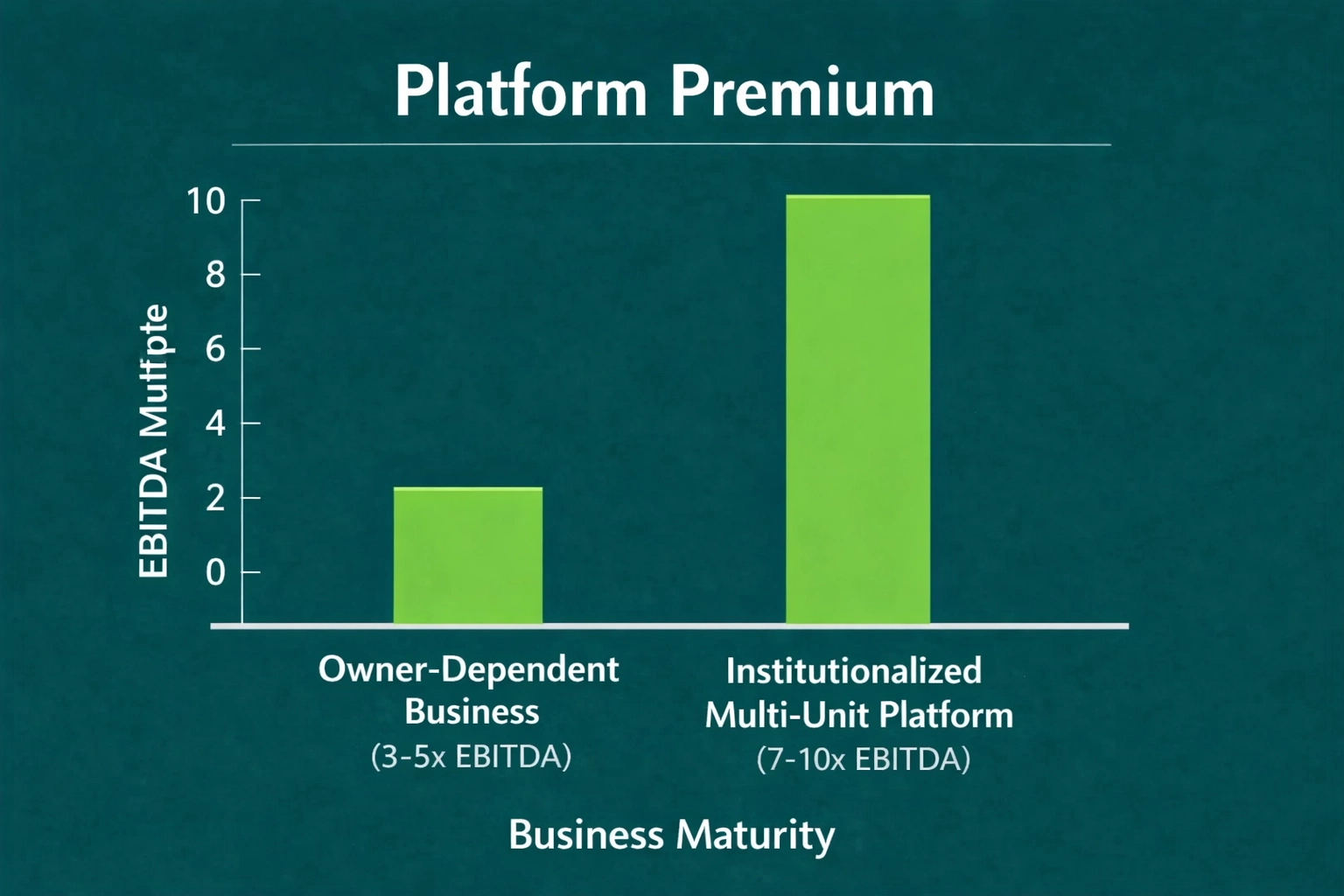
In my experience leading large teams across multi-unit environments, the gap between a 3x to 5x outcome and a 7x to 10x outcome is usually not growth. It is operating discipline. Owner-dependent businesses trade like risk assets. Institutionalized platforms trade like scalable infrastructure.
I have seen owners lose millions because they expanded faster than they standardized. When fragmented reporting, uneven unit performance, and founder dependence show up in diligence, the buyer does not see scale. The buyer sees execution risk.
Understanding the Landscape of Multi-Unit Valuation
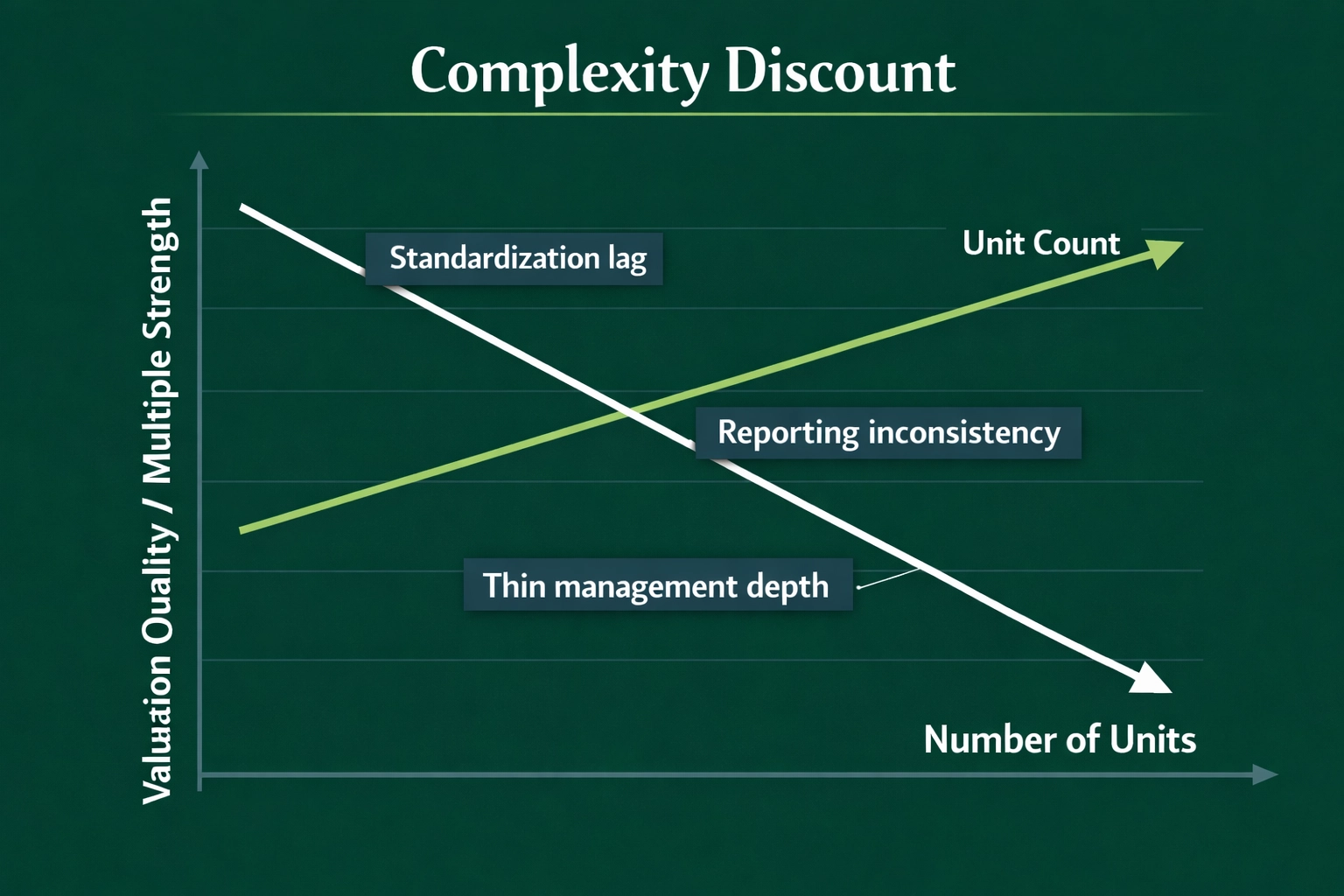
In the current M&A environment, buyers underwrite durability first and growth second. Therefore, a business with ten locations is not automatically worth more than a business with five. If the earnings are inconsistent, the management layer is thin, and the founder still carries the operation, scale becomes a complexity discount instead of a platform premium.
In my experience managing multi-unit operations, operational drift destroys value quietly. Standards weaken across locations. Reporting becomes uneven. Local workarounds replace system discipline. As a result, the buyer starts viewing the deal as a collection of separate execution problems instead of one integrated platform.
Professional investors and private equity groups buy platforms, not scattered assets. A platform supports growth without requiring more founder time. In addition, it converts capital into expansion because the model is already controlled. If growth still depends on the owner solving exceptions every day, enterprise value stays capped.
Premium multiples go to businesses with institutional maturity. That means documented processes, accountable field leadership, consistent unit economics, and reporting that stands up under diligence. Every layer of management depth removes perceived risk. Every system that works without the founder expands transferability.
What It Is & Why It Matters?
I call this the Platform Trap: owners add locations, grow revenue, and assume valuation will follow. However, expansion without operating control usually does the opposite. It increases risk faster than it increases value.
Inconsistent unit economics, uneven labor models, and fragmented field management tell a buyer the business is not truly integrated. Therefore, the acquisition starts to look like a bundle of separate fixes rather than one scalable company. When SOPs vary by location, diligence gets harder and buyer confidence drops fast.
That is where the complexity discount shows up. Instead of earning a platform premium, the seller gets marked down for execution risk, margin instability, and weak transferability. I have seen this end in reduced price, heavy earn-outs, or stalled processes that never recover.
Owner dependence is even more punitive in a multi-unit business. If you are still the escalation point for staffing, vendor issues, pricing decisions, and local performance problems across multiple geographies, you are not selling a platform. You are selling a founder-centered operation with a ceiling on value.
The Role of Revenue Stability and Predictability
In every deal, buyers start with one core question: how dependable is the revenue after closing. I have seen strong operators get penalized because too much of the top line depended on local relationships, promotional bursts, or founder-driven selling that did not look durable under diligence.
In a multi-unit business, predictable revenue comes from repeatable demand, not optimism. Subscription structures, contracted revenue, membership models, and high-frequency repeat behavior all increase confidence because they make future cash flows easier to underwrite. Therefore, the buyer is not just paying for current performance. The buyer is paying for earnings that are likely to hold.
Differentiation matters just as much. If each location is competing on convenience alone, revenue gets treated like a commodity and margins stay exposed. In my experience, the businesses that earn stronger multiples have a clear position in the market and a customer reason to return that does not depend on constant owner involvement.
Customer concentration also changes the valuation conversation fast. Consumer-facing systems usually benefit from natural diversification. However, service and industrial models can still carry outsized exposure to a small number of accounts. When too much revenue sits with one contract or one relationship, buyers underwrite fragility and lower the multiple.
The goal is to make revenue institutional, transferable, and visible in the data. When the brand drives demand, when the model produces repeat business across locations, and when no single customer or founder relationship can disrupt the cash flow, valuation expands for the right reason: risk comes down.
Driving Multi-Unit Valuation Expansion
Valuation is an assessment of risk-adjusted cash flows. To achieve a significant business valuation lift, the owner must transition from operator to CEO. A multi-unit business earns platform treatment only when additional units can be added without degrading margins, controls, or reporting quality.
When selling a multi-unit business, multiples expand only when EBITDA is predictable and transferable. EBITDA growth by itself is not enough. I have seen businesses improve headline earnings and still get discounted because the earnings quality could not survive diligence.
The core mantra is simple: increasing enterprise value BEFORE a transaction, not during one. The 12 to 72 months before exit is the critical window where pricing power, margin discipline, reporting quality, and management depth can materially lift valuation. Once a business is in market, the buyer underwrites the business as it exists, not as the owner intends to fix it.
The primary driver of the valuation multiple is transferable enterprise value. This is the value that remains after the founder exits. Therefore, businesses tied to founder relationships, founder judgment, or founder intervention trade lower because the buyer is underwriting a handoff problem.
In the current market, buyers also look for clear multiple expansion potential. They want evidence that new capital can accelerate a system that already works. If the systems are broken, capital does not create upside. It magnifies failure.
Framework: The Multi-Unit Valuation Drivers
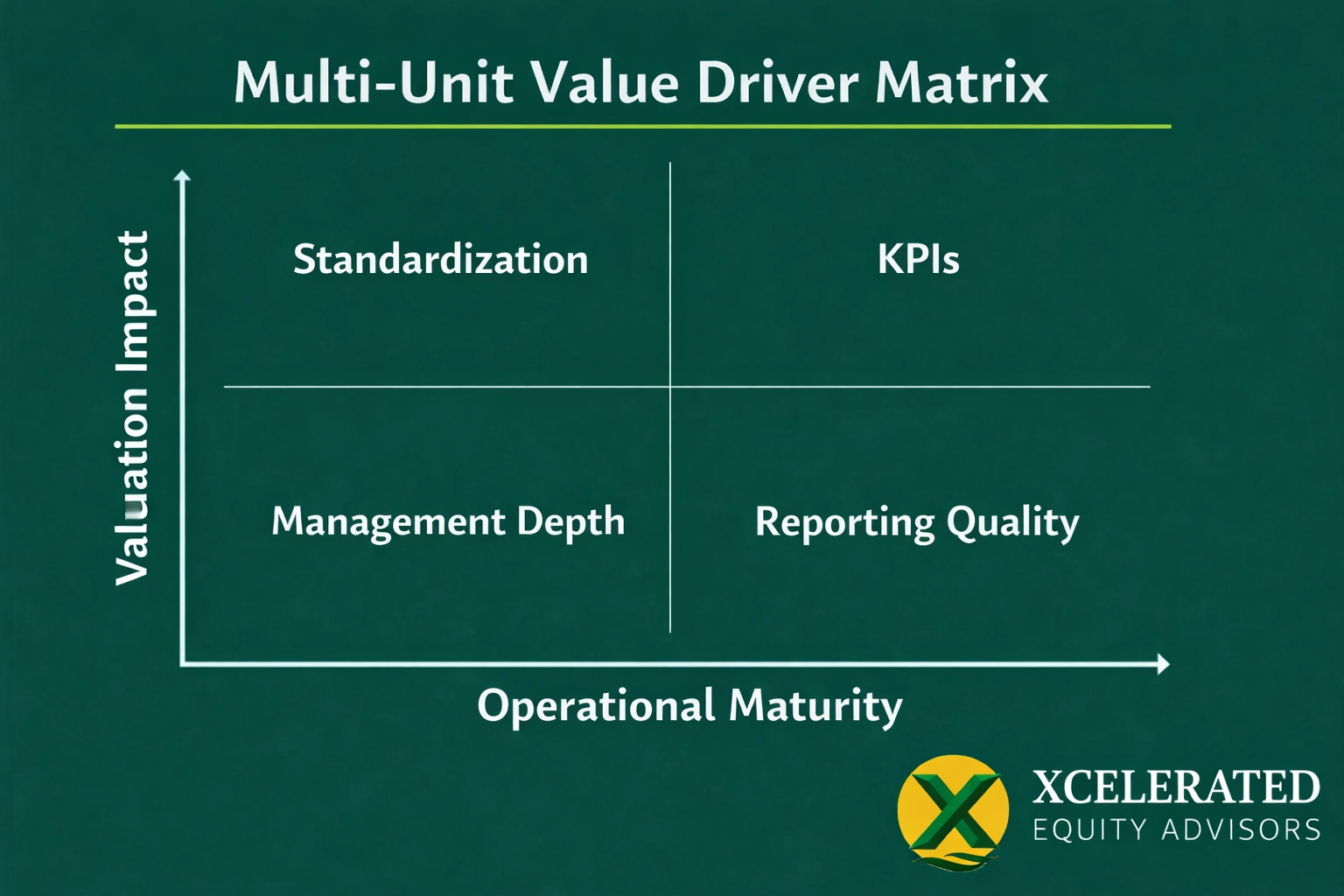
To maximize the multiple when selling a multi-unit business, owners must optimize across four specific dimensions. This matrix separates institutional platforms from average operators and prepares the company for real diligence scrutiny.
1. Operational Standardization
Every location must run on one playbook. That includes hiring, scheduling, procurement, service delivery, escalation paths, and performance management. Buyers pay more for a model that produces consistent results regardless of who is running a specific unit.
2. Unit-Level Economics & KPIs
Real-time visibility into unit performance is non-negotiable. Therefore, clean financials, standardized dashboards, and clear unit-level KPIs are required. If you cannot explain margin variance by location in minutes, the buyer will assume there are deeper control issues.
3. Management Layer Depth
A scalable business needs field leadership that operates without the founder. Regional managers, directors of operations, and accountable functional leaders prove the business can absorb growth. In my experience, management depth is one of the clearest dividing lines between 3x to 5x businesses and 7x to 10x platforms.
4. Data Integrity & Reporting
Professionalized reporting and a buyer-ready data room are not administrative upgrades. They are valuation tools. Inaccurate data, delayed closes, and inconsistent reporting invite retrades. Clean data signals control, competence, and lower execution risk.
Key Takeaways
- More units do not create a premium multiple. More control does.
- Owner dependence pushes multi-unit businesses into the 3x to 5x range.
- Institutionalized platforms with clean reporting and management depth can command 7x to 10x.
- Revenue growth without standardization creates a complexity discount.
- Transferable EBITDA is what buyers pay for.
Application: The Path to Premium Valuation
Preparation for selling a multi-unit business should begin well before the company goes to market. In my experience, owners create the biggest valuation gains when they address risk early enough for the improvements to show up in the numbers, in the management structure, and in the operating rhythm of the business.
Waiting until you are ready to exit to repair weak controls or founder dependence is where value gets lost. By that point, the buyer is evaluating what is proven, not what is planned. As a result, unfinished work gets discounted and operational promises carry little weight.
The following actions directly increase valuation multiples:
- Conduct an ExitMap Assessment: Identify where buyer risk is embedded in the business today. This creates a practical baseline for valuation work and clarifies which issues will compress your multiple if left unresolved. Start with the assessment here: https://xeadvisors.com/exit-assessment/ This will identify where value is lost before a transaction.
- Execute Value Growth Sprints: Focus on pricing power and margin optimization. To increase EBITDA before selling a business, you must look for incremental gains in COGS and labor efficiency. A 15–30% EBITDA lift prior to a sale can significantly impact the final purchase price.
- Formalize the Succession Plan: Implement incentives and systems that reduce founder reliance. This includes an organizational chart that clearly defines roles and accountability beyond the owner. If the business can run for 90 days without your input, your multiple just increased.
- Synchronize Advisors: Engage a business exit strategy consultant early to coordinate with tax, legal, and wealth advisors. This ensures that the business is not just ready to sell, but that the owner is personally and financially prepared for the transition.
ExitMap Assessment
Most owners do not see the valuation gaps in their business until a buyer exposes them in diligence. That is when negotiating leverage starts to erode.
The ExitMap Assessment provides:
- Clarity on your current exit readiness
- Identification of valuation gaps
- A structured plan to increase enterprise value
Start with the assessment here: https://xeadvisors.com/exit-assessment/ This will identify where value is lost before a transaction.