


Most owners have a number in their head – what they believe the business is worth, what they expect to walk away with, what they have been building toward. However, the gap between that number and what a buyer will actually pay is rarely explained by market conditions or bad timing. It is almost always explained by hidden constraints: structural limitations inside the business that cap enterprise value regardless of how much revenue is being generated.
Hidden constraints are invisible from inside the operation. They do not show up on a P&L as a line item. Instead, they surface during diligence, when a buyer’s team starts asking questions the seller cannot answer cleanly – and then they show up in the offer price.
I have been through exits where the constraints were obvious in retrospect and invisible during operations. In every case, the owners who closed the gap between their number and the buyer’s number were the ones who identified the constraints early and addressed them while there was still time to affect the outcome.
The Ceiling Is Not Random
Every business has a natural enterprise value ceiling determined by its current infrastructure, not its current revenue. That ceiling rises when systems improve, management depth increases, and founder dependency decreases. It stays fixed – or compresses – when growth is added to a foundation that cannot support it.
The ceiling manifests differently at different revenue stages, and the patterns are predictable.
At $10M, the constraint is almost always founder-led sales. The business has grown because the founder is a credible, effective closer with deep customer relationships. The problem is that none of that is transferable. A buyer cannot acquire the founder’s relationships. They can only acquire the system that generates and manages those relationships. If no such system exists, the buyer is underwriting a customer base that may not survive the transition – and they will price that risk directly into the offer.
At $30M, the constraint shifts to infrastructure and go-to-market alignment. The systems that ran the business at $10M are no longer adequate. Reporting is manual or inconsistent. Middle management exists on the org chart but is not truly accountable. Sales, operations, and finance are not integrated. The business is larger but more fragile, and sophisticated buyers see it immediately. This is the stage where complexity has outpaced control, and the result is margin compression that the owner often attributes to market conditions rather than internal dysfunction.
At $100M and above, the constraint is typically market position and channel saturation. Internal systems are usually sufficient at this scale, but growth has slowed because the business has extracted most of the value from its current geography, customer segment, or go-to-market approach. The ceiling here requires a different kind of strategic investment – new markets, new offerings, or new channels – rather than operational improvement.
Understanding which ceiling applies to your business right now determines which actions will actually move the number.
The Signals Most Owners Misread
Margins compressing as revenue grows is the clearest signal. If EBITDA margin is flat or declining while revenue is increasing, the business is scaling inefficiently. Each incremental dollar of revenue is costing more to produce than the last one. That is not a sales problem. It is a systems and cost structure problem – and a buyer’s quality of earnings review will find it.
The A-player problem is subtler but equally diagnostic. When your best employees execute well but average performers consistently struggle, the problem is not the average performers. It is the system they are working inside. A high-value business produces consistent results with standard talent because the process carries the load, not the individual. When exceptional people are the only ones producing acceptable outcomes, the business is dependent on heroics rather than infrastructure – and heroics do not transfer.
Founder involvement creeping up, not down is the most common signal I see in businesses approaching exit. As complexity increases, the founder gets pulled back into operational decisions that should be handled at the field level. If the owner is more involved in daily operations today than they were two years ago despite the business being larger, the management layer is not actually functioning. That is a direct valuation discount.
Customer economics deteriorating quietly is the financial version of the same problem. When the cost to acquire and serve customers is rising while average revenue per customer is flat or declining, the unit economics are signaling a ceiling. This does not always show up clearly in aggregate financials – it hides in segment-level data that most owners are not tracking. A buyer’s diligence team will build that analysis from scratch, and they will find what the owner did not.
What Buyers Actually See
A sophisticated buyer evaluating a business for acquisition is running one core analysis: what happens to these earnings if the founder leaves? Every constraint they identify is a risk adjustment to that question, and every risk adjustment compresses the multiple.
A business where the founder is central to sales, key customer relationships, and operational decision-making trades at a significant discount to a business where those functions are systemized. The earnings may be identical. The transferability is not – and buyers pay for transferability, not just earnings volume.
Consider two businesses, both generating $2M in EBITDA. The first is founder-dependent, with inconsistent margins, manual reporting, and a customer base concentrated in two relationships. A buyer might offer 3.5x – a $7M enterprise value – and structure the deal with a heavy earnout to protect against transition risk. The second has a functioning management team, clean financials, diversified revenue, and documented processes. The same $2M in EBITDA at a 5.5x multiple produces an $11M enterprise value with a clean structure and no earnout. The $4M difference is entirely explained by hidden constraints in the first business that were never addressed.
Removing the Ceiling Before Going to Market
Hidden constraints cannot be removed during a transaction. Once a deal process is live, buyers underwrite the business as it exists. Improvements in progress do not receive full valuation credit. Intentions to fix known problems are treated as additional risk, not as value. Increasing enterprise value before a transaction is the only sequence that produces a premium outcome.
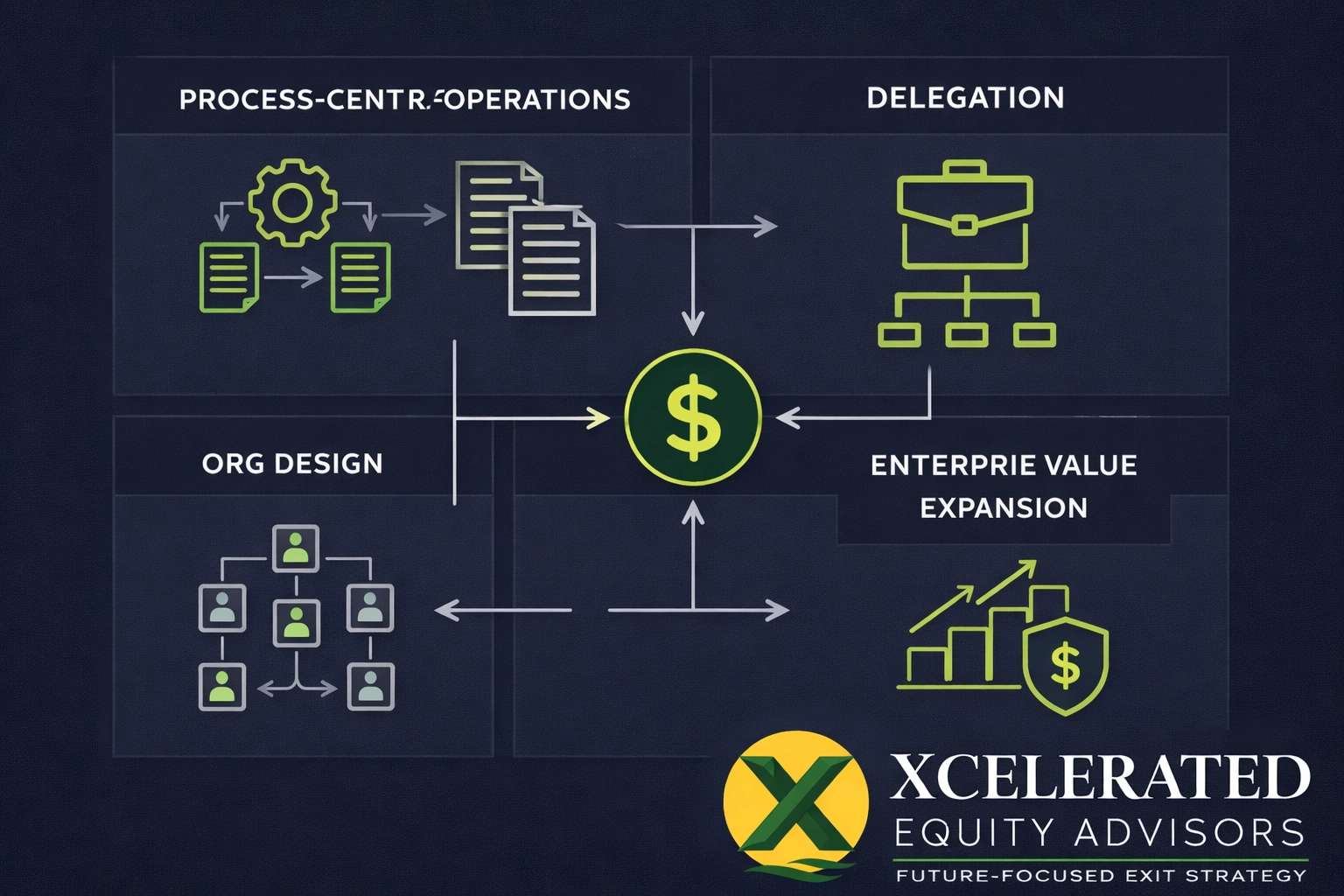
The practical priority order depends on which ceiling applies. For founder-dependency constraints, the work is building a management layer that functions without the founder and documenting the sales and delivery processes that currently exist only in the founder’s judgment. For infrastructure constraints at the $30M level, the work is systems integration, reporting standardization, and financial clean-up. For market position constraints, the work is strategic planning around new growth vectors that can be underwritten as a credible forward narrative.
In all cases, the work takes time to produce results that show up in financial statements. That is why the 12 to 72 month pre-transaction window is the only period where this work creates measurable valuation lift.
Owners do not create premium outcomes by waiting for the deal process to fix weak systems. They create premium outcomes by increasing enterprise value before a transaction while operational improvements still convert into higher EBITDA quality, lower diligence risk, and stronger buyer conviction.
Start with the assessment here: https://xeadvisors.com/exit-assessment/ This will identify where value is lost before a transaction.