
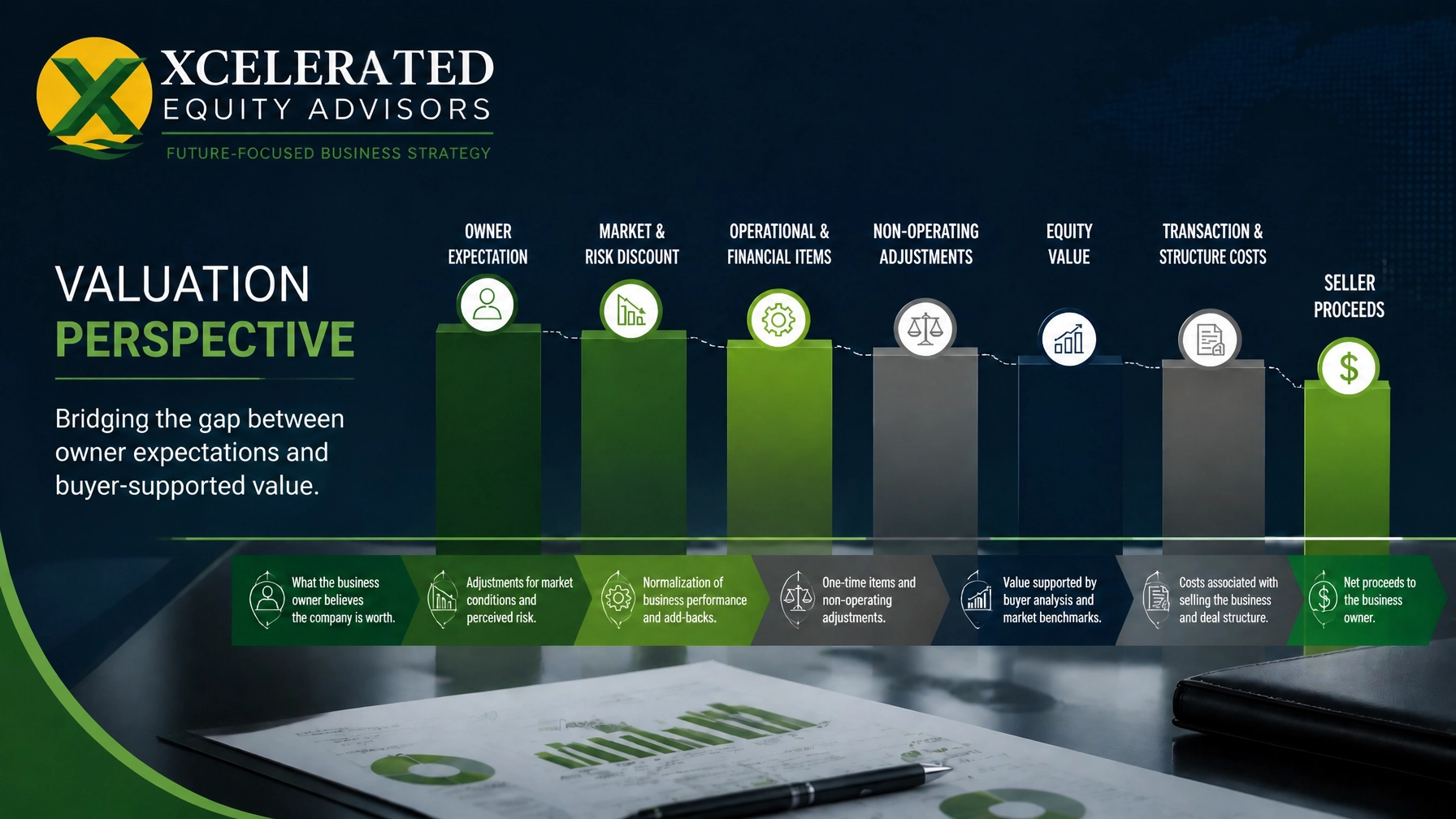

Owners often enter a transaction discussion with a value anchored to reported EBITDA, recent growth, or a comparable sale. That opening view may match internal planning, but it often does not match what a buyer can support through diligence. The gap usually comes from differences in definitions, evidence, replacement cost, working capital, debt treatment, and the timing and certainty of payment.
How buyer-supported enterprise value becomes equity value and seller proceeds
Keep four numbers separate from the start.
- Owner expectation
- Buyer-supported enterprise value
- Equity value after debt and closing adjustments
- Expected seller proceeds by timing and certainty
Do not negotiate from a headline number until each step of that bridge is clearly defined and supported by evidence.
Start with the earnings number a buyer can support
Buyers begin with earnings they believe will continue after closing. Reported EBITDA is only the starting point. The first adjustment is often a dispute over what belongs in the earnings base and what does not.
Supported add-backs can survive quality-of-earnings diligence when the accounting records and underlying facts support them. A one-time legal expense tied to a resolved matter may be accepted when the general ledger, invoice, settlement record, and management explanation support the adjustment.
Unsupported add-backs usually do not survive diligence. Recurring travel, family payroll, vehicle costs, or consulting fees described as discretionary may remain in the normalized expense base if the seller cannot demonstrate that they will disappear after closing.
Replacement cost matters for the same reason. If the owner performs sales, operating, financial, or executive functions, a buyer will assign a market cost to replace that work. Removing owner compensation without restoring replacement cost inflates EBITDA and overstates value.
The accounting treatment may be straightforward. The buyer-supported earnings number is still a diligence conclusion based on continuity and evidence.
Distinguish enterprise value from equity value and seller proceeds
Enterprise value is the buyer’s value for the operating business. It is not the owner’s proceeds. Equity value is what remains after funded debt, accepted debt-like items, and working-capital adjustments are resolved. Seller proceeds may differ again because a portion of equity value may be deferred, contingent, or subject to post-closing claims.

A working-capital peg is one common source of separation between enterprise value and equity value. The buyer expects a normal level of receivables, inventory, prepaid expenses, and operating payables at closing. If the business is delivered below that level, the purchase price may adjust downward because the buyer must fund the shortfall after closing.
Multi-unit businesses face additional net working-capital traps when inventory, receivables, payables, and operating practices vary across locations.
Debt-like items create the same effect. Accrued payroll, unpaid taxes, deferred maintenance, unusual vendor balances, customer deposits, or similar obligations can reduce equity value when the buyer must satisfy them after closing.
Deferred revenue creates a related working-capital and debt-like classification issue when the seller has collected cash but the buyer inherits the remaining service obligation.
The net debt and balance-sheet definitions that affect final proceeds should be resolved before the owner treats a price expectation as actionable.
Use one reconciliation and label the definitions clearly
A controlled value reconciliation should move through four distinct numbers.
1. Owner expectation
This is the number the owner has in mind before the buyer tests the earnings base and closing adjustments. It may reflect reported EBITDA, internal adjustments, a prior conversation, or a comparable sale.
2. Buyer-supported enterprise value
This is the value the buyer can support after reviewing accepted EBITDA adjustments and applying its valuation framework to the operating business.
3. Equity value after debt and closing adjustments
This is enterprise value reduced by funded debt, accepted debt-like items, and working-capital adjustments required at closing.
4. Expected seller proceeds by timing and certainty
This separates what the seller may receive at closing from what may be held in escrow, paid later, or earned only if future conditions are met.
Illustrative numerical example
The following example is illustrative only. Do not treat the assumptions below as market benchmarks.
- Owner-adjusted EBITDA: $2.0 million
- Less replacement-cost or unsupported adjustment issue: $300,000
- Buyer-accepted EBITDA: $1.7 million
- Illustrative multiple: 6.0x
- Buyer-supported enterprise value: $10.2 million
- Less funded debt and accepted debt-like items: $2.0 million
- Less working-capital shortfall: $500,000
- Equity value before transaction expenses and taxes: $7.7 million
That bridge already shows why owner expectation can diverge from buyer-supported value. If the owner expected 6.0x on $2.0 million of EBITDA, the opening expectation would be $12.0 million of enterprise value. The buyer-supported enterprise value in this example is $10.2 million because the buyer accepts only $1.7 million of EBITDA.
Now separate equity value from expected seller proceeds.
- Equity value before transaction expenses and taxes: $7.7 million
- Cash at close: $6.5 million
- Escrow: $700,000
- Contingent consideration: $500,000
These numbers are not interchangeable. Equity value is not the same as cash at close. Escrow is not the same as cash under the seller’s control. Contingent consideration is not certain proceeds.
Where the value reconciliation usually breaks down
The buyer-supported number changes when definitions are loose or evidence is thin. That usually appears in a small group of recurring areas.
- EBITDA adjustments that are asserted but not documented
- Owner compensation removed without a credible replacement-cost estimate
- Working-capital pegs based on a favorable period rather than normal operations
- Debt-like items identified late in the process
- Risk shifted from price into escrow or contingent consideration
For each adjustment, distinguish documented facts from assumptions and estimates.
That discipline keeps the reconciliation grounded in what the buyer can underwrite rather than what the seller hopes to preserve.
Close with a controlled value reconciliation
Build the reconciliation before setting an asking price or relying on a headline valuation summary. Define the earnings base. Test the support for each adjustment. Separate enterprise value from equity value. Isolate working-capital and debt-like items. Then separate cash at close from escrow and contingent consideration.
This article is for planning purposes only. It is not a valuation opinion and not legal, tax, or investment-banking advice.
Start with Xcelerated Equity Advisors ExitMap assessment.