
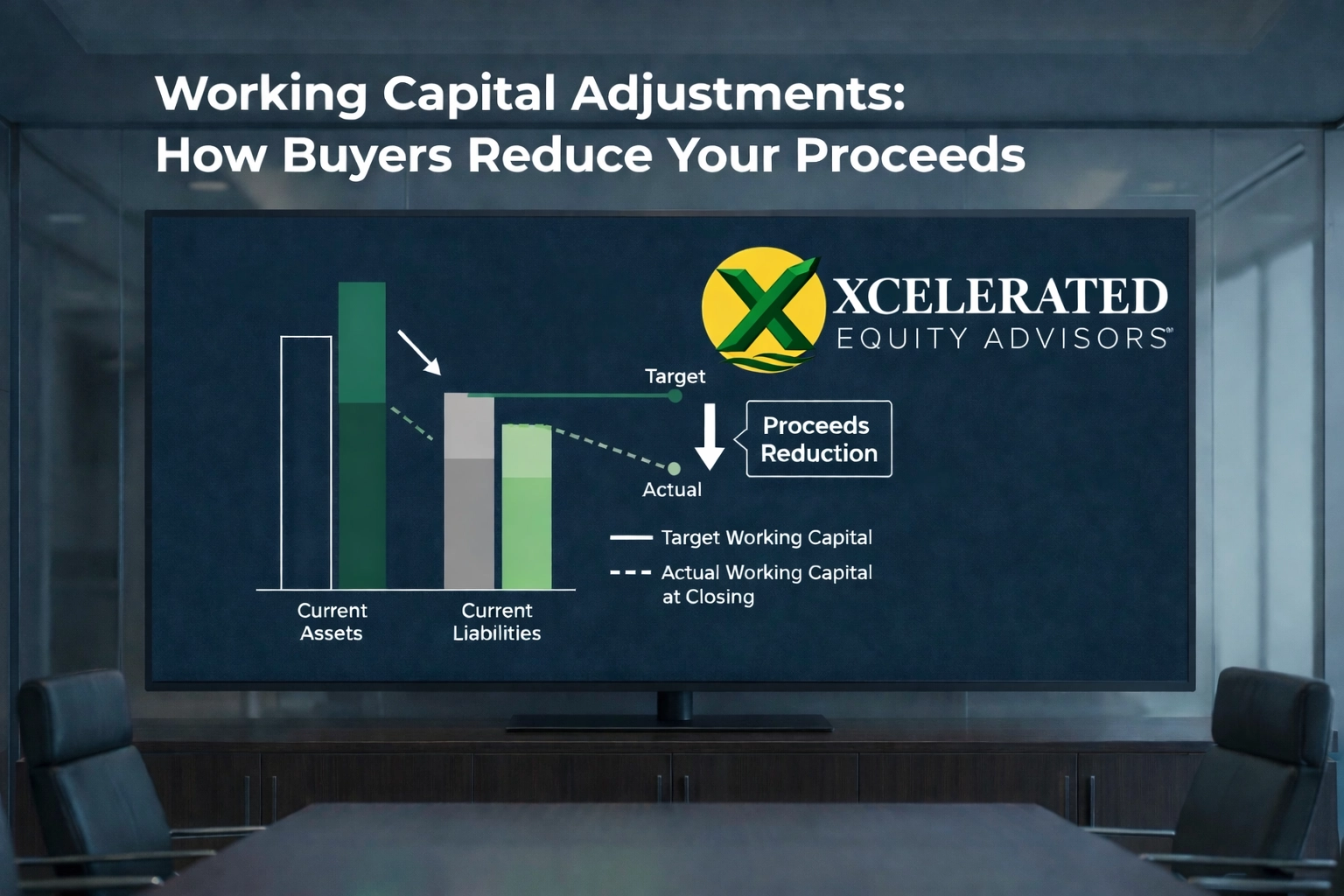

I watched a seller receive a wire transfer three months after closing that moved in the wrong direction. The buyer's auditors completed the post-close true-up and determined that the actual net working capital at closing was $450,000 below the peg. The seller wired back $350,000 from the proceeds they had already received. The original shortfall had been visible in the closing statement. They had accepted it because the deal was done, the attorneys were exhausted, and no one wanted to reopen a $15 million transaction over what looked like a rounding error. It was not a rounding error.
How Working Capital Adjustments Actually Work After the LOI
Most lower-middle-market transactions include a post-close true-up mechanism — a contractual reconciliation period, typically sixty to ninety days after closing, during which the buyer's auditors finalize the working capital calculation and compare it to the peg. If the actual net working capital falls short, the seller owes the difference. The wire has already cleared. The business has already transferred. The seller is writing a check back to the buyer.
The post-close true-up is where the peg negotiation that happened before the LOI becomes consequential. A peg that was set aggressively during the letter of intent phase does not become less aggressive after closing. It becomes enforceable.
What most sellers do not understand is that the true-up is not simply a verification of the closing statement. It is a second diligence process, conducted by the buyer's team after they have access to the full books, with the explicit purpose of identifying adjustments that reduce the seller's proceeds. The buyer controls the timing. The buyer controls the methodology. And the buyer already has the business.
How Buyers Manufacture the Gap During Diligence
The period between LOI signing and closing is where the working capital calculation is actively reshaped. Buyers use three primary mechanisms. By the time these adjustments are introduced, the seller is already in exclusivity and has limited ability to reset the terms.
The first is cut-off manipulation. Cut-off testing is a standard audit procedure that verifies transactions are recorded in the correct accounting period. In a legitimate context, it ensures the books are accurate. In a transaction context, buyers use it to shift liabilities into the pre-closing period and push assets into the post-closing period. A vendor invoice for services performed in the final month before closing that has not yet been processed becomes an accrued liability. The buyer insists on recording it. Current liabilities increase. Net working capital drops. The seller's proceeds follow.

Alt Text: A professional accounting ledger showing detailed line items for accounts receivable and accounts payable adjustments.
A $100,000 unrecorded vendor accrual identified in the final week of diligence is a $100,000 reduction in the seller's wire. Not a negotiation. Not a discussion. A mathematical result of the definition the seller accepted in the purchase agreement.
The second mechanism is inventory normalization. Buyers routinely argue that inventory levels in the trailing period were artificially low — due to supply chain constraints, demand volatility, or deliberate seller management — and that the business requires higher inventory to operate post-close. If the buyer successfully raises the working capital peg by $500,000 on this basis, the seller must either deliver $500,000 more in inventory at closing or absorb a dollar-for-dollar reduction in proceeds. The argument is made during diligence, after the LOI is signed and the seller has no competing buyers.
The third is accounts receivable exclusion. Buyers identify receivables aged beyond 90 days and remove them from the current assets calculation — classifying them as impaired regardless of collectability. At the same time, every corresponding liability remains in the calculation. A customer in restructuring with $125,000 outstanding? Excluded from assets. The vendor payable on the other side of that transaction? Fully included. This asymmetry is not an accounting standard. It is a buyer preference embedded in a definition the seller agreed to without recognizing the consequence.
The $450,000 Case Study
The mechanics of post-close erosion compound quickly. Consider a transaction with an agreed enterprise value of $15 million and a negotiated working capital peg of $2.2 million. The closing statement shows actual NWC of $2.1 million — a $100,000 shortfall that the seller accepts at close. Ninety days later, the buyer's auditors complete the true-up.
They identify $150,000 in slow-moving inventory and write it down, removing it from current assets. They find $75,000 in accrued vacation pay that was not reflected on the closing balance sheet. They disqualify $125,000 in receivables from a client undergoing restructuring.
The actual NWC is now $1.75 million. The peg is $2.2 million. The total shortfall is $450,000. The seller already absorbed the initial $100,000 at close. The additional $350,000 is a post-close wire back to the buyer — three months after the transaction completed.
Each of these adjustments was individually defensible under the definitions in the purchase agreement. None of them individually looked like a deal-breaking issue. Together, they represent a $450,000 reduction that arrived after the seller had already moved on.
The Quality of Earnings Interaction
Every seller preparing for a transaction understands that the quality of earnings report is the buyer's primary valuation tool. What most sellers do not recognize is that every add-back claimed to increase EBITDA carries a secondary balance sheet consequence.
If a seller removes a one-time expense from the P&L to strengthen the earnings multiple, the buyer will examine the corresponding liability on the balance sheet. If that liability has not been removed with equal precision, the buyer argues it represents an accrued obligation that reduces net working capital. The add-back increases the purchase price. The liability reduces the proceeds. The seller captures only part of the value they created.
This is also where accounting methodology becomes a direct financial risk. If the purchase agreement does not explicitly define the accounting basis — and most lower-middle-market agreements do not with sufficient specificity — the buyer defaults to the most conservative interpretation available. Switching from cash to accrual mid-process increases reported liabilities and reduces working capital.
That additional liability is not a surprise to the buyer's team. It is the expected outcome of leaving the methodology undefined.
Sellers who do not lock down the accounting hierarchy before signing the purchase agreement are handing the buyer an interpretive mechanism that will be used against them in the true-up.
What Sellers Must Control Before Closing
Three disciplines protect the post-close wire.
First, define every adjustable account before the LOI is signed. The working capital peg should be accompanied by a written NWC policy that lists specific general ledger accounts, valuation methodologies for inventory, receivable aging thresholds, and accrual treatment. Any account that is not explicitly defined will be defined by the buyer's auditors during the true-up — under the most conservative methodology available to them.
Second, conduct a pre-close audit of your own closing statement. Sellers who allow the buyer's team to produce the initial closing statement and then react to it are operating from a defensive position with limited leverage. Producing the closing statement independently, five to seven business days before closing, allows the seller to identify aggressive positions before they become contractual facts.
Third, treat every quality of earnings add-back as a balance sheet question. For every item normalized on the income statement, the corresponding balance sheet treatment must be resolved explicitly in the purchase agreement. An add-back that increases EBITDA but leaves an unresolved liability on the balance sheet is not a clean win. It is a deferred reduction in proceeds.
The period between LOI and closing is when buyers have exclusivity, sellers have deal fatigue, and every technical concession on a working capital definition translates directly into a smaller final check. A $200,000 adjustment on a $15 million deal does not feel like a reason to reopen the transaction. That is precisely why buyers make $200,000 adjustments.

Alt Text: A professional advisor pointing to a specific line item on a digital financial spreadsheet during a meeting.
These adjustments are not discovered at closing. They are defined during diligence. If they are not controlled early, they are enforced later.
Start with the assessment here: https://xeadvisors.com/exit-assessment/ This will identify where value is lost before a transaction.
[…] Room before a transaction starts to reduce re-trade risk and preserve negotiating leverage. Review Working Capital Adjustments to understand how buyers reduce proceeds when records are […]
[…] implement a standardized document retention policy across all business units. Second, ensure your working capital adjustments are documented and defensible. Third, build a "shadow" data room today that you update […]