


There is a specific moment most founders recognize immediately when I describe it. Revenue has been growing for several years. The team is larger. The customer base is broader. But margins are thinner than they were when the business was half this size, the founder is more involved in daily operations than ever, and the growth that used to feel like momentum now feels like weight.
That is the scalability gap. It is not a revenue problem. It is an infrastructure problem that revenue growth exposed.
I have seen this pattern consistently in multi-unit businesses that expanded faster than they systemized. The business outgrows the processes that built it, but leadership has not yet replaced those processes with something that can carry more load. The result is a company that is larger, more complex, and paradoxically less valuable than a smaller version of itself would have been.
For any owner moving toward an exit, the scalability gap is the single most important problem to solve and the most dangerous one to leave undiagnosed.
What the Scalability Gap Actually Is
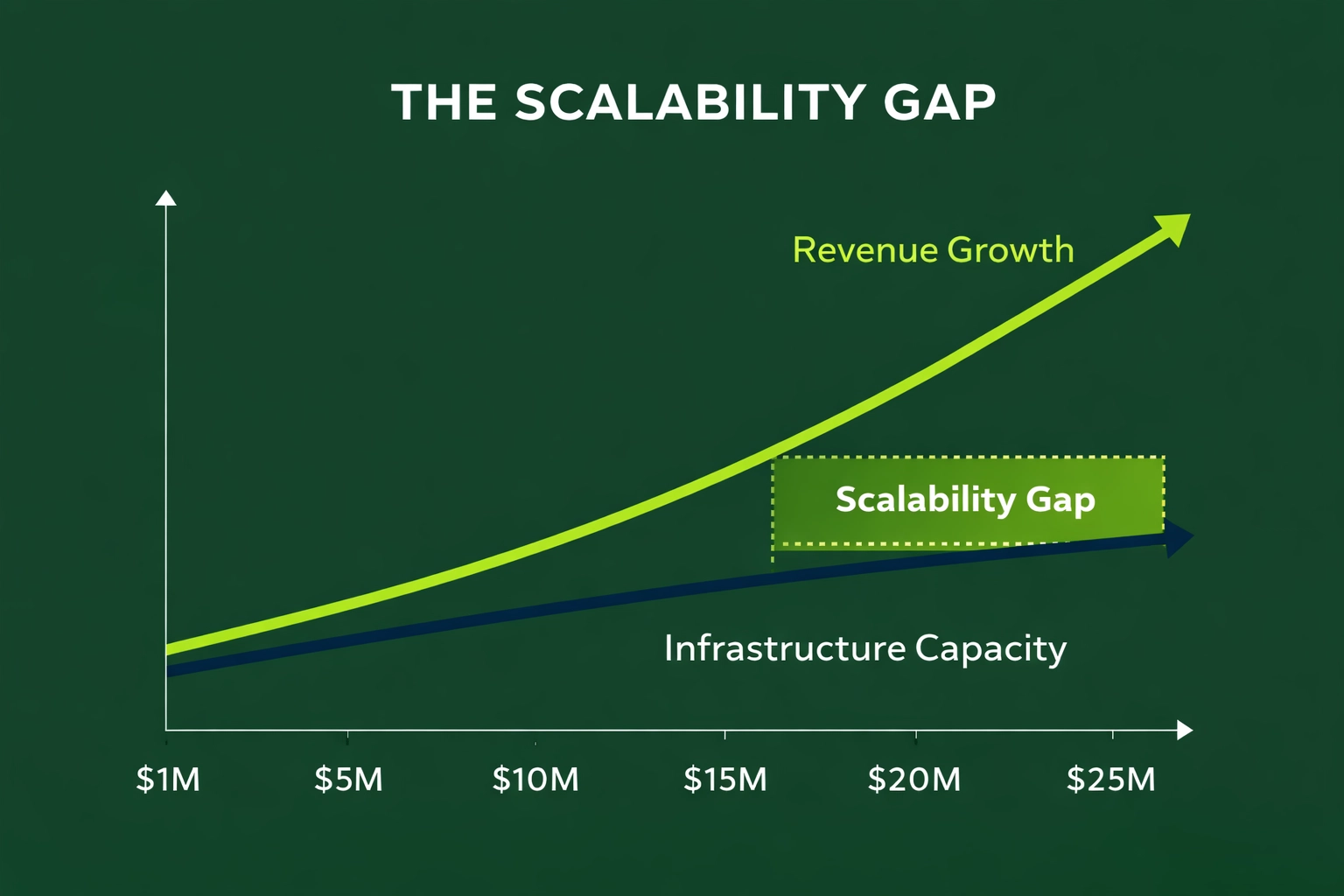
The scalability gap is the distance between a company’s current operational capacity and the load it is being asked to carry. It opens when revenue growth outpaces infrastructure, and it widens every month the underlying systems are not rebuilt to match the business’s current size.
Most businesses hit a structural fracture point somewhere between $5M and $25M in revenue. The systems that worked at $3M informal communication, manual reporting, founder-led decisions on almost everything cannot process the volume and complexity of a $15M business. As a result, the founder absorbs the overflow. They become the integration layer between departments that do not have clean handoffs. They resolve problems that documented processes would have prevented. They are not growing the business anymore. They are holding it together.
This is what I call heroic management, and it is a valuation killer. A business that depends on the founder’s daily heroics to maintain performance is not a platform. It is a person-dependent operation with a ceiling on transferable value. Every buyer, whether strategic or PE, sees it immediately and prices it accordingly.
Why Revenue Growth Makes It Worse, Not Better
The counterintuitive reality of the scalability gap is that undisciplined revenue growth accelerates it. Each new customer added to an infrastructure that cannot support current volume increases the cost of service delivery. Margins compress. Error rates rise. Key employees burn out. The founder gets pulled further into operations to compensate.
The financial signal is a P&L where revenue is climbing but EBITDA margin is flat or declining. That pattern tells a sophisticated buyer one thing: this business is scaling inefficiently, and the earnings quality will deteriorate further under new ownership unless the infrastructure is rebuilt. That risk perception compresses the multiple directly. This is why we focus on The EBITDA Lift as a core pillar of value growth.
A business generating $2M in EBITDA on $15M in revenue with thin, inconsistent margins and heavy founder involvement might trade at 3.5x, or an enterprise value of $7M. The same earnings base with documented systems, accountable field leadership, and clean financial reporting can trade at 5.5x or higher, or an enterprise value of $11M or more. The EBITDA did not change. The risk profile did. That $4M difference is the cost of the scalability gap.
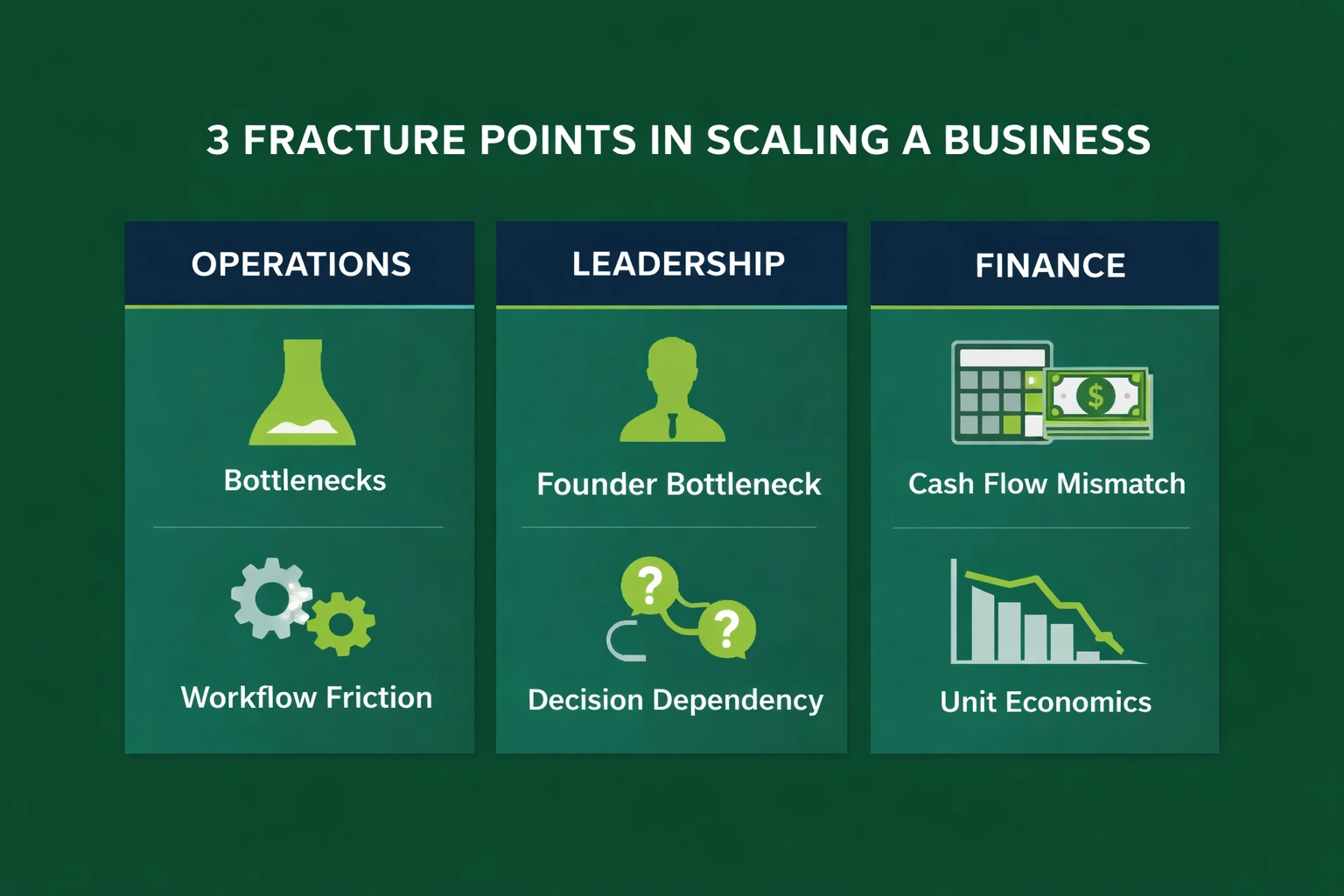
The Three Places the Gap Opens
Operations. Legacy processes built for a smaller business become bottlenecks at scale. Spreadsheet-based reporting, manual approval chains, and undocumented workflows create execution risk and data latency that buyers flag immediately during diligence. When a buyer asks for a unit-level performance dashboard and the seller spends two weeks assembling one manually from disconnected sources, the narrative around operational control is already damaged.
Leadership. The founder-as-bottleneck problem compounds with every hire that is added without a corresponding decision-making framework. Without documented SOPs and clear accountability structures, middle managers cannot make independent decisions. Everything escalates. The founder’s time becomes the scarce resource constraining every function of the business simultaneously. Delegating authority without a framework produces chaos. The solution is not to delegate less. It is to build the structure that makes delegation safe.
Finance. Rapid expansion typically creates a cash flow mismatch where hiring, inventory, and infrastructure costs surge before the associated revenue is collected. Without rigorous unit economics, specifically a clear understanding of the cost to acquire and serve each customer relative to their lifetime value, businesses can grow themselves into a liquidity crisis. This requires disciplined Capital Allocation for Value to ensure growth is margin-accretive.
Closing the Gap Before Going to Market
The scalability gap cannot be closed during a transaction. Once a process is live, buyers underwrite the business as it currently exists. They do not give credit for improvements in progress or intentions to fix known problems. This is why increasing enterprise value before a transaction, not during one, produces real results.
The sequence matters. At 48 to 72 months, the priority is growth with discipline: expanding revenue while building the infrastructure to carry it. At 24 to 36 months, the focus shifts to systemization: documented SOPs, management depth, integrated reporting, and clean financials that hold up under QoE scrutiny. At 12 months, the work is stabilization and diligence readiness. Major initiatives launched in the final twelve months rarely receive full valuation credit because buyers want to see proven, sustained performance, not a project that just finished.
The practical starting point is an honest gap assessment. Which decisions still require the founder? Where does reporting break down under pressure? Which customers are consuming margin rather than producing it? These are the questions a buyer will ask. Answering them proactively, and fixing what they reveal, is the work that separates a premium exit from a discounted one.
What a Scalable Business Looks Like to a Buyer
A buyer evaluating a business for a platform acquisition is looking for evidence of one thing: can this business perform without its current owner? The signals they look for are specific.
Clean, system-generated financial reporting with at least two years of consistent data. A management team with defined roles, documented accountability, and demonstrated ability to operate through the founder. Standardized delivery processes that produce consistent results regardless of who is running a given unit or account. Customer revenue that is distributed across a diversified base with no single relationship representing more than 10–15% of total sales. EBITDA margins that have held or improved as the business grew. Evidence that scale is producing efficiency rather than consuming it.
When those signals are present, the business is not just sellable. It is competitive. It creates tension between buyer types, produces stronger offers, and gives the seller leverage to hold terms rather than accepting whatever the first serious buyer proposes.
When they are absent, the seller negotiates from weakness, and the scalability gap becomes visible in the final price.
Application
If your growth has started to feel like it is working against you rather than for you, the scalability gap is likely the reason. The ExitMap Assessment identifies specifically where the gap exists in your business, which operational, leadership, and financial risks a buyer will find during diligence, and how to close them before the process begins.
Start with the assessment here: https://xeadvisors.com/exit-assessment/ This will identify where value is lost before a transaction.
[…] the next game centers on Succession & Independence. In the 12-72 month window before a buyer is involved, the priority is converting owner-dependent […]