


I’ve seen owners spend $500k on a new fleet of trucks only to have the buyer value them at book value during diligence. That same $500k spent on a professionalized management layer or a proprietary ERP system could have pushed the multiple from a 4x to a 5x, creating $2M in paper wealth overnight.
Strategic capital allocation dictates terminal value. Most business owners evaluate capital expenditures through the narrow lens of tax mitigation or immediate operating need. However, that lens ignores how buyers actually price a company. The 12 to 72 months preceding an exit is the critical window where every dollar should be deployed to either expand the top line or de-risk the bottom line.
A buyer is not underwriting what the owner believes the business is worth. Instead, the buyer is underwriting future cash flow and the probability that cash flow survives a change of control. Capital allocated toward growth expands the earnings base. Capital allocated toward efficiency increases the reliability and transferability of those earnings. Therefore, increasing enterprise value BEFORE a transaction requires a disciplined balance between those two uses of capital.
The hierarchy of investment changes as the exit horizon narrows. Early in the timeline, growth capital has enough runway to produce measurable historical performance. As a result, the later stage should focus on institutionalizing the company and reducing execution risk. At that point, a dollar spent on a robust ERP system or a management layer can create more enterprise value than a dollar spent on additional equipment.
The Multiplier Effect of Efficiency
Efficiency is not a cost program. It is a portability program. Buyers pay premium multiples when they believe earnings will transfer cleanly after the founder steps back. However, if those earnings sit inside owner judgment, informal workflows, or undocumented approvals, the buyer discounts the multiple because the earnings are not portable.
Portability is created through systemization. Professionalized management layers, integrated ERP environments, documented SOPs, and KPI-driven reporting convert founder-dependent performance into enterprise-owned performance. As a result, the buyer sees less transition risk, less execution fragility, and more confidence in the forward cash flow stream.
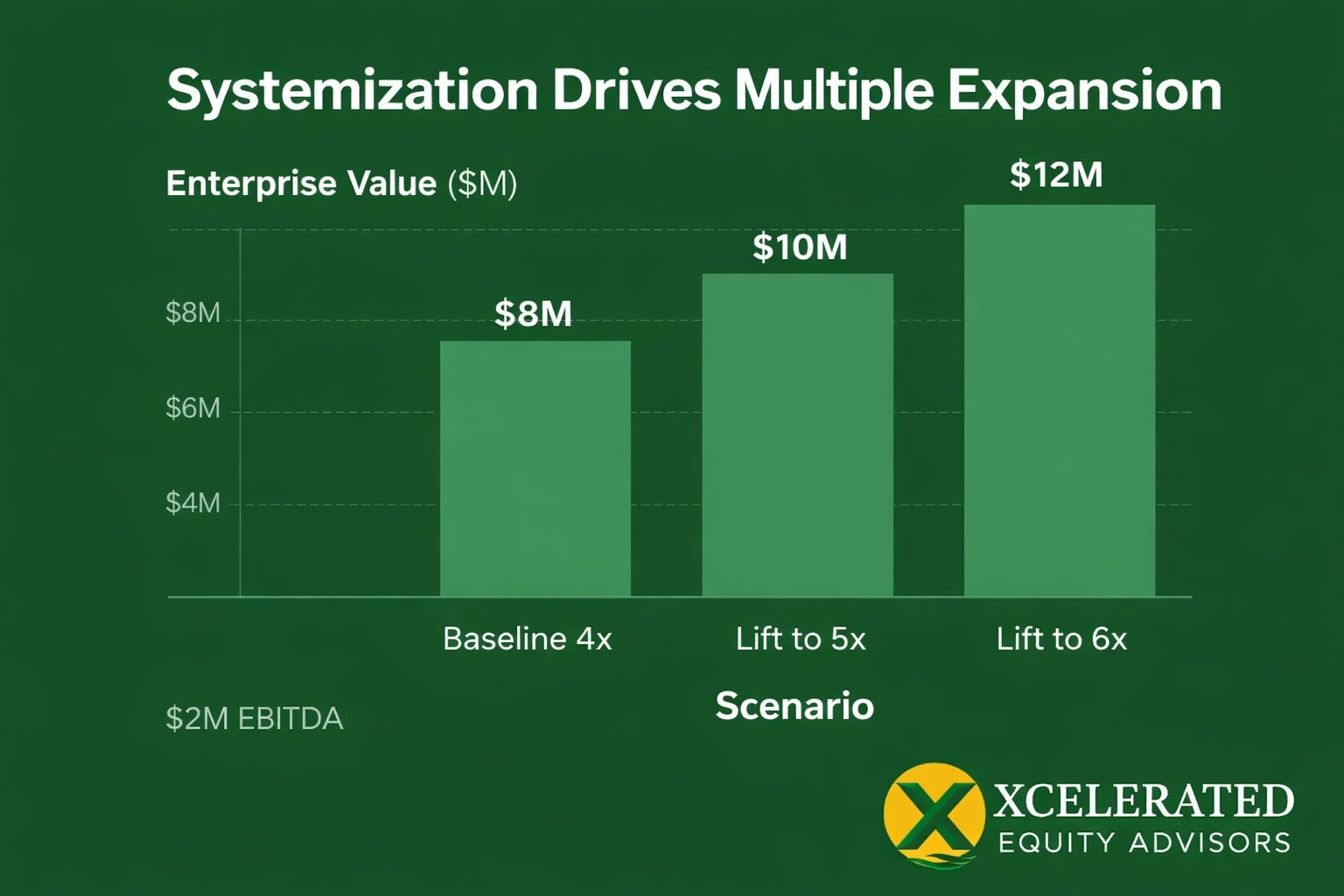
The math is straightforward. At $2M of EBITDA and a 4x multiple, enterprise value is $8M. Move that same earnings stream to a 5x multiple through stronger systems and management depth, and value increases to $10M. Push it to 6x with real portability, and value reaches $12M. In other words, the same earnings base can produce a materially different outcome when the company is built to transfer. For a deeper look at what actually moves the multiple in a multi-unit business, see our recent blog post <BLOG_POST:496f5454-4be8-4408-a4fd-be7ae05df0ca>.
By contrast, a growth-only strategy often requires more spend, more complexity, and more execution risk to produce the same valuation gain. Therefore, efficiency capital frequently generates the cleaner path to enterprise value because it improves how buyers underwrite the quality of the earnings rather than only the size of them.
Growth Capital: Strategic vs. Tactical
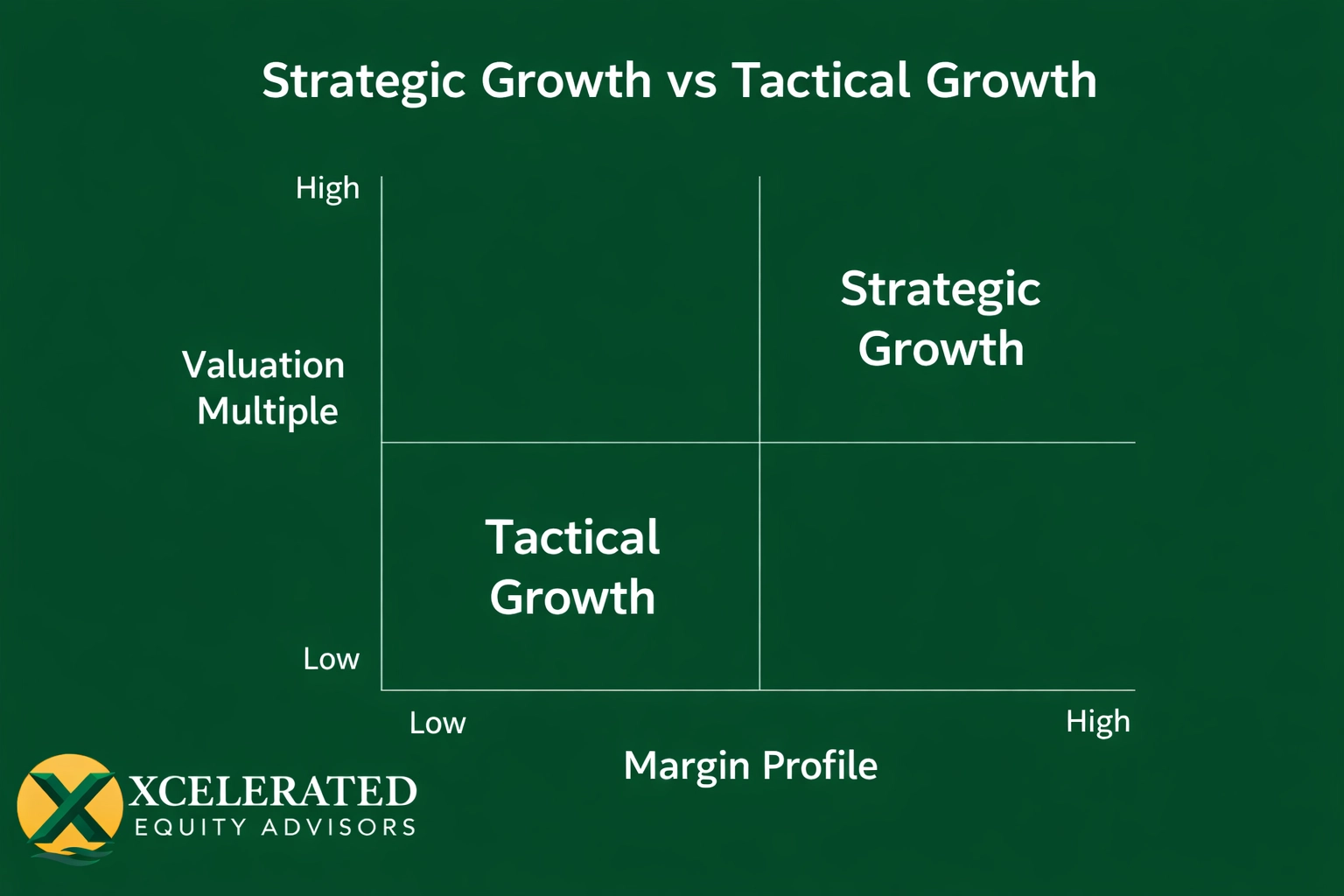
Growth capital should be divided into two categories: buying demand and building a moat. Tactical growth buys demand. It usually shows up as more trucks, more media spend, more sales labor, or more inventory to support current volume. Strategic growth builds a moat. It improves pricing power, strengthens customer retention, expands into higher-margin offerings, or creates a capability competitors cannot easily replicate.
Buyers do not reward all revenue equally. They reward revenue that is durable, scalable, and margin-accretive. Therefore, capital that expands gross margin and sharpens market position usually drives a stronger multiple than capital that simply helps the business keep up with current demand. Tactical growth can preserve revenue. Strategic growth can change how the market values the company.
In the pre-exit period, growth investments should be screened through a buyer lens. If the investment improves the margin profile and strengthens the company’s strategic position, it is likely strategic. If it only supports volume without improving economic quality, it is likely tactical. As a result, owners should prioritize capital that upgrades the quality of revenue rather than just the quantity. This distinction also matters when positioning the company for different buyer types, which we address in our recent blog post <BLOG_POST:0e7d7476-6012-4c97-8298-e65c4e74c8f6>.
The 12-72 Month Value Trajectory
The allocation strategy should change with the exit horizon because buyers pay for proven results and visible risk reduction. At 72 months, the priority is growth. Capital should support market expansion, product development, and capability build-out that can produce a credible growth record over time. This is the stage where owners establish the future narrative buyers will eventually underwrite.
By 36 months, the emphasis should shift toward systemization. This is the period to build middle management, integrate technology, standardize reporting, and remove founder dependence from daily operations. Buyers want evidence that the business can execute through a team, not through one person. In addition, they want clean, system-generated financials that stand up under QoE scrutiny.
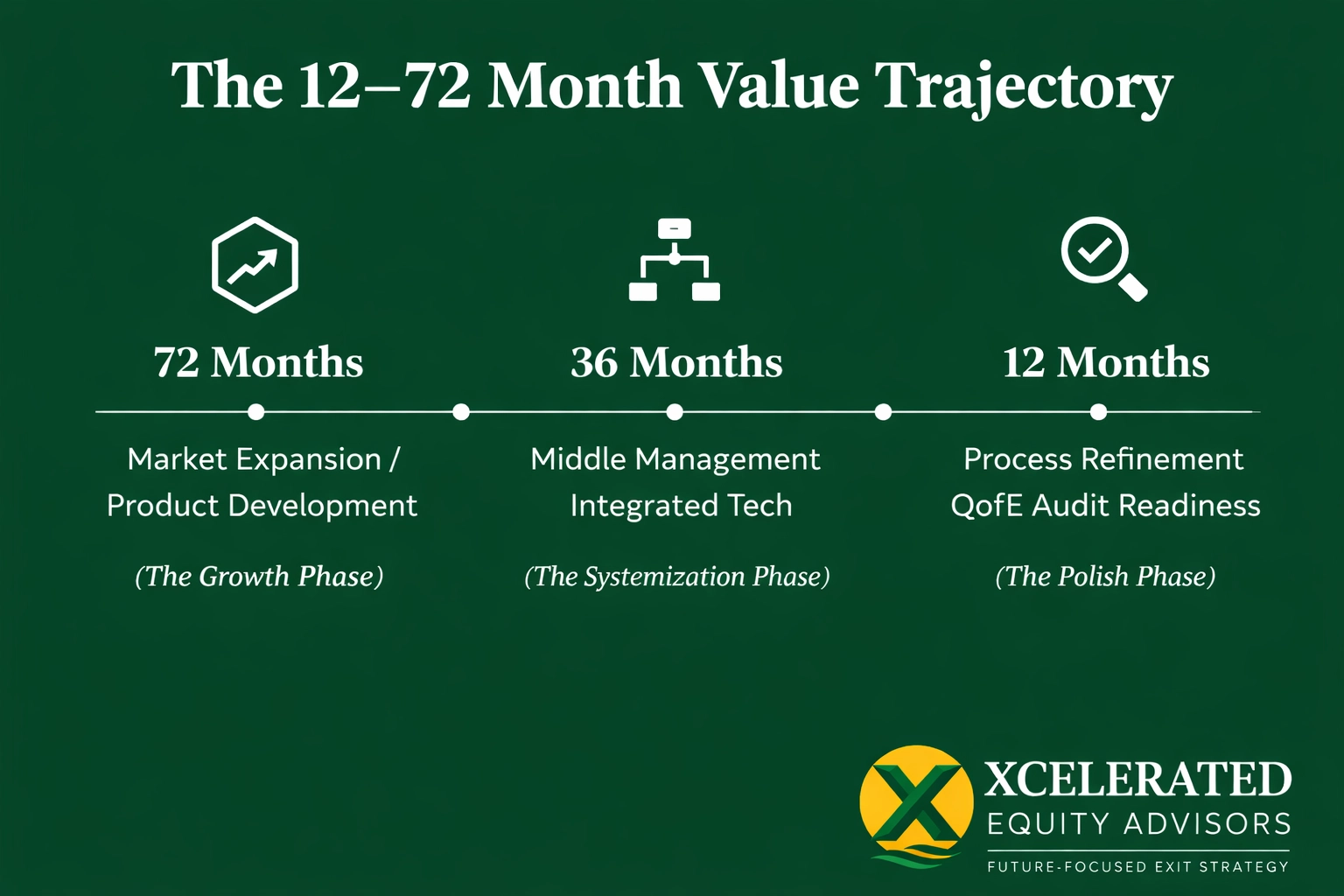
At 12 months, the mandate is polish rather than reinvention. Capital should be directed toward process refinement, diligence readiness, KPI consistency, and QoE audit preparation. Major initiatives launched this late rarely earn full credit because buyers discount projects that have not yet translated into proven results. Therefore, the final stage is where value is validated, not created.
Infrastructure as an Asset Class
Infrastructure is the bridge between a founder’s vision and a buyer’s checkbook. Most owners categorize SOPs and technology as admin expense, but in a transaction they are the assets that protect portable earnings. A buyer can buy trucks anywhere. What they are actually paying for is a management system that ensures those trucks produce a predictable 20% margin without the founder in the seat.
Investing in infrastructure is investing in the structural integrity of the future payout. That includes documented SOPs, integrated technology, middle management, reporting discipline, and incentive structures that keep performance intact through a change of control. When those elements are present, the buyer sees a business that can transfer with less disruption and less transition risk.
That is why infrastructure carries valuation weight well beyond its accounting treatment. It does not sit in the business as overhead. It sits in the business as proof that earnings are durable, measurable, and not trapped inside the owner.
Assessing Return on Capital Employed (ROCE)
Every capital allocation decision must be measured against its impact on Return on Capital Employed. In an exit context, ROCE is a proxy for how efficiently the business converts capital into value. High ROCE indicates a business with strong pricing power and efficient operations: two traits that attract premium multiples.
Owners must distinguish between “maintenance CAPEX” and “growth CAPEX.” Maintenance CAPEX is the cost of staying in business. Growth CAPEX is the cost of increasing the business’s value. To maximize exit value, maintenance CAPEX should be optimized, while growth and efficiency CAPEX should be prioritized based on their impact on the multiple.
A common mistake is over-investing in mature segments with low growth potential. This “equal distribution” of capital across business units dilutes the overall value. Capital should be disproportionately allocated to the units with the strongest unit-level economics, the highest returns on incremental invested capital, and the clearest path to margin expansion. This creates a more credible buyer narrative and a more efficient capital base.
Risk Mitigation and the Discount Rate
Valuation is essentially a mathematical function of cash flow divided by a discount rate. Most owners focus on the numerator (cash flow). However, the denominator (risk) is often where the most value is gained or lost. Capital allocation that mitigates risk has a disproportionate impact on the final sale price.
Risk factors include customer concentration, supplier dependency, and lack of systemization. Allocating capital to diversify the customer base or secure long-term supply agreements reduces the discount rate. Similarly, investing in cybersecurity and regulatory compliance prevents catastrophic value erosion during the due diligence process.
A buyer’s “quality of earnings” (QofE) report will scrutinize how capital has been spent. Discretionary spending or inconsistent investment patterns suggest a lack of strategic oversight. Disciplined capital allocation, backed by a clear investment thesis, demonstrates professional governance and reduces the buyer’s perceived risk.
The ExitMap Approach to Capital Allocation
Determining the right mix of growth and efficiency requires a diagnostic framework. It is not an instinct exercise. It is a capital allocation exercise tied directly to valuation, portability, and diligence risk. The ExitMap Assessment is designed to clinically identify where owners are misclassifying maintenance CAPEX as growth CAPEX, where capital is being absorbed by low-return activities, and where spending is failing to improve transferable earnings.
The output is a practical view of capital deployment through a buyer lens. It clarifies which expenditures merely maintain current operations, which investments strengthen unit-level economics or ROCE, and which initiatives can legitimately support multiple expansion. Therefore, the assessment functions as a capital allocation diagnostic before it becomes a transaction-readiness tool.
The right capital plan does not just preserve earnings. It improves the quality of earnings and the confidence interval around them. Start with the assessment here: https://xeadvisors.com/exit-assessment/ This will identify where value is lost before a transaction.
[…] you can change the narrative. By focusing on strategic value growth 12 to 72 months before a sale, you can increase your final proceeds by 15% to 30% or more. This […]
[…] is the purpose of strategic value growth. Well-executed Value Growth Sprints can drive 15% to 30% EBITDA lift while improving the quality of […]
[…] lifetime value, businesses can grow themselves into a liquidity crisis. This requires disciplined Capital Allocation for Value to ensure growth is […]