
Growth is not an infinitely scalable resource when it is tethered to a single individual. In the early stages of a business, the CEO’s direct involvement in every decision acts as a catalyst for rapid progress and quality control. However, as the organization matures and scales, this centralized involvement inevitably transforms into a structural bottleneck that restricts enterprise value.
The transition from a founder-led business to a management-led organization is the most significant hurdle for middle-market companies. When the leader remains the primary decision-maker for all functions, they inadvertently limit the company’s speed, agility, and overall scalability. This centralized control creates a ceiling that prevents the business from reaching its peak financial potential. Increasing enterprise value happens before a transaction, not during one. The work of removing management bottlenecks and building transferable leadership capacity is what creates measurable valuation lift.
A CEO who acts as a bottleneck creates a "permission-based" culture where progress halts whenever the leader is unavailable. This reliance on one individual introduces significant operational risk that savvy buyers identify immediately during due diligence. If every major contract, hire, or operational change requires executive sign-off, the organization’s velocity is capped by the CEO’s physical bandwidth.
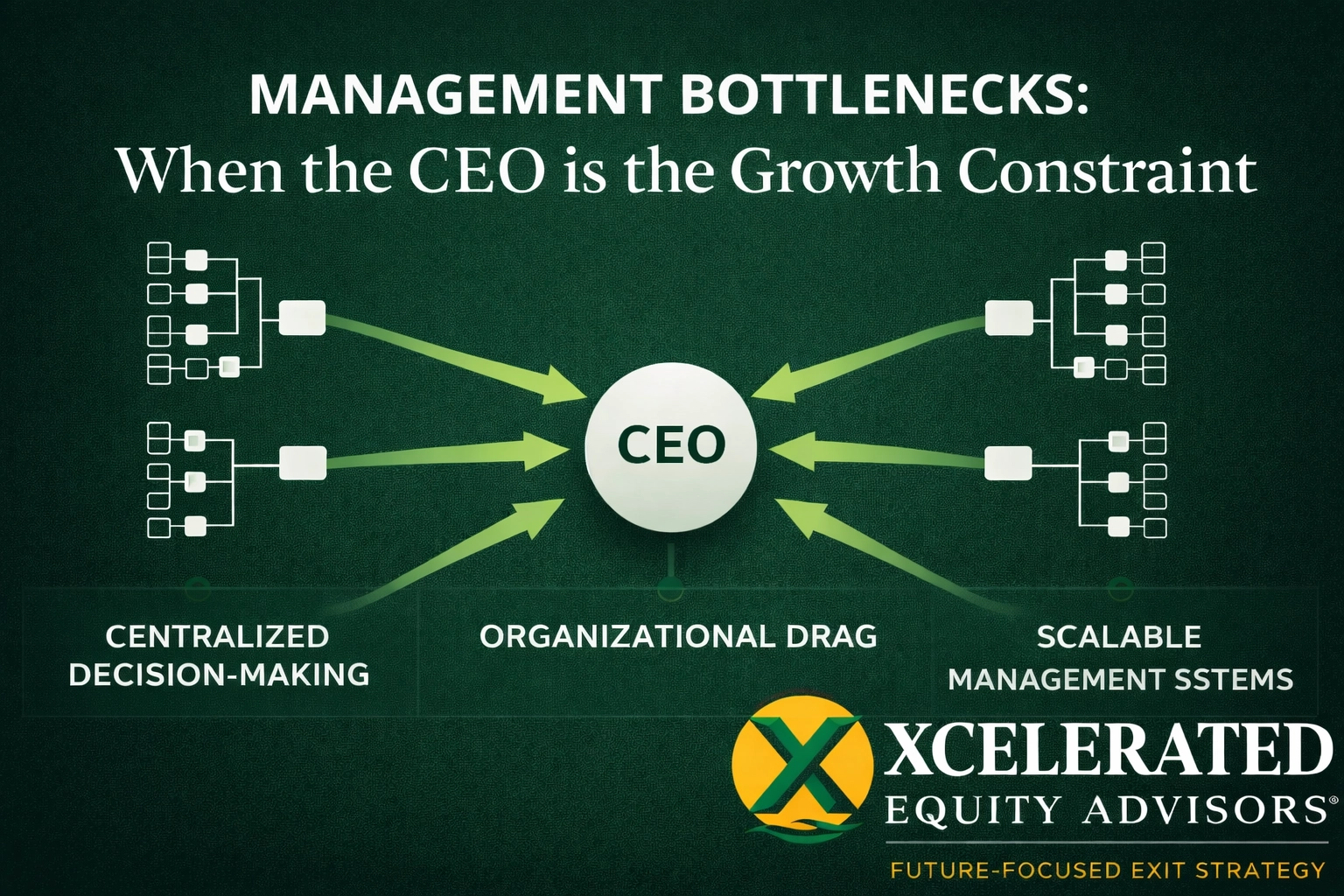
Strategic growth requires a deliberate shift from tactical involvement to high-level governance and strategic oversight. When the leader remains the primary point of contact for key clients, vendors, and internal staff, they establish a "Hub and Spoke" architecture. In this model, every spoke leads back to the center, creating a massive traffic jam at the core of the business operations.
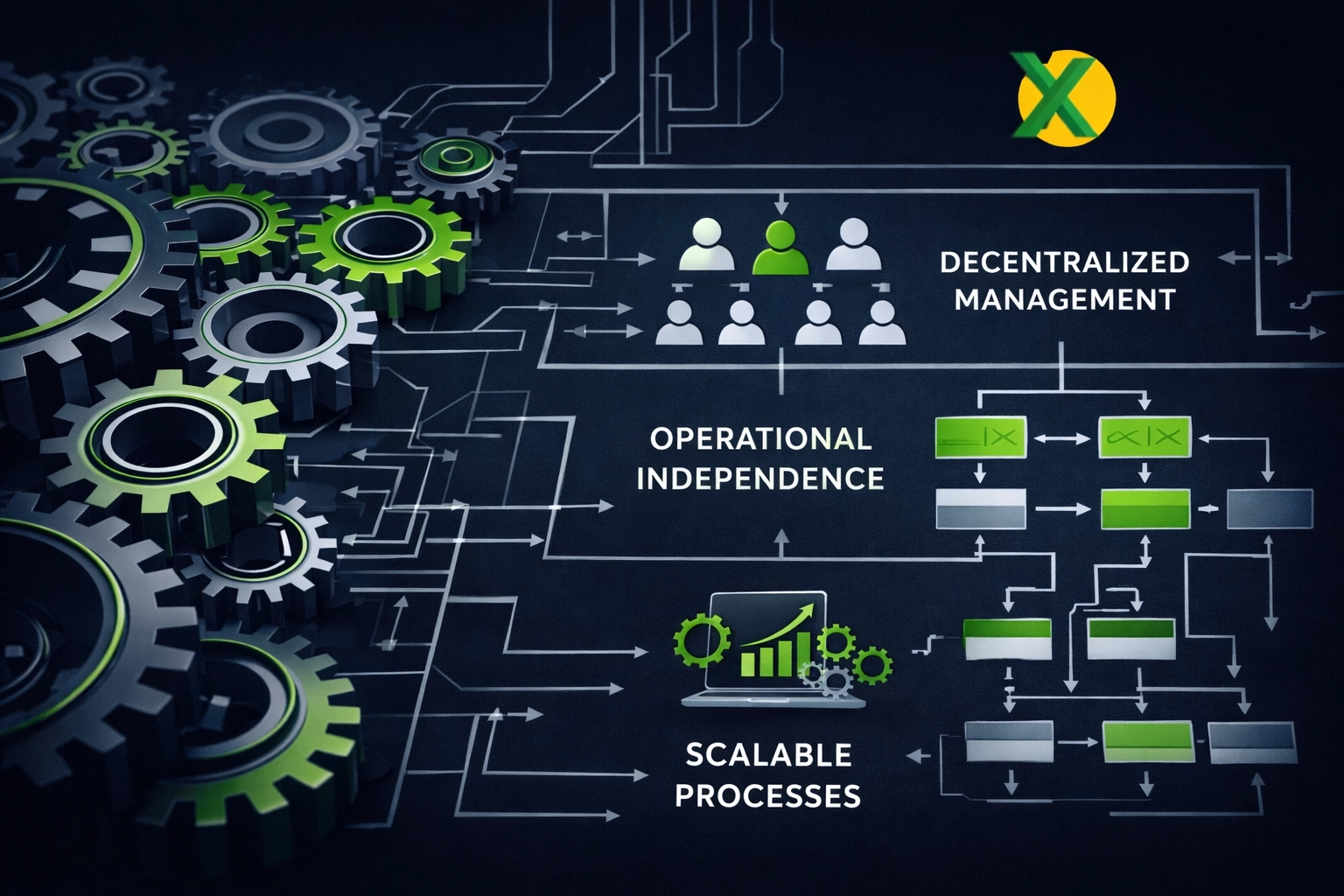
Decentralized management teams drive enterprise value by distributing the cognitive load of leadership across multiple capable professionals. A company with a robust management layer demonstrates that the business is an independent entity, rather than a personal extension of the owner. This distinction is critical for any owner looking to maximize their exit value and ensure long-term sustainability.
Leadership capacity is often the invisible barrier that prevents a company from crossing the chasm between $10 million and $50 million in revenue. Growth does not create leadership problems; it simply reveals the ones that were already present in the organizational structure. As complexity increases, informal workarounds fail, and the CEO’s inability to delegate authority becomes a primary constraint.
The decision bottleneck is both a cultural and structural failure within the organization. When employees feel they lack the authority to solve problems without executive approval, they stop taking initiative and wait for instructions. This creates a passive workforce that is unable to react to market changes or customer needs with the necessary speed.
High-potential leaders and top-tier talent will not remain in environments where they lack empowerment and autonomy. When the CEO micro-manages every function, they drive away the very people needed to scale the company to the next level. The resulting talent drain leaves the organization with "order-takers" rather than "value-creators," further entrenching the CEO as a bottleneck.
From a valuation perspective, owner dependency is a critical risk factor that leads to significant discounts. Private equity firms and strategic buyers look for "transferability": the ability of the business to continue generating cash flow after the owner departs. If the CEO is the primary driver of sales, operations, and strategy, the business is perceived as a risky asset with low transferability.
The financial impact of a management bottleneck is often hidden in "growth leaks" throughout the organization. These leaks manifest as missed opportunities, delayed project timelines, and inefficient resource allocation. While the company may still be profitable, it is operating at a fraction of its potential because the leader cannot process information fast enough to keep up with market demand. This is why increasing enterprise value before a transaction matters more than trying to defend value during one. Once a company is in market, buyers price the existing management risk into diligence, structure, and multiple.
Building leadership depth requires a clinical approach to organizational design and authority distribution. It involves identifying the key functions that currently require the CEO’s input and systematically transferring that authority to a management team. This process is not about teaching leadership skills, but about building organizational capacity to handle increased complexity. These changes need time to take hold, prove out in performance, and show up in EBITDA, resilience, and buyer confidence.
Effective delegation is not just about offloading tasks; it is about transferring the authority to make meaningful decisions. A decentralized management model allows the CEO to focus on strategic initiatives, such as mergers and acquisitions, high-level partnerships, and long-term vision. This shift in focus is what moves the needle on enterprise value and prepares the company for an eventual exit.
A business that can run itself is worth significantly more than a business that requires the owner's constant attention. Buyers are willing to pay a premium for a "turnkey" management team that has already demonstrated the ability to hit targets and grow the company independently. This reduces the buyer's risk and shortens the transition period required after a transaction.
The move toward decentralization also improves the CEO's personal quality of life by reducing management stress. When the organization is no longer dependent on the leader for every minor approval, the leader can reclaim their time and focus on higher-value activities. This balance is a hallmark of a mature, exit-ready business that is positioned for a successful transition.
To unlock the next stage of growth, leaders must be willing to let go of the control that served them in the early days. This requires a shift in mindset from being the "smartest person in the room" to being the architect of a system that functions without them. Transitioning authority is the most direct path to accelerating growth and enhancing the company's market multiple.
The CEO must recognize that their role is to facilitate the growth of others, not to be the sole provider of solutions. By fostering a culture of accountability and autonomy, the leader transforms the company from a fragile, owner-centric model into a resilient, scalable enterprise. This evolution is necessary to ensure the business can thrive in a competitive landscape and command top dollar at exit.
Management bottlenecks are a choice, not a necessity of business growth. By addressing these constraints head-on, owners can delineate clear paths for advancement and foster an environment that attracts high-caliber talent. The result is a more efficient, profitable, and valuable company that is ready for the next level of expansion or a lucrative sale.
Identifying these bottlenecks early is essential for preserving and growing enterprise value. A comprehensive assessment of management depth and owner dependency provides a roadmap for the necessary organizational changes. Addressing these issues before entering the market ensures that the business is presented in the best possible light to potential acquirers. Increasing enterprise value before a transaction, not during one, is the governing principle. Owners who reduce founder reliance and institutionalize decision-making enter a process with stronger leverage, cleaner diligence, and better odds of multiple expansion.
[Risk] -> [Direct valuation/exit implication].
CEO-centric decision-making -> Reduced transferability of operations leading to a significant discount on the enterprise value multiple.
[Risk] -> [Direct valuation/exit implication].
Lack of management depth -> Increased perceived risk by buyers resulting in unfavorable earn-out structures and lower cash-at-close.
[Risk] -> [Direct valuation/exit implication].
Permission-based culture -> Stagnant revenue growth trajectories that diminish the attractiveness of the business to strategic investors.
Are you the primary constraint on your company’s growth? Take the Owner Centricity Quiz to measure your business’s dependence on you and find out if it is truly ready for a scalable future.
Start with the assessment here: https://xeadvisors.com/exit-assessment/ This will identify where value is lost before a transaction.