
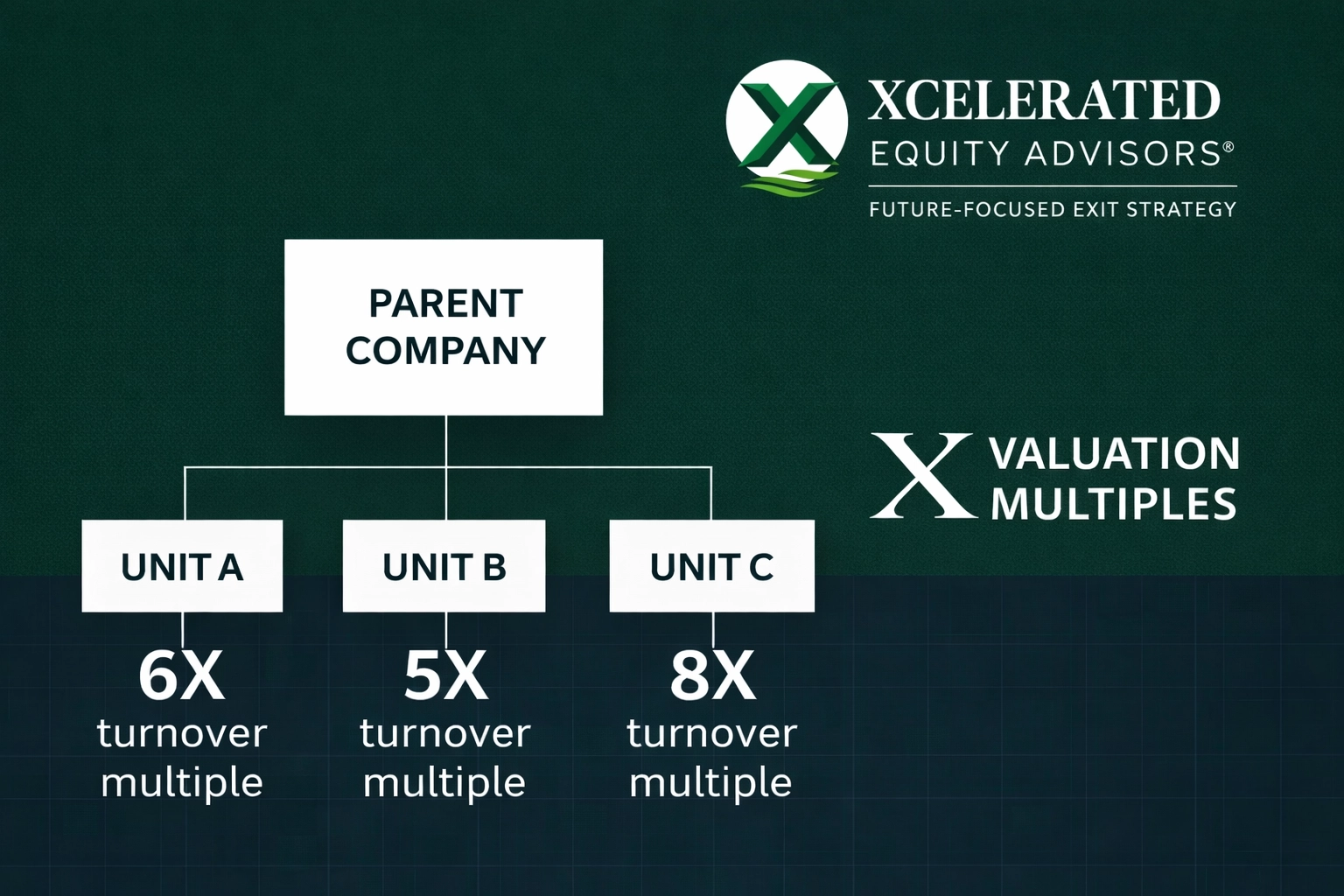

Most multi-unit businesses are not valued as scalable platforms. They are discounted due to operational risk, inconsistent performance, and owner dependence. Here is what actually drives valuation multiples when selling a multi-unit business.
The Strategic Reality of Multi-Unit Exits
Most multi-unit business owners believe scale alone increases valuation. It does not. Buyers do not pay for unit count. They pay for systems that produce predictable cash flow without owner involvement.
The difference between a 4x and an 8x multiple is not revenue growth. It is operational control. When selling a multi-unit business, fragmented operations, inconsistent unit performance, and owner dependence introduce risk. Risk compresses valuation multiples.
If your business requires your daily involvement to maintain performance, you are not selling a platform. You are selling a job. The market will discount it accordingly.
What It Is & Why It Matters?
Owners of multi-unit enterprises often succumb to the "Platform Trap." In this scenario, the owner prioritizes rapid unit expansion to drive top-line revenue while allowing operational drift to occur. As new locations are added, the original standards that made the first unit successful begin to erode. Inconsistent unit economics, varied labor models, and decentralized management teams create a fragmented organization. For a potential acquirer, this fragmentation represents a significant risk profile.
When a business lacks standardized SOPs across all locations, the buyer views the acquisition as a series of individual turnarounds rather than a turnkey investment. This leads to what is known in the M&A world as a "complexity discount." Instead of a premium multiple based on regional dominance or scale, the owner is penalized for the lack of operational control. The result is a stalled sale, a reduced purchase price, or a high percentage of the deal tied to restrictive earn-outs that the owner may never fully realize. Furthermore, owner dependence risk becomes magnified in a multi-unit setting where the founder acts as the primary "firefighter" across multiple geographies.

Driving Multi-Unit Valuation Expansion
Valuation is an Assessment of risk-adjusted cash flows. To achieve a significant business valuation lift, the owner must transition from being an operator to a CEO. A multi-unit business is valued as a platform when it demonstrates that additional units can be integrated into the existing infrastructure without degrading margins or increasing owner involvement.
When selling a multi-unit business, valuation multiples expand only when EBITDA is both predictable and transferable. Increasing EBITDA alone is not sufficient. You must increase EBITDA before selling a business in a way that reduces operational risk.
The primary driver of the valuation multiple is "transferable enterprise value." This is the value that remains in the business after the founder exits. Buyers pay for predictability. If the EBITDA is dependent on the founder’s personal relationships or their constant intervention at the unit level, the business is high-risk. True value growth advisory focuses on institutionalizing knowledge and professionalizing the management layer to de-risk the diligence process before the business ever hits the market.
In the current market, what buyers look for when buying a business in the multi-unit space is "Multiple Expansion potential." They want to see that by adding capital to your existing systems, they can achieve a 20-30% return on investment. If your systems are broken, their capital is at risk, and your multiple will reflect that instability.
The Misconception: Why Growth Does Not Equal Value
Growth alone does not create enterprise value. In a multi-unit business, expansion without standardization usually increases risk instead of building a scalable platform. Buyers do not pay for footprint alone. They pay for control, transferability, and repeatable unit economics.
A larger business with inconsistent margins, fragmented reporting, and heavy founder involvement is often less valuable than a smaller business with disciplined execution. Revenue growth without operating discipline creates diligence friction, weakens buyer confidence, and compresses the valuation multiple.
Framework: The Multi-Unit Valuation Drivers
To maximize the multiple when selling a multi-unit business, owners must optimize across four specific dimensions. This matrix separates the top-tier platforms from the average operators.
1. Operational Standardization
Every location must operate under a singular playbook. This includes standardized hiring practices, procurement, and service delivery. Buyers look for a "plug-and-play" model where the outcome is independent of the specific person in charge of a unit. If Location A has a 20% labor cost and Location B has a 32% labor cost without a documented reason, you have a standardization failure.
2. Unit-Level Economics & KPIs
Real-time visibility into unit performance is non-negotiable. Clean, buyer-ready financials and standardized unit-economics dashboards allow for the immediate identification of outliers. This transparency builds buyer confidence and accelerates the time to close. You must be able to demonstrate "Same-Store Sales Growth" (SSSG) alongside new unit performance to prove the health of the core brand. This is where exit readiness becomes measurable, not conceptual.
3. Management Layer Depth
A scalable business requires a middle management layer that functions without the founder. This includes regional managers or a high-level operations director. This structure proves the business is a platform rather than a high-paying job for the owner. A robust management layer is the most effective hedge against owner dependence risk. If that layer is thin, targeted growth advisory work typically starts with role clarity, incentives, and operating cadence.
4. Data Integrity & Reporting
Professionalized reporting and a buyer-ready data room are the cornerstones of a successful exit. Inaccurate data or delayed reporting during diligence leads to "retrades," where the buyer lowers the price based on perceived management incompetence. Exit readiness is often won or lost in the quality of the back-office data. In practice, the best operators treat this as an operational discipline, not a finance clean-up project, and use growth advisory to align reporting to the way buyers underwrite transferable EBITDA.
Key Takeaways
- Valuation multiples are driven by risk, not revenue
- Owner dependence reduces enterprise value
- Operational standardization is required for platform valuation
- Buyers pay for predictable, transferable EBITDA
Application: The Path to Premium Valuation
Preparation for selling a multi-unit business should begin 12 to 72 months before exit. Valuation is built before the sale process starts. The following actions directly increase valuation multiples:
- Conduct an ExitMap Assessment: Identify the specific value gaps in your current operation. This Assessment provides a roadmap for what a buyer will perceive as a risk during the diligence phase. Understanding your baseline is the only way to measure future growth.
- Execute Value Growth Sprints: Focus on pricing power and margin optimization. To increase EBITDA before selling a business, you must look for incremental gains in COGS, labor efficiency, and customer acquisition costs. A 15–30% EBITDA lift prior to a sale can translate into millions of dollars in additional enterprise value when the multiple is applied.
- Formalize the Succession Plan: Implement incentives and systems that reduce founder reliance. This includes an organizational chart that clearly defines roles and accountability beyond the owner. If the business can run for 90 days without your input, your multiple just increased.
- Synchronize Advisors: Engage a business exit strategy consultant early to coordinate with tax, legal, and wealth advisors. This ensures that the business is not just ready to sell, but that the owner is personally and financially prepared for the transition. Our proven process ensures all levers are pulled in unison.
ExitMap Assessment
Most owners do not know how a buyer will value their business until they enter a sale process. By then, it is too late to fix the gaps.
The ExitMap Assessment provides:
- Clarity on your current exit readiness
- Identification of valuation gaps
- A structured plan to increase enterprise value
Start with the assessment here: https://xeadvisors.com/exit-assessment/ This will identify where value is lost before a transaction.
Tags: exit readiness, owner dependence, valuation drivers, customer concentration, management team depth, strategic planning, succession planning, value growth, business salability